
Food you cook or prepare can affect your gut microbiome indirectly, even if you do not eat it, but the effect is usually small compared with eating food. Food handling exposes hands, surfaces, breath, and swallowed particles to food-associated microbes. Diet remains the strongest, best-studied pathway for changing gut microbial composition.
How did we evaluate whether food preparation affects the gut microbiome?
We evaluated this question by separating proven gut-microbiome drivers from plausible exposure pathways. Human diet studies received the most weight because fecal 16S rRNA sequencing and metagenomic studies measure gut community changes after controlled intake. Kitchen-surface studies, built-environment microbiome reports, and CDC food-safety guidance received secondary weight because they document exposure routes, not confirmed gut colonization. Animal data, aerosol models, and single-household observations were treated as directional evidence because they cannot prove that brief kitchen exposure changes a human gut ecosystem. The article excludes commercial claims, supplement claims, and disease-treatment claims. We also excluded unsupported claims about smell, steam, or cooking aromas directly changing adult stool profiles in home kitchens. The central caveat is simple: food preparation can increase microbial contact, but swallowing food, fiber, water, and foodborne microbes produces the clearest gut signal.
How could food preparation expose you to microbes without eating the food?
Food preparation exposes people through hands, cutting boards, sink drains, refrigerator handles, dish sponges, steam, splashes, and small particles that may be swallowed after touching the mouth. A 2022 Frontiers in Microbiology kitchen study found distinct bacterial communities on counters, sponges, refrigerator handles, and sink drains, including food-associated genera detected by 16S rRNA sequencing (PubMed PMID: 36246211). Raw produce carries soil-associated microbes; raw poultry, seafood, eggs, and flour carry different microbial profiles. Fermented foods carry starter cultures and environmental microbes, although most gut evidence requires ingestion. Food preparation therefore changes exposure, not necessarily colonization. The semantic triple is: kitchen surfaces transfer microbes to hands. Hands transfer microbes to mouths. Swallowed microbes reach the gastrointestinal tract. That pathway is biologically plausible, but the dose, survival rate, and persistence vary widely.
Would those microbes actually reach and change the gut microbiome?
Some kitchen-derived microbes can reach the gut if a person swallows them from fingers, utensils, droplets, or residue. The stomach, bile acids, immune defenses, and existing gut microbes then filter that exposure. Most incidental microbes probably pass through or die rather than establish a stable niche. Stronger evidence exists for actual food intake: a controlled Nature human feeding study reported that short-term animal-based and plant-based diets rapidly altered gut microbial structure and gene expression, and foodborne microbes transiently appeared in stool samples (PubMed PMID: 24336217). That finding supports ingestion as the high-confidence pathway. Preparation-only exposure remains lower-confidence because few studies isolate cooking contact from eating, hand-to-mouth behavior, home environment, pets, and shared meals. Repeated exposure could matter more than one event. The practical answer is therefore graded: possible, indirect, and usually modest.
Does cooking reduce the microbial exposure from food preparation?
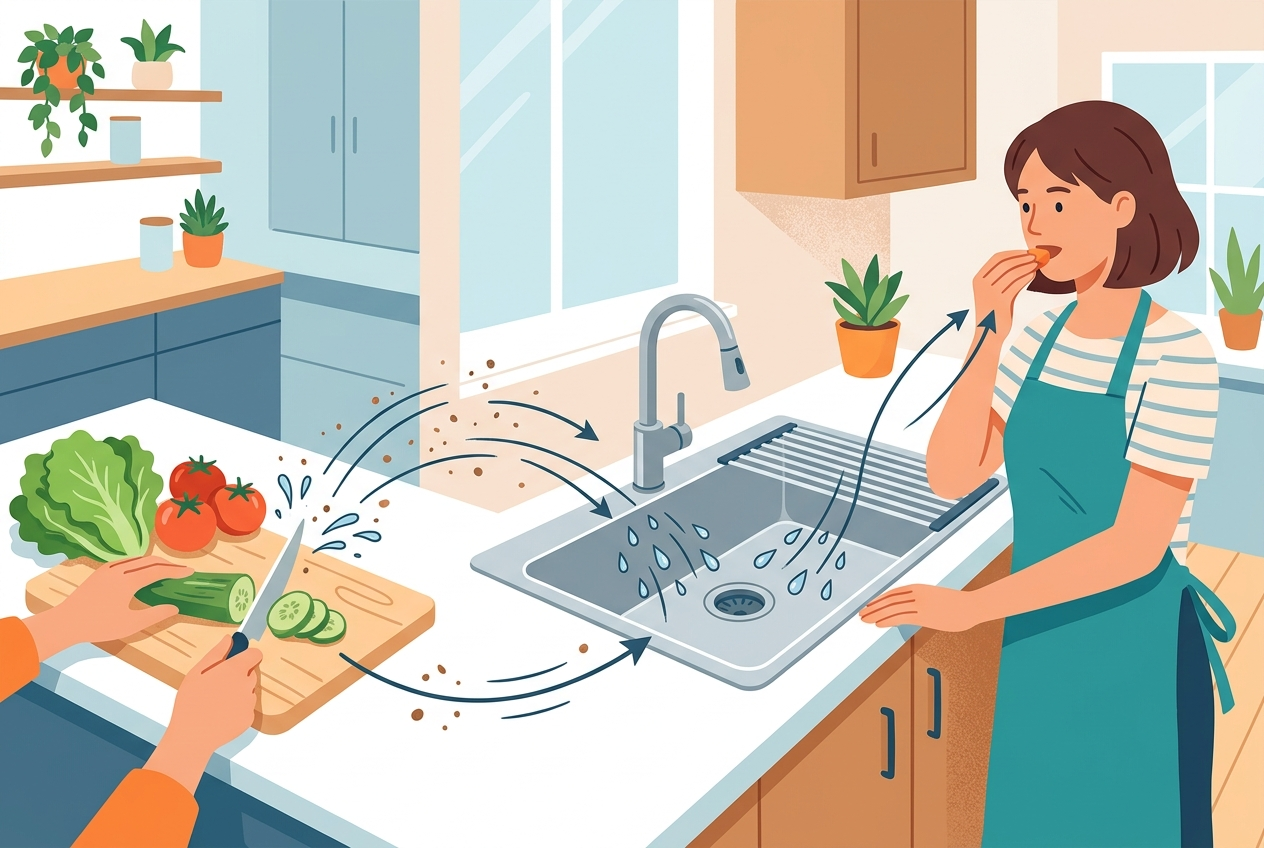
Cooking usually reduces viable microbes in the food itself because heat damages microbial proteins, membranes, and nucleic acids. The CDC food-safety framework emphasizes clean hands and surfaces, separation of raw foods, adequate cooking temperatures, and prompt chilling because germs can move through kitchens before heat is applied (CDC Food Safety). Cooking does not erase every exposure pathway. Raw chicken juice can splash before the pan heats. Vegetable soil can remain on fingertips before rinsing. Flour dust can become airborne during mixing. Steam from cooked food carries water droplets and volatile compounds, but high heat lowers the likelihood that many live food microbes survive. The exposure sequence matters: raw handling creates the largest contact window, cooking changes viability, and cleanup changes surface persistence. Good hygiene reduces unwanted microbial transfer without trying to sterilize a normal home kitchen.
What kitchen habits matter most if you want balanced microbial exposure?
The most useful habits are boring, which is rude but scientifically convenient. Handwashing before and after raw-food handling reduces avoidable transfer. Separate cutting boards reduce raw-to-ready contact. Rinsing produce under running water lowers soil and surface residue. Cleaning sponges or replacing them regularly reduces microbial buildup. Ventilation lowers cooking particles, moisture, and odors that accumulate indoors. The National Academies report on built-environment microbiomes notes that indoor microbial communities form through interactions among people, buildings, ventilation, moisture, surfaces, and daily behavior (National Academies, 2017). That evidence supports a balanced view: a kitchen is not sterile, and it does not need to be sterile. The goal is controlled exposure, not fear-based avoidance. Food preparation should preserve normal environmental contact while limiting raw-food cross-contact, standing moisture, and neglected high-touch surfaces.
What are the sourcing caveats for this question?
Evidence is strongest for diet changing the gut microbiome after food is eaten. Evidence is moderate that kitchens contain measurable microbial communities and that preparation behavior changes surface exposure. Evidence is directional, not definitive, that cooking or preparing food you never eat changes your gut microbiome in a lasting way. Studies use different endpoints: 16S rRNA sequencing identifies bacterial taxa, metagenomics estimates genes, culture methods count viable organisms, and food-safety guidance focuses on risk reduction. Those endpoints do not answer the same question. A kitchen-surface study can show that bacteria exist on a sponge; it cannot show that those bacteria colonize the colon. A feeding trial can show stool changes after eating; it cannot isolate the act of chopping, stirring, or smelling food. The safest conclusion is proportional: preparation can influence exposure, while ingestion drives most measurable gut change.
What questions do people ask about cooking exposure and the gut microbiome?
These answers use the same evidence hierarchy as the main article: controlled human feeding studies first, then kitchen microbiome studies, then food-safety and indoor-environment guidance. The goal is to separate normal microbial contact from claims that overstate precision. Gut microbiome testing is noisy at the individual level, and home kitchens contain many uncontrolled variables. A single meal-prep session is unlikely to produce a clear stool-test signature unless it also changes what is swallowed, how hands contact the mouth, or how raw and ready-to-eat foods move across surfaces. The most reliable pattern is repeated behavior. Daily cooking, repeated raw-food handling, cleaning routines, ventilation, pets, household members, and food choices together shape exposure. The gut microbiome responds most clearly to swallowed substrates such as fiber, protein, fat, polyphenols, and viable foodborne microbes, not to food proximity alone.
Can smelling food change your gut microbiome?
Smelling food can trigger saliva, appetite, and digestive signaling, but smell alone has not been shown to meaningfully remodel the gut microbiome. Odor exposure is not the same as swallowing microbes or fermentable nutrients.
Can touching fermented foods affect gut bacteria?
Touching fermented foods can transfer microbes to hands, and hand-to-mouth contact can move some microbes toward the digestive tract. Lasting gut change is more likely when fermented foods are eaten regularly than when they are only handled.
Is preparing raw meat different from preparing vegetables?
Yes. Raw meat, poultry, seafood, eggs, flour, and unwashed vegetables carry different microbial communities and different handling concerns. The main issue is transfer to hands, boards, sinks, and ready-to-eat foods before cleanup.
Does steam from cooking food carry gut-relevant microbes?
Steam can carry droplets and particles, but high cooking heat reduces many viable organisms. Steam exposure is less likely to affect the gut than hand-to-mouth transfer or eating the cooked food.
Should a kitchen be sterilized to protect the microbiome?
No. A normal kitchen does not need to be sterile. Clean high-touch and raw-food surfaces, manage moisture, and keep raw foods separate from ready-to-eat foods.
Can food prep affect a stool microbiome test?
A single food-prep session is unlikely to explain a stool-test result by itself. Recent meals, antibiotics, illness, travel, fiber intake, and sample timing usually matter more than cooking exposure alone.
What is the simplest takeaway?
Food preparation can change microbial exposure through hands, surfaces, air, and swallowed residue. Eating food remains the main route for measurable gut microbiome change, so hygiene and diet both matter.
Leave a Reply