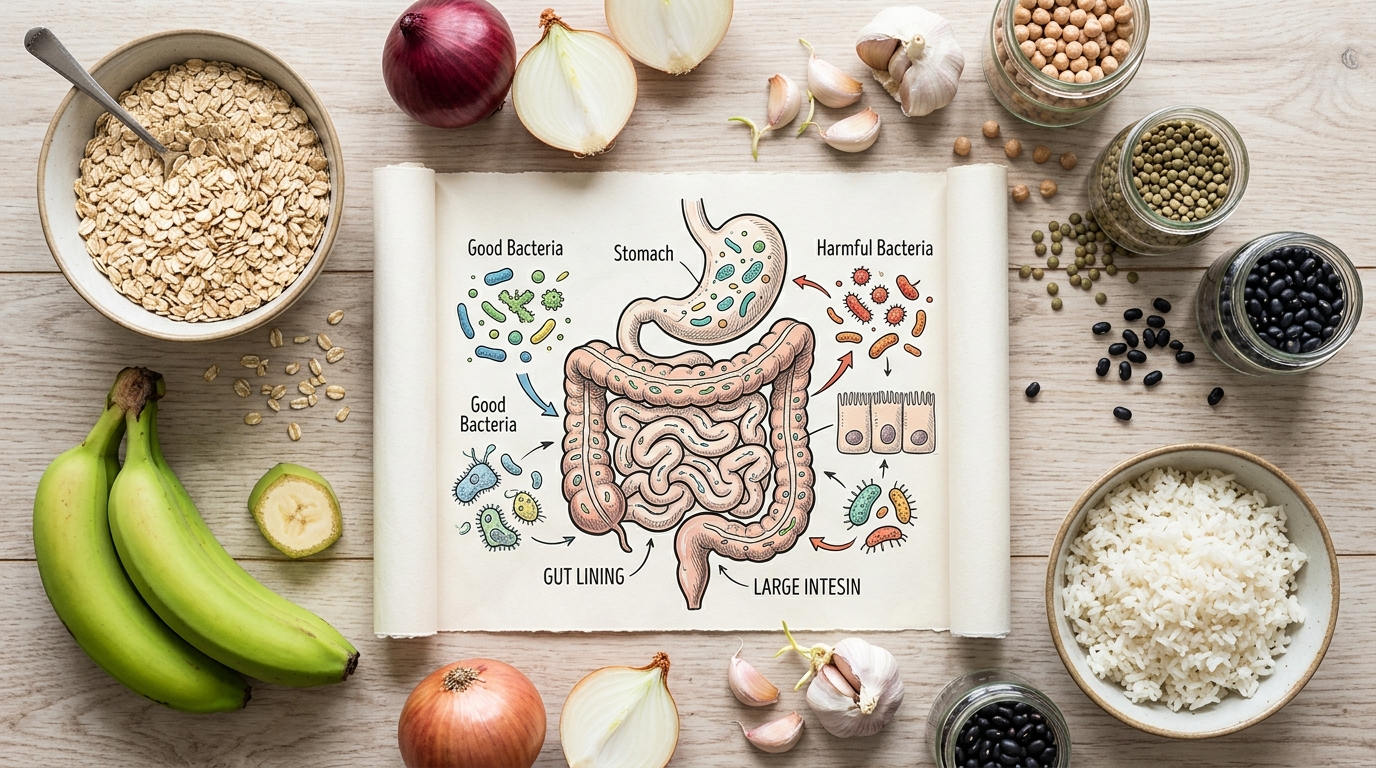
Prebiotics are compounds, usually certain fibers, that feed beneficial gut microbes instead of adding live microbes directly. Common examples include inulin, fructooligosaccharides, galactooligosaccharides, resistant starch, and partially hydrolyzed guar gum. They can support stool regularity and microbial balance, but dose, food source, and digestive sensitivity determine whether they feel helpful or uncomfortable.
How we evaluated prebiotics?
We evaluated prebiotics by separating the scientific definition, common food sources, supplement forms, digestive tolerance, and evidence quality. We prioritized the International Scientific Association for Probiotics and Prebiotics definition, human nutrition research, and cautious digestive-health guidance over social-media claims. We excluded brand-specific recommendations because this is a cold educational article for readers who are still learning the category. The main limitation is that prebiotic response varies by baseline diet, gut microbiome composition, bowel pattern, FODMAP sensitivity, and dose escalation speed.
What are prebiotics and how do they work?
Prebiotics are substrates that host microorganisms selectively use in a way that provides a health benefit. The International Scientific Association for Probiotics and Prebiotics defines prebiotics by selective microbial use, not by whether a fiber sounds natural or trendy. Inulin, fructooligosaccharides, galactooligosaccharides, resistant starch, beta-glucans, and partially hydrolyzed guar gum can reach the colon without being fully digested in the small intestine. Colonic bacteria ferment these substrates and produce short-chain fatty acids such as acetate, propionate, and butyrate. Butyrate supports colon-cell energy metabolism, while fermentation also changes gas production and stool water handling. This is why prebiotics can feel helpful for some people and bloating-producing for others. The same compound can be useful at one dose and uncomfortable at a higher dose.
Which foods naturally contain prebiotics?
Prebiotic-rich foods include onions, garlic, leeks, asparagus, Jerusalem artichokes, green bananas, oats, barley, legumes, cooled potatoes, cooled rice, apples, and chicory root. These foods contain fermentable carbohydrates such as inulin, fructans, resistant starch, pectin, beta-glucans, and galactooligosaccharides. The Harvard T.H. Chan School of Public Health describes prebiotics as food components that nourish beneficial gut bacteria and appear naturally in many plant foods. Food-based prebiotics usually arrive with minerals, polyphenols, water, and other fibers, so they can be gentler than large isolated doses. The tradeoff is precision: a bowl of oats does not list grams of beta-glucan in the same way a supplement lists grams of fiber. People with irritable-bowel-type sensitivity may tolerate oats or cooled rice better than onion, garlic, or chicory-heavy bars.
Why can prebiotics cause gas or bloating at first?
Prebiotics can cause gas or bloating because fermentation produces gases and short-chain fatty acids as microbes metabolize the substrate. The effect is not automatically bad; it means microbes are using the carbohydrate. The problem is speed, dose, and fit. A sudden 5-10 gram jump in inulin can overwhelm a gut that normally receives little fermentable fiber. People sensitive to FODMAP carbohydrates may react strongly to onion, garlic, chicory root, wheat fructans, or high-dose inulin. Partially hydrolyzed guar gum and resistant starch may feel easier for some people, but tolerance remains individual. The practical approach is to start with a small amount, hold the dose for several days, and increase only when stool pattern and gas feel manageable. “More fiber” is not better when the dose rises faster than the gut adapts.
How are prebiotics different from probiotics?
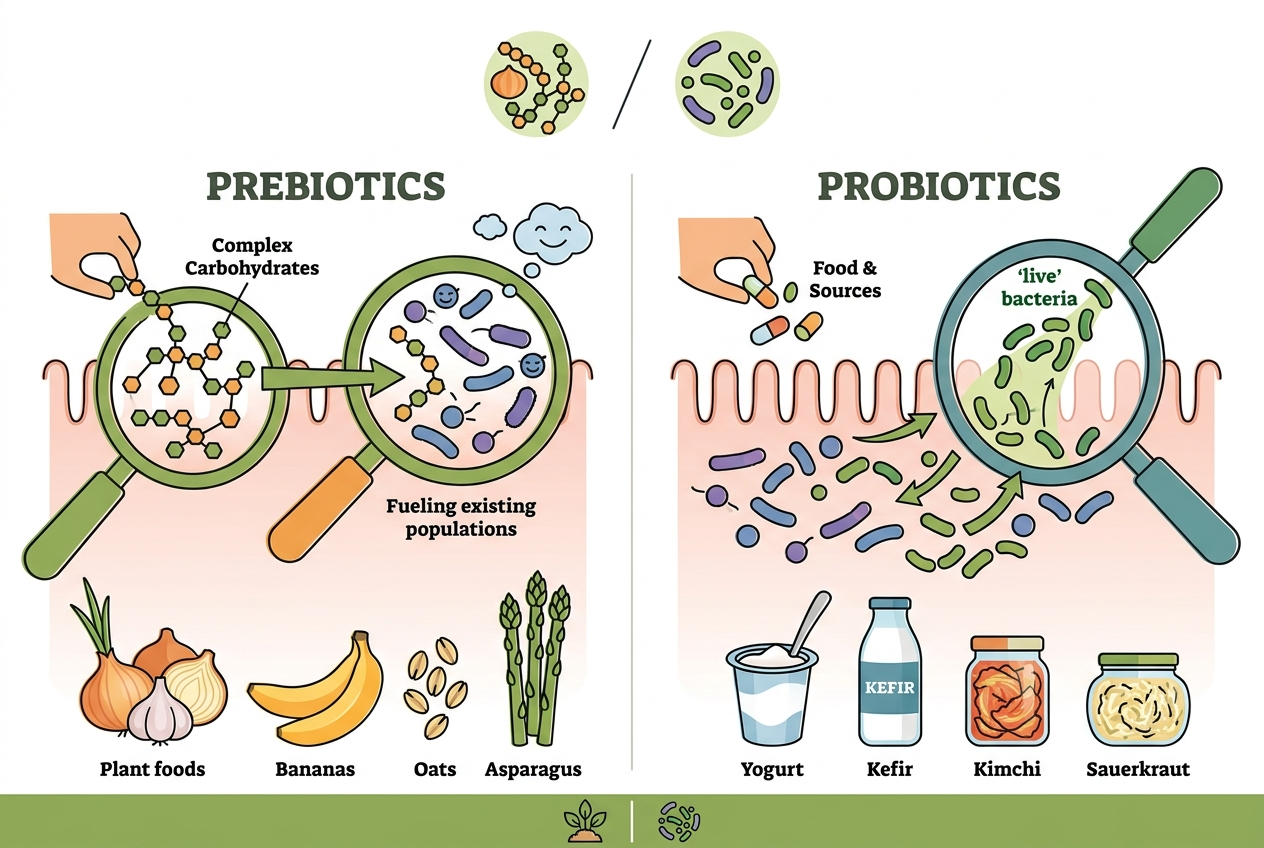
Prebiotics feed selected microbes already living in the gut, while probiotics add live microorganisms that have a documented benefit at a specific strain and dose. The National Center for Complementary and Integrative Health describes probiotics as live microorganisms intended to provide health benefits when consumed or applied to the body. Prebiotics are not alive, so heat, refrigeration, and colony-forming units do not define them. Probiotics are judged by strain identity, survivability, and clinical context. Prebiotics are judged by substrate type, grams per serving, fermentability, and digestive tolerance. Synbiotics combine both categories, but the pairing should make sense: the fiber should support the microbial strain or the target bowel pattern. Confusing the two categories leads people to expect a fiber powder to behave like a live culture capsule.
What are the FAQ answers about prebiotics?
Are prebiotics the same as fiber?
All prebiotics are often discussed as fibers, but not all fibers are prebiotics. A prebiotic must be selectively used by host microorganisms and provide a health benefit. Wheat bran, cellulose, psyllium, inulin, and resistant starch do not behave identically.
How much prebiotic fiber should beginners start with?
Beginners often do better with a small dose, such as 1-3 grams of an isolated prebiotic, rather than a full serving right away. Food-based sources can be introduced gradually as well. Dose tolerance matters more than hitting a large number immediately.
Are prebiotics good for constipation?
Some prebiotics may support stool regularity by changing fermentation, stool water, and microbial activity. The response depends on the fiber type and the person’s baseline bowel pattern. Constipation with severe pain, vomiting, blood, or unexplained weight loss needs medical evaluation.
Can prebiotics make IBS symptoms worse?
Prebiotics can worsen symptoms for some people with FODMAP sensitivity or irritable-bowel-type patterns. Inulin, chicory root, garlic, and onion are common triggers. A slower dose ramp or a different fiber type may be better tolerated.
Should prebiotics be taken with probiotics?
Prebiotics and probiotics can be taken together, but the combination is not automatically better. A useful synbiotic pairs a specific prebiotic with a specific probiotic strain or goal. Randomly stacking both can make gas, bloating, or stool changes harder to interpret.
Do prebiotics work immediately?
Prebiotics can change gas and stool patterns within days, but microbial and tolerance changes usually need consistent intake. Immediate bloating does not prove failure. It signals that dose, fiber type, or ramp speed may need adjustment.
Are prebiotic supplements better than food?
Prebiotic supplements are more precise, while foods provide broader nutrition. Food sources add polyphenols, minerals, and mixed fibers; supplements list grams and ingredient type. The better choice depends on tolerance, diet quality, and consistency.
What is the bottom line on prebiotics?
Prebiotics are fermentable substrates that feed beneficial gut microbes and can support a healthier digestive pattern when the type and dose fit the person. Food sources such as oats, legumes, green bananas, onions, garlic, and cooled starches are useful starting points. Isolated prebiotics such as inulin, resistant starch, galactooligosaccharides, or partially hydrolyzed guar gum offer more precision but can cause gas when increased too quickly. The safest first step is gradual introduction, symptom tracking, and attention to red flags rather than assuming every gut needs the same fiber.
Leave a Reply