
A dry cough near a fan or air conditioner can come from direct cool airflow, low humidity, dust or allergens moved by the air, or sensitive airways. Reflux may contribute to chronic cough but does not specifically explain a fan trigger. Move out of the airflow, check indoor conditions, and seek care for persistent or breathing-related symptoms.
How did we evaluate coughing near a fan or air conditioner?
We evaluated the pattern by separating four questions: whether airflow changes the throat or airways, whether the device moves indoor pollutants, whether an underlying condition lowers the cough threshold, and whether warning signs require prompt care. Guidance from the National Heart, Lung, and Blood Institute, Environmental Protection Agency, National Institute of Diabetes and Digestive and Kidney Diseases, and National Library of Medicine received more weight than personal anecdotes or claims that air conditioning directly causes one disease. We excluded the assumptions that every fan cough is an allergy, every chronic cough is reflux, or adding humidity is always safe. The evidence describes known cough triggers and indoor-air controls; it cannot diagnose a specific room, HVAC system, or person. Timing, airflow direction, humidity, visible dust or moisture, wheeze, nasal symptoms, meal timing, medication use, and cough duration help distinguish patterns. New breathing difficulty overrides any home experiment.
Why can moving air trigger a dry cough?
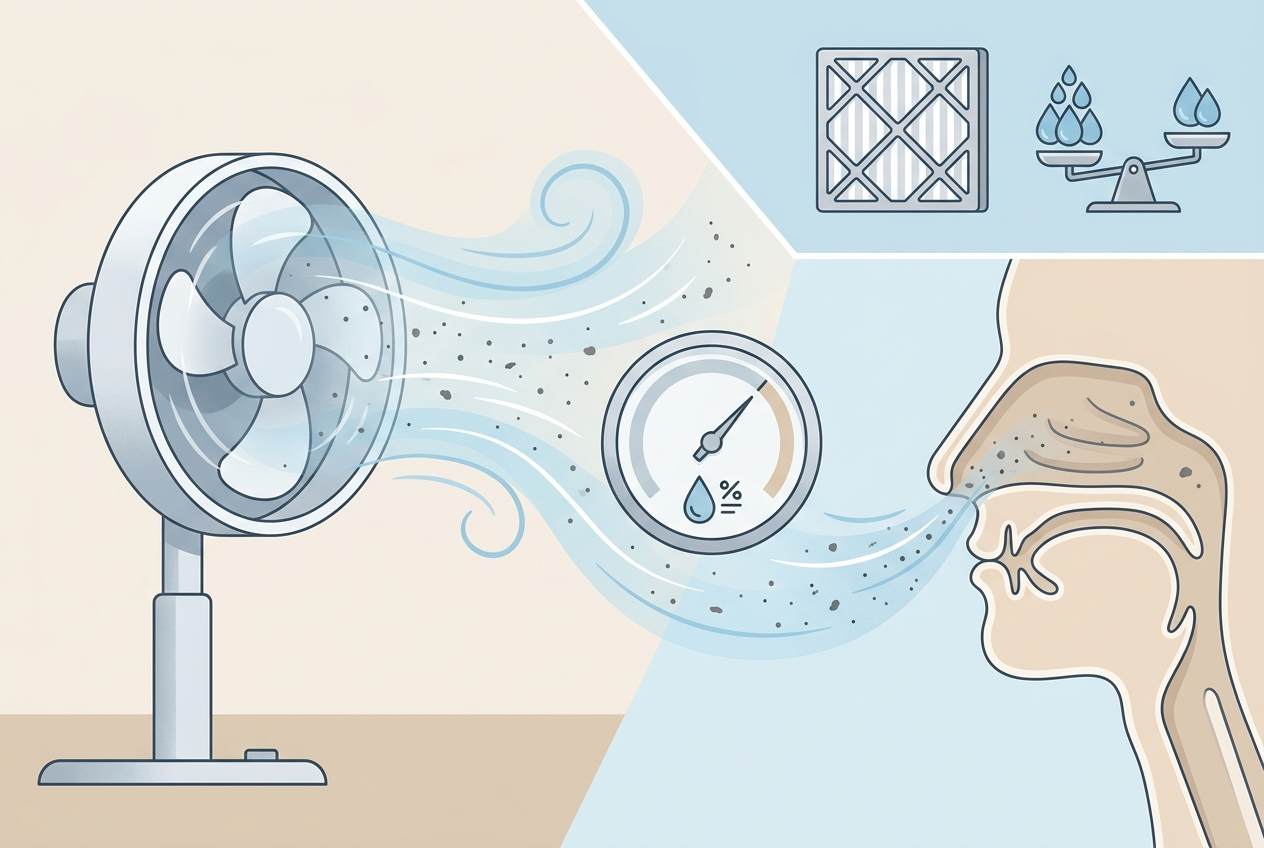
Direct airflow increases evaporation from the surface of the nose, mouth, and throat, which can make an already sensitive airway feel dry or ticklish. Cool air can also provoke cough or chest tightness in people with airway hyperresponsiveness. A fan adds another variable: it can resuspend settled dust, pet dander, pollen, cleaning residue, or other particles from bedding, carpets, shelves, and blades. An air conditioner can reduce humidity, but a poorly maintained filter, drain pan, or duct can also accompany dust or moisture problems. None of these pathways means that the appliance created a chronic disease. The most informative clue is reproducibility: symptoms start in the direct stream, improve after moving away, and return under similar conditions. Even then, the response only identifies an exposure pattern. Infection, asthma, allergic rhinitis, medication effects, smoke, reflux, and other causes can lower the cough threshold and make ordinary airflow noticeable.
How can you tell whether airflow, dust, or humidity matters most?
Change one variable at a time. First, keep the room and temperature the same but redirect the fan or vent away from the face and upper body. If the cough improves, direct airflow becomes more plausible. Next, inspect fan blades, vent grilles, the accessible filter, and nearby surfaces for dust; follow the manufacturer’s cleaning and replacement instructions rather than spraying fragrance or disinfectant into the air stream. Measure relative humidity with a hygrometer for several days. The EPA indoor-air guide recommends roughly 30% to 50% indoor humidity because very damp rooms support mold and dust mites, while very dry air can feel irritating. Note whether symptoms also occur during vacuuming, bed-making, pet exposure, outdoor pollen days, or in another building with air conditioning. A portable air cleaner may reduce some particles, but it does not identify the source or replace moisture control, cleaning, and ventilation.
Could asthma or allergies explain the pattern?
Asthma can present with cough, wheeze, shortness of breath, or chest tightness, and symptoms often vary over time. The NHLBI lists very cold air, poor air quality, dust mites, mold, pet allergens, pollen, infections, stress, and exercise among recognized triggers. Allergic rhinitis or nonallergic nasal irritation can also send mucus toward the throat and produce repeated throat clearing or cough. A fan may expose the pattern by moving cool air or particles; it does not prove which condition is present. Record whether the cough occurs at night, during exercise, after laughter, with seasonal nasal symptoms, or alongside wheeze. A clinician may use history, lung examination, spirometry, peak-flow patterns, or allergy assessment rather than symptoms alone. Do not borrow another person’s inhaler or start repeated antihistamine use as a diagnostic test. New wheeze, reduced exercise tolerance, or recurring nighttime cough deserves medical assessment.
Could acid reflux cause a cough that seems linked to air conditioning?
Gastroesophageal reflux can accompany chronic cough or hoarseness even when heartburn is absent. The NIDDK lists chronic cough among possible mouth, throat, or lung-related GERD symptoms, but that association does not prove reflux causes an individual cough. A fan-specific response points first toward airflow, temperature, or moved particles unless episodes also track meals, lying down, regurgitation, sour taste, heartburn, or swallowing symptoms. Reflux and airway sensitivity can coexist, so choosing one label too early may hide the other pattern. Avoid using a long antacid trial as a home diagnostic shortcut, especially when symptoms are new or persistent. Instead, record meal timing, position, nasal symptoms, airflow exposure, wheeze, and medication use in the same log. Chest pain, trouble swallowing, bleeding, persistent vomiting, or unexplained weight loss requires clinical evaluation rather than assumption of uncomplicated reflux.
What is a safe one-week home check for this cough?
Use a short, controlled observation only when there is no breathing difficulty or other warning sign. On days one and two, redirect airflow away from the face without changing room temperature. On days three and four, clean accessible fan blades and grilles, replace or clean the HVAC filter according to the equipment instructions, and damp-dust nearby surfaces. Measure humidity rather than guessing; keep it within the EPA’s approximate 30% to 50% range and avoid overusing a humidifier, which can disperse minerals or support microbial growth when poorly maintained. On days five through seven, compare the same room with the fan off, indirect, and direct for similar periods. Record cough frequency, throat irritation, wheeze, nasal symptoms, temperature, humidity, and recent meals. Stop the experiment if symptoms worsen. Do not deliberately expose yourself to suspected mold, strong chemicals, smoke, extreme cold, or a device that smells burned or shows water damage.
When should a dry cough be evaluated by a clinician?
Seek emergency help for shortness of breath, difficulty breathing, facial or throat swelling, blue or gray lips, severe chest pain, confusion, fainting, or coughing blood. MedlinePlus also advises prompt medical contact for cough with fever, a high-pitched breathing sound, foul or colored phlegm, rapid violent onset, or persistence beyond roughly 10 to 14 days. Arrange a routine visit sooner when cough repeatedly interrupts sleep, follows exercise, includes wheeze, occurs after a new medicine such as an ACE inhibitor, or appears in a building with visible mold or dampness. Bring the exposure log, humidity readings, medication list, filter history, and information about smoking, vaping, work exposures, pets, recent infection, and reflux symptoms. A clinician may examine the nose, throat, lungs, and heart, then choose spirometry, imaging, allergy assessment, or reflux evaluation based on the pattern. Testing should follow the likely cause, not a generic cough panel.
What are common questions about fan- or AC-related cough?
Can a fan make allergies worse?
A fan can move settled dust, pollen, pet allergens, or mold fragments into the breathing zone. The EPA identifies mold, dust mites, pollen, and pet allergens as triggers for allergic and asthma symptoms.
Is dry air the only reason an air conditioner causes coughing?
No. Low humidity can irritate the throat, while cool air, resuspended particles, a dirty filter, moisture problems, infection, or underlying airway sensitivity may produce a similar pattern.
Should I use a humidifier beside the bed?
Measure humidity first and clean any humidifier exactly as directed. Raising humidity above the recommended range can support mold and dust mites, so more moisture is not automatically better.
Can a dirty AC filter cause a cough?
A loaded or poorly fitted filter can accompany higher particle exposure, but the filter alone may not explain the symptom. Replace or clean the correct filter on schedule and inspect the room for other sources.
Why do I cough only when air blows on my face?
Direct cool airflow can dry and stimulate sensory nerves in the nose, throat, or airways. Improvement after redirecting the stream supports an airflow trigger but does not identify the underlying sensitivity.
Does coughing near AC mean I have asthma?
No. Cold-air-triggered cough can occur with asthma, but diagnosis requires the symptom pattern and often lung-function testing; allergies, infection, reflux, medication effects, and irritation can overlap.
What is the practical bottom line?
A fan or air conditioner can expose a cough trigger without being the root diagnosis. Test the simple variables first: move out of direct airflow, inspect and clean accessible dust, follow the correct filter schedule, measure rather than guess humidity, and record whether symptoms follow temperature, particles, exercise, meals, position, or nasal congestion. Keep indoor humidity near the EPA’s 30% to 50% range instead of automatically adding moisture. A repeatable response to cold air, exercise, wheeze, or nighttime symptoms supports an airway assessment; a pattern with regurgitation, heartburn, meals, or lying down supports a reflux discussion. These clues can coexist and should not be used to self-diagnose. Stop the home check and seek urgent care for breathing difficulty, facial or throat swelling, blue or gray lips, severe chest pain, fainting, confusion, or coughing blood. Persistent or recurring cough deserves a clinician review even when redirecting the fan helps.
Leave a Reply