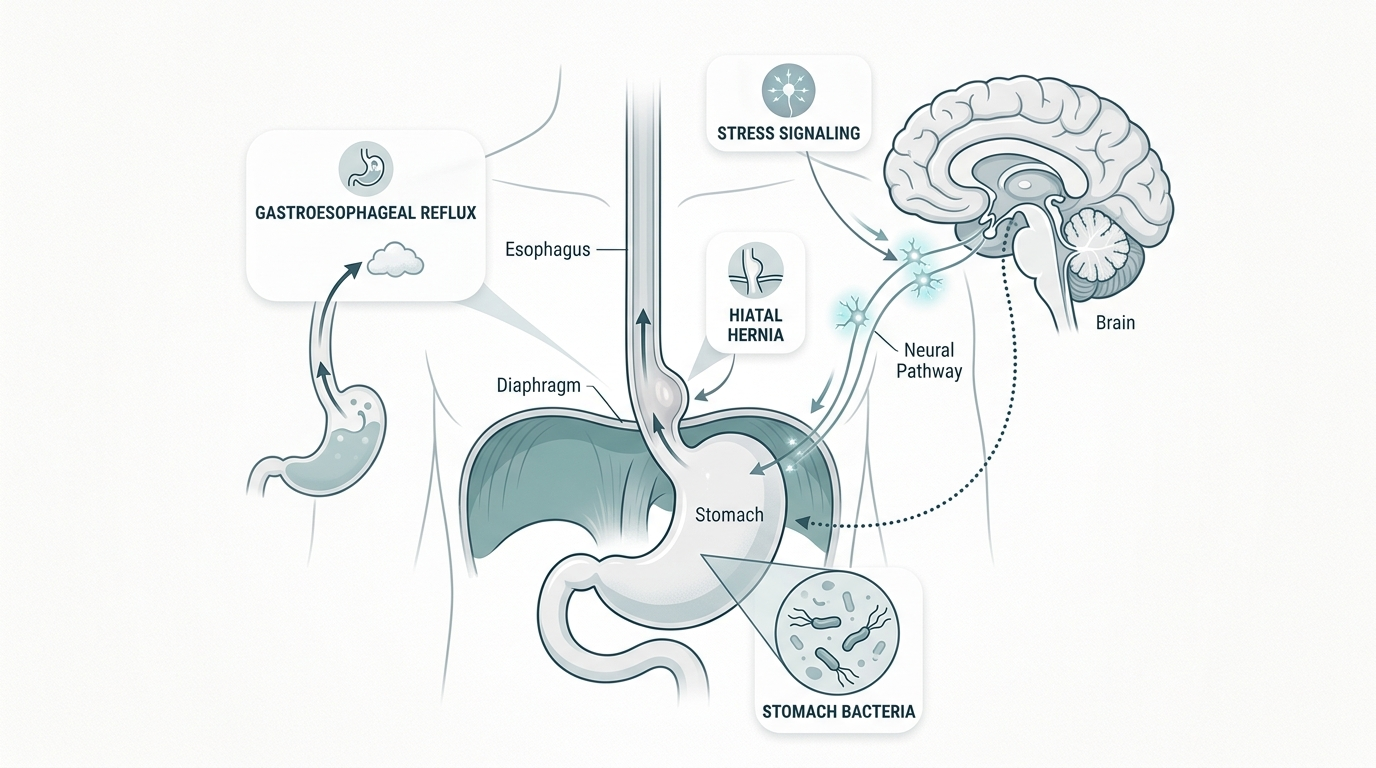
Symptoms alone cannot reliably distinguish GERD, a hiatal hernia, Helicobacter pylori infection, and anxiety-related gut symptoms because they overlap. Regurgitation favors GERD; a hernia requires imaging or endoscopy; H. pylori requires breath, stool, or biopsy testing; and anxiety may amplify symptoms without excluding a physical condition. Red flags need prompt medical assessment.
How did we evaluate GERD, hiatal hernia, H. pylori, and anxiety?
We compared each condition by mechanism, characteristic symptom pattern, objective test, and the findings that symptoms cannot establish. National Institute of Diabetes and Digestive and Kidney Diseases guidance carried the most weight for GERD, dyspepsia, peptic ulcers, endoscopy, and pH monitoring. MedlinePlus sources defined hiatal-hernia anatomy and H. pylori test options. We treated timing, posture, meals, and stress as clues rather than proof because the four categories can coexist. We excluded online acid tests, symptom quizzes, response to antacids as a diagnosis, and the assumption that normal endoscopy means symptoms are imaginary. Anxiety can change symptom intensity through gut-brain signaling, while reflux, a hernia, and H. pylori remain physical questions that may need separate testing. This framework helps organize a clinician visit; it cannot diagnose chest pain, upper-abdominal pain, trouble swallowing, or persistent indigestion remotely.
Why do these four problems feel so similar?
The esophagus, stomach, diaphragm, and nervous system can generate overlapping sensations in the same upper-abdominal and chest region. GERD moves stomach contents into the esophagus and commonly causes heartburn or regurgitation. A hiatal hernia changes anatomy by moving part of the stomach through the diaphragm, which can make reflux easier but may cause no symptoms itself. H. pylori infects the stomach lining and can cause gastritis or peptic ulcers, yet most infected people have no symptoms. Anxiety changes attention, muscle tension, breathing, and the perception of internal signals; it can intensify nausea, fullness, belching, or burning without producing an H. pylori test or anatomical hernia. One person can also have more than one category at once. The key distinction is therefore not “which symptom belongs to which label?” It is “which mechanism needs confirmation, and which test can confirm it?” Symptom patterns guide testing, but they do not replace it.
Which clues point more toward GERD?
GERD becomes more likely when burning rises behind the breastbone, sour or bitter material returns to the throat or mouth, and symptoms follow meals, bending, or lying down. The NIDDK symptom guide identifies heartburn and regurgitation as common features, while also noting cough, hoarseness, nausea, chest pain, and swallowing problems. Those additional symptoms are less specific because heart, lung, throat, and motility problems can resemble reflux. Improvement with an antacid or acid-suppressing medicine supports acid sensitivity but does not prove GERD, identify a hiatal hernia, or exclude H. pylori. Best clue for classic GERD: recurrent regurgitation linked to meals or posture. Best confirmation when the diagnosis remains uncertain: ambulatory esophageal pH monitoring, sometimes combined with impedance. New chest pressure, shortness of breath, sweating, or pain radiating to the arm or jaw requires urgent evaluation rather than a reflux assumption.
Which clues point more toward a hiatal hernia?
A hiatal hernia cannot be confirmed by how heartburn feels. It describes anatomy: the upper stomach moves through the diaphragm into the chest. Many small sliding hernias cause no direct symptoms, while larger hernias may contribute to reflux, chest or upper-abdominal pressure, early fullness, regurgitation, or swallowing difficulty. MedlinePlus explains that clinicians often discover a hiatal hernia during tests for reflux, chest pain, or abdominal pain, including a barium swallow or upper endoscopy. Symptoms that worsen after a large meal, while bending, or when lying down can fit both GERD and a hernia, so posture does not distinguish them. Best clue for a structural problem: persistent swallowing difficulty, marked post-meal pressure, or a prior imaging finding. Best confirmation: imaging or endoscopy selected by a clinician. A hernia finding also does not prove that every symptom comes from the hernia; reflux testing may still be needed when the relationship remains unclear.
Which clues point more toward H. pylori?
H. pylori becomes a stronger question when discomfort centers in the upper abdomen and includes persistent burning or aching, early fullness, nausea, reduced appetite, or a history of gastritis or peptic ulcer. None of those symptoms is specific. MedlinePlus notes that most people with H. pylori have no symptoms, while symptomatic infection may resemble ordinary dyspepsia. Sour regurgitation into the mouth favors GERD more than H. pylori, but one condition does not exclude the other. Best clue for testing: ongoing dyspepsia, ulcer history, unexplained iron deficiency in an appropriate clinical context, or a clinician’s risk assessment. Best noninvasive confirmation: a urea breath test or stool antigen test. Proton-pump inhibitors, bismuth, and antibiotics can produce false-negative results, so medication timing must follow clinical instructions. A blood antibody test may reflect a past infection and is less useful for proving active infection or confirming eradication after treatment.
Which clues point more toward anxiety or a gut-brain interaction?
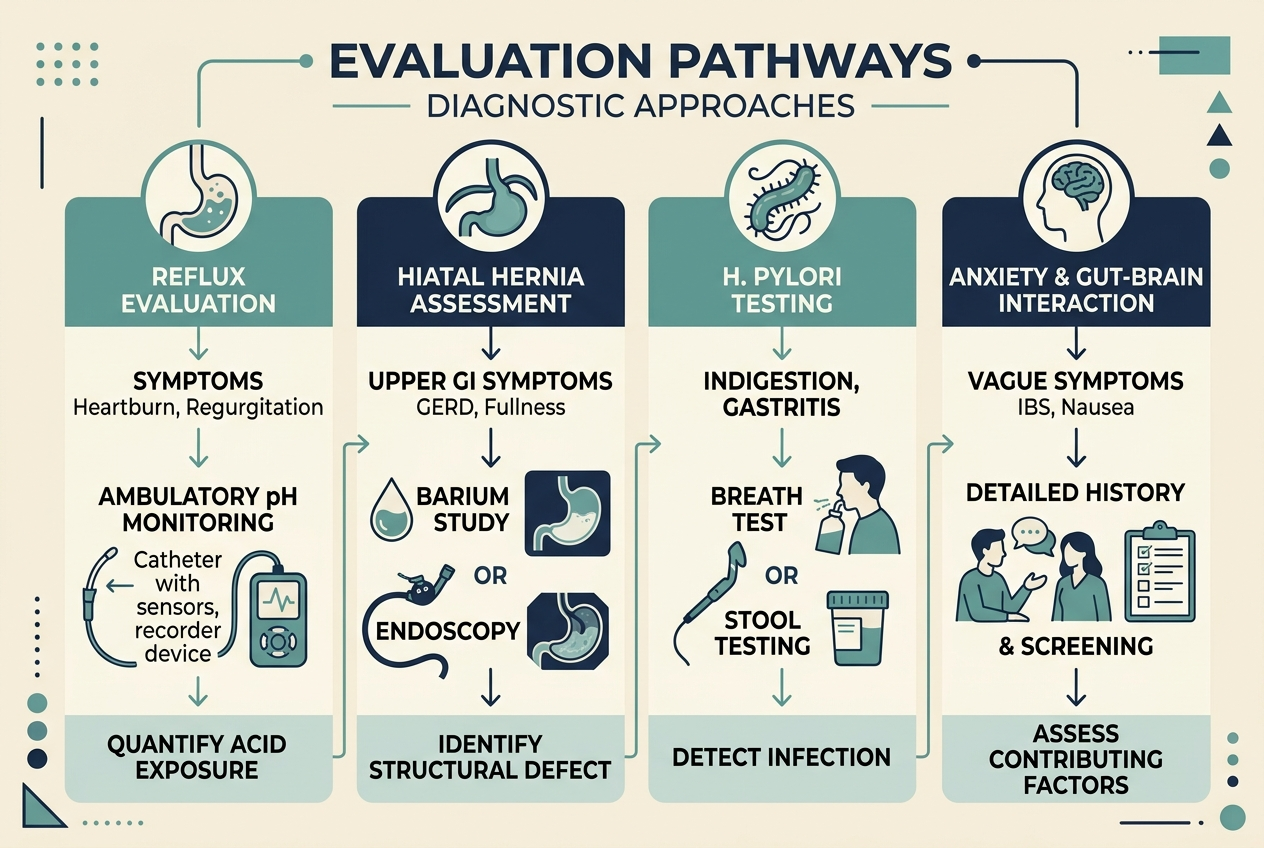
Anxiety becomes relevant when symptoms reliably intensify during threat, rumination, panic, poor sleep, or rapid breathing and ease when arousal settles. Belching, chest tightness, nausea, fullness, and abdominal discomfort can all change with autonomic activation and heightened interoception. That pattern does not mean the symptoms are fabricated. NIDDK describes functional dyspepsia as chronic indigestion without another digestive disease that explains it and identifies it as a disorder of gut-brain interaction. Best clue for a gut-brain contribution: symptom intensity tracks stress more closely than meals or posture after appropriate medical assessment. Best confirmation: there is no single anxiety-versus-stomach test; clinicians use history, validated mental-health screening, and targeted digestive evaluation. Anxiety can coexist with GERD, a hiatal hernia, or H. pylori. A symptom diary should therefore track meals, posture, sleep, bowel changes, medicines, and stress without using one stressful episode to dismiss persistent physical symptoms.
Which tests actually separate these possibilities?
Testing should answer a specific mechanism question. Ambulatory pH monitoring measures reflux reaching the esophagus and is the most direct test for uncertain GERD. Upper endoscopy examines the esophagus, stomach, and duodenum for inflammation, ulcers, narrowing, and other abnormalities; it can also obtain biopsies. A barium upper-GI series can show swallowing mechanics and a hiatal hernia. Urea breath testing and stool antigen testing identify active H. pylori infection, while biopsy testing may be used during endoscopy. The NIDDK GERD diagnosis guide explains that clinicians often begin with symptoms and history, then test when warning signs, alternative diagnoses, or treatment failure raise uncertainty. Best test for acid exposure: pH monitoring. Best test for anatomy: imaging or endoscopy. Best test for active H. pylori: breath or stool antigen. Best assessment for anxiety: clinical screening alongside, not instead of, appropriate digestive evaluation.
| Question | Most direct evaluation | What it cannot prove alone |
|---|---|---|
| Is reflux reaching the esophagus? | Ambulatory pH or pH-impedance monitoring | Whether anxiety contributes to symptom intensity |
| Is there a hiatal hernia? | Barium study or upper endoscopy | Whether the hernia causes every symptom |
| Is active H. pylori present? | Urea breath or stool antigen test | Whether reflux is also present |
| Does gut-brain signaling contribute? | History and validated clinical screening | That physical disease is absent |
Which warning signs need prompt medical attention?
Do not self-sort severe or progressive symptoms into GERD, hernia, H. pylori, or anxiety. Seek urgent help for chest pressure with shortness of breath, sweating, fainting, or pain spreading to the arm, jaw, neck, shoulder, or back. Vomiting blood, material resembling coffee grounds, black tarry stool, sudden severe abdominal pain, a rigid abdomen, or repeated vomiting can signal bleeding or another emergency. Arrange prompt clinical assessment for trouble or pain with swallowing, food sticking, unexplained weight loss, persistent loss of appetite, iron-deficiency anemia, jaundice, progressive abdominal swelling, or symptoms that continue despite appropriate over-the-counter measures. NIDDK lists bleeding, swallowing problems, persistent vomiting, chest pain, and unintended weight loss among symptoms that require medical review. Anxiety may coexist with emergencies and should never be used to explain away a new red flag. A clear timeline, medication list, family history, and prior test results help a clinician choose the safest next step.
What questions do people ask about reflux, hernias, H. pylori, and anxiety?
The questions usually focus on whether one symptom or home experiment can settle the diagnosis. It cannot. Heartburn and regurgitation provide pattern evidence for GERD, while imaging establishes a hiatal hernia and breath, stool, or biopsy testing establishes H. pylori. Normal endoscopy does not exclude all reflux because pH monitoring measures exposure over time, and it does not make a gut-brain disorder imaginary. Stress-linked symptoms do not prove anxiety is the only cause, just as temporary relief from antacids does not identify the full mechanism. The six answers below separate useful clues from diagnostic shortcuts. Bring a clinician a timeline that includes meal timing, posture, regurgitation, upper-abdominal pain, swallowing, bowel changes, medicines, sleep, and stress. That record can focus testing while reducing the temptation to repeat unsupported online acid tests or change several treatments at once.
Can GERD and a hiatal hernia occur together?
Yes. A hiatal hernia can make reflux easier, but many hernias are asymptomatic and GERD can occur without a hernia. Testing should establish both anatomy and reflux when the distinction matters.
Can H. pylori cause acid reflux?
H. pylori primarily affects the stomach lining and can cause gastritis or ulcers. It does not reliably explain classic regurgitation, so a positive test does not automatically establish the cause of reflux symptoms.
Can anxiety cause real chest burning or nausea?
Yes. Gut-brain signaling, muscle tension, breathing patterns, and heightened interoception can create real physical symptoms. Clinicians should still assess new or concerning chest and digestive symptoms on their own merits.
Does a normal endoscopy rule out GERD?
No. Endoscopy can show inflammation or complications, but many people with reflux have no visible erosions. Ambulatory pH or pH-impedance monitoring can evaluate reflux exposure when uncertainty remains.
Can a home stomach-acid test diagnose the problem?
No. Baking-soda timing, betaine challenges, saliva tests, and symptom quizzes do not distinguish these four categories reliably. They can delay appropriate breath, stool, imaging, endoscopic, or pH testing.
Which doctor should evaluate these symptoms?
A primary-care clinician can review red flags, medicines, and initial testing. A gastroenterologist may be appropriate for persistent symptoms, swallowing problems, uncertain GERD, suspected ulcer disease, or the need for endoscopy or reflux monitoring.
What is the clearest way to tell these conditions apart?
Use symptoms to choose a test, not to declare a diagnosis. Recurrent regurgitation and posture-linked burning support GERD, but pH monitoring confirms uncertain reflux. A hiatal hernia is an anatomical finding shown by imaging or endoscopy. H. pylori is an infection shown by a properly prepared breath, stool antigen, or biopsy test. Anxiety and disorders of gut-brain interaction are evaluated through history and clinical screening after red flags and relevant physical causes receive appropriate attention. Multiple categories can coexist, so the goal is not to force every symptom into one label. Record the pattern, review medicines, and ask what mechanism each proposed test will answer. Seek prompt care for chest pressure, bleeding, persistent vomiting, swallowing difficulty, unintended weight loss, severe abdominal pain, fainting, or black stool. A staged evaluation is more reliable than online quizzes, home acid tests, or repeated treatment trials.
Leave a Reply