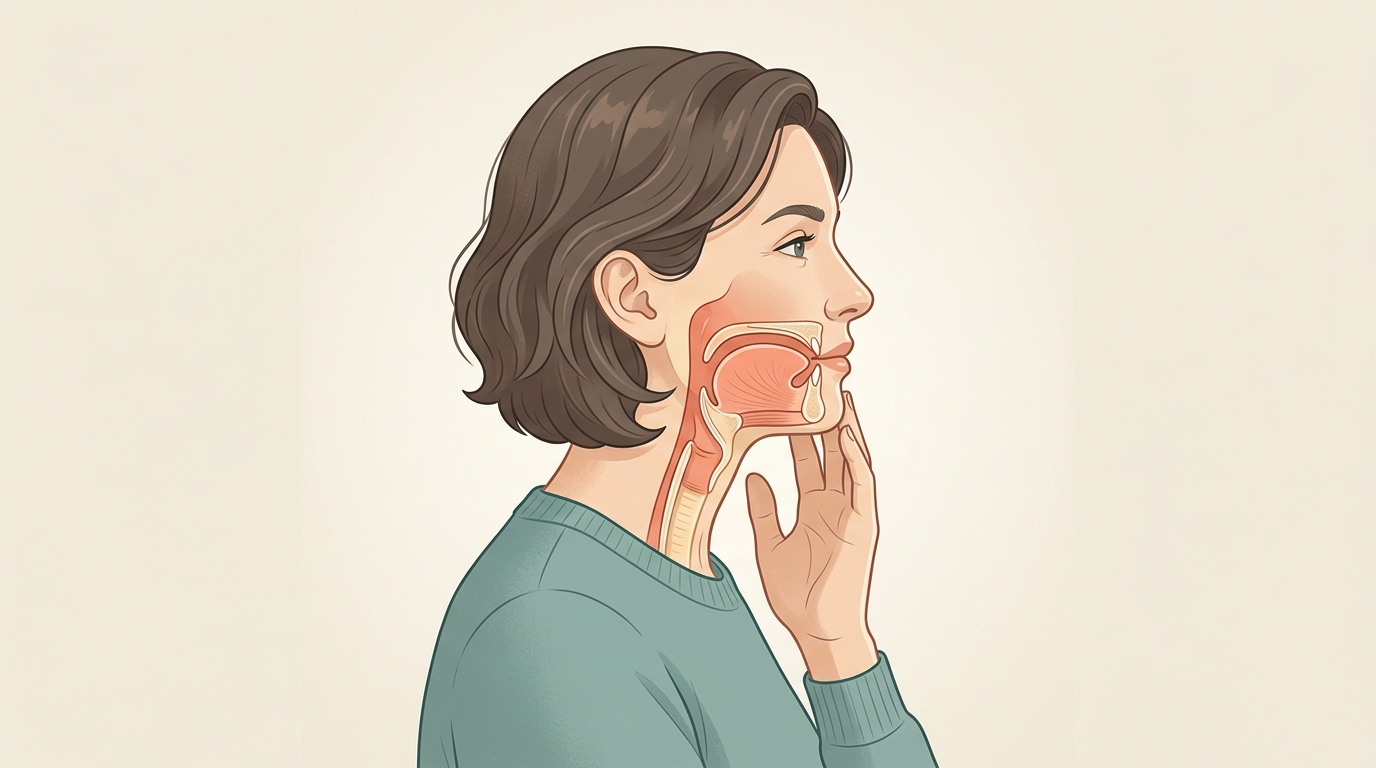
A swollen tongue is not a typical acid-reflux symptom. Reflux can cause sour taste, throat irritation, cough, or hoarseness, but visible tongue enlargement needs a separate explanation. Sudden swelling with breathing trouble, throat tightness, faintness, wheezing, or trouble swallowing is an emergency because the airway can narrow quickly.
How did we evaluate whether reflux can cause tongue swelling?
We compared the established symptom pattern of gastroesophageal reflux with emergency-medicine and allergy guidance on tongue edema. Government health references and consensus documents received more weight than anecdotes that connect two symptoms only because they occurred together. NIDDK lists heartburn, regurgitation, chest pain, nausea, swallowing difficulty, cough, and hoarseness among GERD symptoms; visible tongue swelling is not part of that typical pattern (NIDDK). We separated subjective sensations—burning, coating, dryness, or a “thick” feeling—from objectively enlarged tissue because they require different decisions. We also prioritized airway safety over diagnostic speculation. A photo or symptom description cannot distinguish allergic, medication-related, hereditary, infectious, traumatic, or dental causes reliably. This article therefore explains patterns and urgency, not a home diagnosis. Sudden swelling, recurrent episodes, new medicine exposure, and swallowing or breathing changes require qualified medical assessment.
Is acid reflux a likely cause of a swollen tongue?
Acid reflux is an unlikely primary explanation for true tongue swelling. GERD moves stomach contents into the esophagus and sometimes the throat or mouth, producing heartburn, regurgitation, sour taste, cough, hoarseness, or swallowing discomfort. Those sensations can make the tongue or throat feel irritated without creating measurable tongue edema. A coated tongue, burning mouth, dry mouth, dental irritation, oral thrush, and muscle tension can also feel like swelling even when tongue size is unchanged. Conversely, angioedema enlarges deeper tissues and can affect the lips, tongue, mouth, pharynx, or larynx. A 2024 international consensus defines angioedema as intermittent localized swelling of subcutaneous or submucosal tissue and emphasizes that multiple mechanisms exist (DANCE consensus). Timing matters: reflux often follows meals or lying down, while allergic swelling may begin rapidly after food, medicine, latex, or a sting. Coexistence does not establish causation, so visible swelling should not be dismissed as “just reflux.”
What can cause sudden tongue swelling?
Sudden tongue swelling raises concern for angioedema, which can be driven by histamine or bradykinin. Histamine-mediated episodes may follow foods, medicines, insect stings, or latex and can occur with hives, itching, wheezing, vomiting, dizziness, or low blood pressure. Bradykinin-mediated angioedema may occur with angiotensin-converting enzyme inhibitors such as lisinopril, even after long-term use, or with hereditary or acquired C1-inhibitor disorders. The mechanisms matter because they do not respond to identical treatments. An emergency-medicine review notes that airway angioedema can be fatal and identifies tongue edema as a higher-risk anatomical presentation (PubMed). Infection, dental disease, trauma, burns, tongue biting, and local irritation can also enlarge tissue. A new mouth product or supplement may be temporally relevant, but timing alone does not prove allergy. Do not deliberately re-expose yourself to a suspected trigger. Bring the package, medication list, and episode timeline to the clinician evaluating the swelling.
How can you tell true swelling from irritation or a thick-tongue feeling?
True swelling changes the tongue’s size, contour, movement, or fit inside the mouth. Objective clues include new tooth impressions, difficulty keeping the tongue behind the teeth, altered speech, drooling, trouble swallowing saliva, visible asymmetry, or simultaneous lip and facial swelling. A burning, sour, dry, coated, tingling, or “lump in the throat” sensation can feel dramatic without producing the same visible enlargement. Compare the current appearance with a prior photo only if doing so does not delay emergency care. Note whether the change began over minutes, hours, or days and whether hives, itching, fever, dental pain, mouth ulcers, new foods, new medicines, or recent dental work appeared with it. Reflux timing—after a large meal or lying flat—may explain sour taste or throat burning but does not safely explain away enlargement. Persistent macroglossia has a different differential from a brief angioedema episode and requires examination. The useful distinction is objective change versus sensation, not whether the symptom feels mild or severe.
Which tongue-swelling signs require emergency action?
Call emergency services for tongue swelling accompanied by difficulty breathing, wheezing, noisy breathing, throat tightness, inability to swallow saliva, blue or gray lips, fainting, confusion, or rapidly increasing facial or mouth swelling. Do not drive yourself if the airway may be changing. MedlinePlus warns that severe angioedema can cause life-threatening airway blockage and treats breathing difficulty as an emergency (MedlinePlus). The 2023 anaphylaxis practice parameter also identifies upper-airway mucosal swelling involving the tongue, pharynx, uvula, or larynx as a serious feature (AAAAI). If you have a prescribed epinephrine auto-injector and your action plan says to use it, follow that plan and call emergency services. Antacids do not treat angioedema. Antihistamines do not reliably treat bradykinin-mediated swelling. Apparent improvement should not override urgent instructions when breathing, swallowing, voice, or consciousness has changed.
What information helps a clinician identify the cause?
A concise timeline is more useful than a long list of theories. Record the exact start time, speed of progression, duration, and whether the tongue returned fully to baseline. List every prescription, over-the-counter medicine, supplement, food, dental product, and exposure used before the episode. Highlight ACE inhibitors, nonsteroidal anti-inflammatory drugs, antibiotics, and any newly started product, but do not stop prescribed medicine without urgent clinical direction unless an emergency professional instructs you. Note hives, itching, abdominal pain, vomiting, wheezing, voice change, drooling, fever, dental pain, mouth sores, and family history of unexplained swelling. Photograph visible changes only when safe. Record whether reflux symptoms occurred separately or at the same time. A pattern of recurrent swelling without hives can prompt evaluation for nonhistaminergic or hereditary mechanisms, while rapid swelling with hives points toward a different pathway. No single home observation confirms the mechanism; the goal is to preserve details that disappear after the episode resolves.
What questions do people ask about reflux and a swollen tongue?
Start with two questions: Is the tongue objectively larger, and is the airway changing? Then ask what happened immediately before the episode, which medicines are involved, whether hives or itching appeared, and whether previous episodes followed the same pattern. Reflux belongs lower in the decision tree because its established symptoms center on heartburn, regurgitation, sour taste, swallowing discomfort, cough, and hoarseness. Sudden edema belongs higher because tongue involvement can threaten the airway. A clinician may examine the mouth, throat, teeth, skin, and breathing; review medicines; and decide whether allergy, angioedema, infection, trauma, or another condition requires testing. Recurrent episodes may require allergy or immunology follow-up. Persistent enlargement may require dental, ear-nose-throat, endocrine, or other evaluation depending on findings. The safest question is not “Can reflux do this?” but “What explanation best accounts for the timing, visible change, associated symptoms, and risk?”
Can GERD make your tongue feel thick?
GERD can create sour taste, throat irritation, cough, or swallowing discomfort that a person may describe as thickness. A visibly enlarged tongue is not a typical GERD feature and needs separate assessment.
Can an antacid reduce tongue swelling?
Antacids reduce stomach acidity; they do not treat allergic or bradykinin-mediated angioedema. Do not use symptom relief after an antacid as proof that swelling was caused by reflux.
Can lisinopril cause tongue swelling after years of use?
ACE-inhibitor angioedema can occur even after long-term treatment. Tongue or throat swelling while taking an ACE inhibitor warrants urgent medical evaluation and specific medication review.
Does tongue swelling always come with hives?
No. Histamine-mediated angioedema may include hives, but bradykinin-mediated forms often do not, so the absence of itching does not make tongue swelling harmless.
Can oral thrush look like tongue swelling?
Oral thrush can cause white patches, soreness, burning, or altered taste and may create a swollen sensation. An examination distinguishes surface changes from deeper tissue edema.
What if the swelling went away on its own?
Resolution does not identify the cause. A first episode, medication-associated episode, or recurrent unexplained episode still deserves medical review because a future event can behave differently.
What is the bottom line on reflux and tongue swelling?
Acid reflux can irritate the throat and mouth, but true tongue enlargement is not a routine GERD symptom. Treat sudden visible swelling as a separate problem until a qualified professional identifies the cause. Emergency warning signs include breathing difficulty, noisy breathing, throat tightness, drooling, trouble swallowing saliva, faintness, confusion, and rapidly increasing mouth or facial swelling. Angioedema can follow allergic exposure, medicines such as ACE inhibitors, or hereditary and acquired bradykinin pathways; infection, trauma, dental disease, and other conditions can also produce swelling. The absence of hives does not exclude danger. Keep a complete medication and exposure list, preserve photos when safe, and record the onset and associated symptoms. Reflux timing may explain sour taste or burning, but it cannot rule out an airway problem. When tongue size is visibly changing, safety comes before finding a digestive explanation.
Leave a Reply