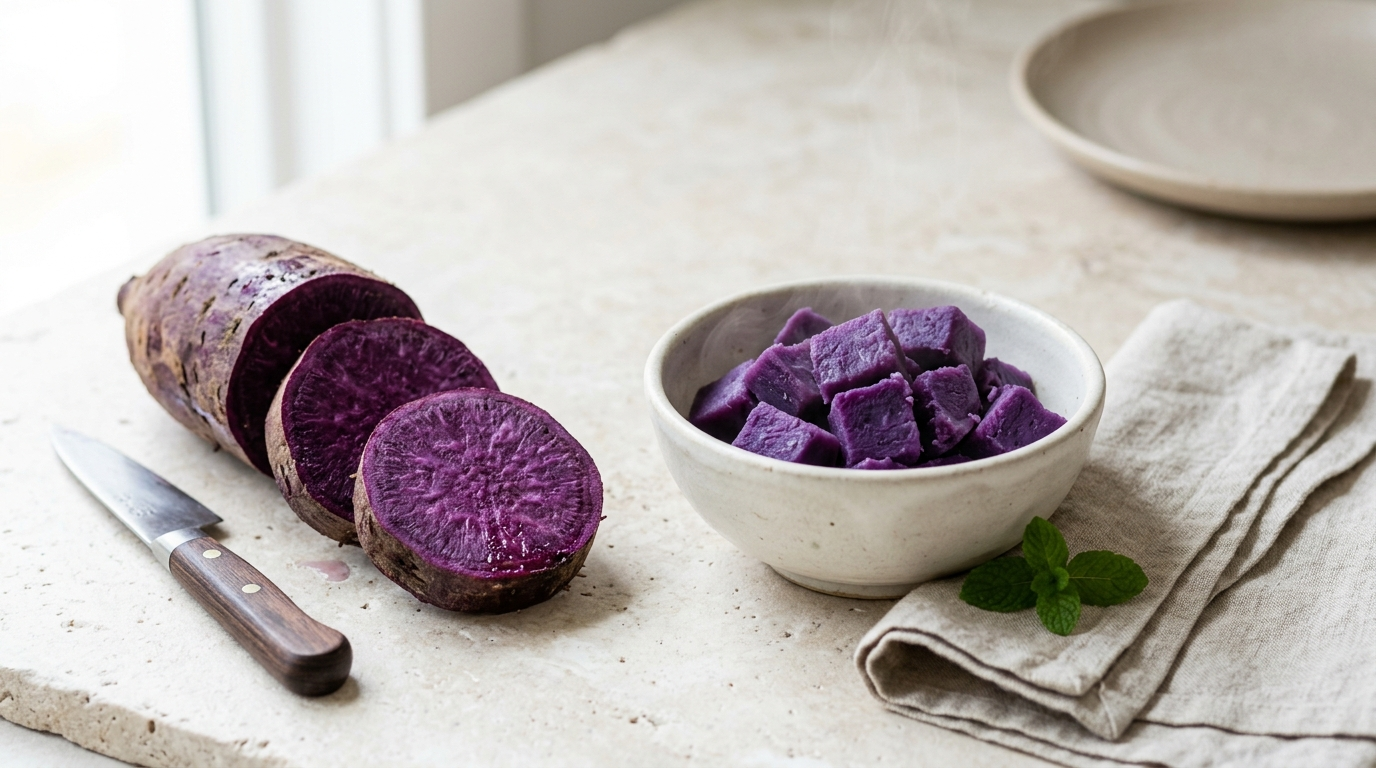
Ube can support gut health as a starchy whole food that may provide fiber, resistant starch, and purple anthocyanins, but evidence specific to cooked ube in humans is limited. Its value depends on the portion and preparation. Plain boiled or roasted ube is nutritionally different from sweetened ube jam, cake, or flavored powder.
How did we evaluate ube and gut health?
We identified ube as Dioscorea alata, then separated evidence about that species from research on purple sweet potato, taro, and Chinese yam. We prioritized human resistant-starch research and species-specific laboratory studies indexed by PubMed; animal studies, isolated extracts, and culinary claims were treated as directional evidence rather than proof of an effect in people. We evaluated four practical variables: starch digestibility, fiber fermentation, anthocyanin content, and the ingredients added during preparation. We excluded claims that ube “heals the gut,” detoxifies the colon, or reliably changes specific microbes because controlled trials of ordinary cooked ube have not established those outcomes. Food composition also varies by cultivar, maturity, storage, cooking, cooling, and serving size, so one purple yam dish cannot represent every preparation. This method supports a food-choice answer: ube can contribute to dietary variety, but its purple color does not turn a dessert into a clinical intervention.
Is ube actually good for gut health?
Plain ube can be part of a gut-supportive diet because the tuber supplies carbohydrate, some dietary fiber, and starch fractions that may reach the colon. Colonic microbes ferment accessible carbohydrates into metabolites such as acetate, propionate, and butyrate, but the response depends on the starch structure and the existing microbial community. A review of resistant starch and microbiome responses found substantial person-to-person variation across starch interventions, which makes a guaranteed “good bacteria” outcome unrealistic. Ube also contains purple pigments called anthocyanins, although pigment concentration does not directly measure fiber or resistant starch. The strongest practical advantage is substitution: boiled, steamed, or roasted ube can add plant diversity when it replaces a highly refined side or dessert. The benefit becomes less predictable when ube is mixed with large amounts of sugar, condensed milk, butter, or refined flour. Ube supports a pattern; it does not independently define one.
How is ube different from purple sweet potato and taro?
Ube is Dioscorea alata, a true yam in the Dioscoreaceae family. Purple sweet potato is usually Ipomoea batatas in the morning-glory family, and taro is Colocasia esculenta in the Araceae family. All three can appear purple, but they differ in botanical species, starch structure, fiber, moisture, flavor, and anthocyanin profile. Research on purple sweet potato cannot automatically prove an effect for ube, even when a photo, recipe, or supplement label uses the terms interchangeably. The same rule applies to Chinese yam studies involving Dioscorea polystachya or medicinal rhizome preparations: related plants are not identical interventions. Before interpreting a nutrition claim, check the ingredient list or produce label for the scientific or common name and review how the food was prepared. Color is an unreliable identity test because white, cream, and purple cultivars exist, while food coloring can intensify processed desserts. Accurate species identification prevents borrowed evidence from becoming a confident but false ube claim.
Does ube contain resistant starch?
Purple yam starch can include fractions that resist digestion by human amylases, but the amount in a serving of cooked ube is not fixed. Species, cultivar, grinding, heat, moisture, cooling, and reheating change starch structure. Laboratory researchers have produced resistant-starch fractions from Dioscorea alata through autoclaving, cooling, debranching enzymes, and hydrolysis; a 2018 structural study showed that those treatments changed crystallinity and in-vitro digestibility. Those engineered samples do not establish the resistant-starch dose in home-cooked ube. Cooking generally gelatinizes accessible starch, while cooling can allow some starch chains to reorganize through retrogradation. A chilled-then-reheated portion may therefore differ from freshly mashed ube, yet no household method guarantees a specific gram amount. Treat resistant starch as a plausible component, not a label-free dosage. Whole-food variety and total dietary fiber remain easier to evaluate than an unmeasured resistant-starch promise attached to one purple tuber.
Can ube feed beneficial gut bacteria?
Ube-derived resistant starch can serve as a microbial substrate in laboratory systems, but that finding is not the same as a demonstrated benefit from eating ube. A 2018 Food & Function study tested specially prepared Dioscorea alata resistant starch with Bifidobacterium adolescentis in simulated gastrointestinal and large-bowel conditions. Certain processed starch fractions supported bacterial growth and increased short-chain fatty-acid production in vitro. The experiment involved one organism and isolated starch media, not people eating boiled purple yam. Human microbial communities contain hundreds of interacting species, and baseline diet affects which organisms use a particular substrate. The defensible conclusion is narrow: purple-yam starch has prebiotic potential that merits human testing. It is premature to promise that an ube serving raises Bifidobacterium, increases butyrate, or improves symptoms. Pairing ube with varied legumes, vegetables, fruit, whole grains, nuts, and seeds creates a broader set of fermentable substrates than relying on one food.
What is the best way to eat ube for digestive value?
Best for a whole-food side: boil, steam, or roast peeled ube until fully tender, then serve it with vegetables and a protein source. Best for a measured ingredient: use plain frozen grated ube or unsweetened ube powder whose label lists the yam without added sugar, color, or flavoring. Best for dessert: treat ube halaya, ice cream, cake, and sweetened drinks as desserts rather than equivalent servings of a cooked tuber. Start with a modest portion if your usual fiber intake is low, because abrupt changes in fermentable carbohydrate can increase gas or stool changes. Chew thoroughly and assess the complete meal, not only the ube; coconut milk, dairy, sugar alcohols, large fat loads, and portion size can each affect tolerance. Raw yams should not be used as a resistant-starch shortcut. Cooking improves palatability and reduces exposure to naturally occurring compounds that make uncooked tubers unsuitable as a routine food.
Is ube a probiotic food?
No. Ube is not a probiotic unless a finished product contains live microorganisms that are identified and present in an adequate amount through the end of shelf life. A plain yam supplies starch, fiber, and plant compounds; it does not inherently deliver a documented strain such as Lactobacillus rhamnosus GG or Bifidobacterium longum 35624. Fermenting ube may introduce microorganisms, but “fermented” and “probiotic” are not interchangeable labels. Heat processing can also reduce or eliminate live cultures. Ube is better described as a potential source of microbiota-accessible carbohydrate, and laboratory research suggests that some prepared purple-yam resistant starch can support bacterial fermentation. That is a prebiotic mechanism, not a probiotic identity. When comparing products, read the ingredient list and storage instructions. A purple yogurt, drink, or powder may contain ube flavor, color, sugar, and a separate starter culture; the full formulation determines whether live organisms remain, not the purple color or the word “ube” on the front.
Can ube cause gas or bloating?
Yes, ube can contribute to gas or bloating in some people because colonic fermentation produces gases alongside short-chain fatty acids. The response depends on portion size, preparation, baseline fiber intake, bowel transit, the rest of the meal, and individual sensitivity. A new large serving of ube plus beans, onions, coconut milk, or sugar alcohols creates a different exposure than a small portion of plain cooked yam. Start with a modest serving and change one variable at a time if you are testing tolerance. Gas alone does not prove damage to the microbiome, and the absence of gas does not prove that fermentation is beneficial. Persistent pain, vomiting, blood in stool, unintended weight loss, fever, or a major change in bowel habits warrants medical evaluation rather than increasingly restrictive food experiments. A simple meal-and-symptom log can identify a repeatable pattern while reducing the risk of blaming ube for symptoms driven by portion size or another ingredient.
Is ube dessert as gut-friendly as plain purple yam?
Usually not. Ube halaya, cake, cookies, ice cream, and milk-based drinks may contain substantial added sugar, condensed milk, cream, butter, refined flour, emulsifiers, or artificial color. Those ingredients change energy density, fiber concentration, lactose exposure, fat content, and portion size. A dessert can still fit an overall eating pattern, but it should not borrow the nutritional profile of plain boiled Dioscorea alata. Compare the ingredient list and Nutrition Facts panel rather than judging by color. Look for the amount of added sugar, dietary fiber, serving size, saturated fat, and whether ube appears as a meaningful ingredient or only as flavoring. A product labeled “purple yam flavor” may contain little whole tuber. For more digestive value, pair a modest dessert serving with a meal instead of treating it as a fiber supplement. The useful distinction is not “healthy versus unhealthy”; it is whole tuber versus formulated dessert, with different ingredients and different expectations.
Is frozen or powdered ube the same as fresh ube?
Frozen plain ube can be a practical substitute for fresh ube when the ingredient list contains only purple yam and storage has been appropriate. Freezing changes texture more reliably than it erases all starch or pigment, although thawing, cooking, and reheating still affect the finished food. Ube powder varies more. Some powders are dehydrated whole tuber, while others combine yam, maltodextrin, sugar, milk solids, flavoring, or color. Dehydration concentrates material by weight, so a tablespoon of powder is not nutritionally equivalent to a tablespoon of cooked yam. Review serving size, fiber, added sugar, and preparation directions. Culinary extracts may contribute aroma and color without meaningful starch or fiber. A laboratory-resistant-starch powder is also not interchangeable with ordinary ube flour because processing can deliberately alter crystallinity and digestibility. Choose the format for its intended recipe, then evaluate the actual label. “Made with ube” describes an ingredient relationship; it does not guarantee a fixed nutrient or microbiome effect.
Can ube relieve constipation?
Ube should not be presented as a proven remedy for constipation. A whole cooked tuber contributes fluid-containing food and some fiber, which can support stool formation within an adequate dietary pattern, but human trials have not established a reliable constipation effect for ordinary Dioscorea alata servings. Stool frequency also depends on total fiber, hydration, physical activity, medicines, pelvic-floor function, bowel transit, and underlying conditions. Increasing fermentable carbohydrate too quickly can add gas without correcting hard stool or difficult evacuation. Use ube as one starch option, increase overall fiber gradually, and maintain normal fluid intake rather than forcing excessive water. Constipation accompanied by severe pain, vomiting, blood, fever, anemia, unintended weight loss, or inability to pass gas needs prompt medical attention. Recurrent straining, incomplete evacuation, or symptoms lasting several weeks deserve clinician review. A food can support regularity without acting like a drug, and that narrower claim fits the current evidence for ube.
For a detailed comparison of specific products and strains, see Emma Relief vs Let Loose for Gut Health: Which Type of Formula Fits Better?.
For a detailed comparison of specific products and strains, see Best Probiotics for Men’s Gut Health in 2026: What to Compare.
For a detailed comparison of specific products and strains, see Looking for a Good Supplement for Bloating? How to Compare Probiotics, Enzymes, and Peppermint Oil.
What is the bottom line on ube and gut health?
Ube is a colorful whole-food starch with plausible digestive value, not a microbiome cure. Species-specific laboratory research shows that processed Dioscorea alata resistant starch can resist digestion and support bacterial fermentation, but controlled human studies of ordinary cooked ube remain limited. The most evidence-aligned choice is plain boiled, steamed, or roasted ube in a varied diet, using a portion that feels comfortable. Identify ube correctly instead of borrowing evidence from purple sweet potato, taro, or another yam species. Treat sweetened ube jam, cake, ice cream, drinks, extracts, and colored powders according to their complete ingredient lists. If the goal is microbial diversity, rotate many plant foods rather than assigning the job to one tuber. If the goal is symptom relief, track meal composition and seek clinical evaluation for persistent or alarming changes. Ube can contribute starch, fiber, pigments, and variety; its best claim is useful food, not guaranteed therapy.
Leave a Reply