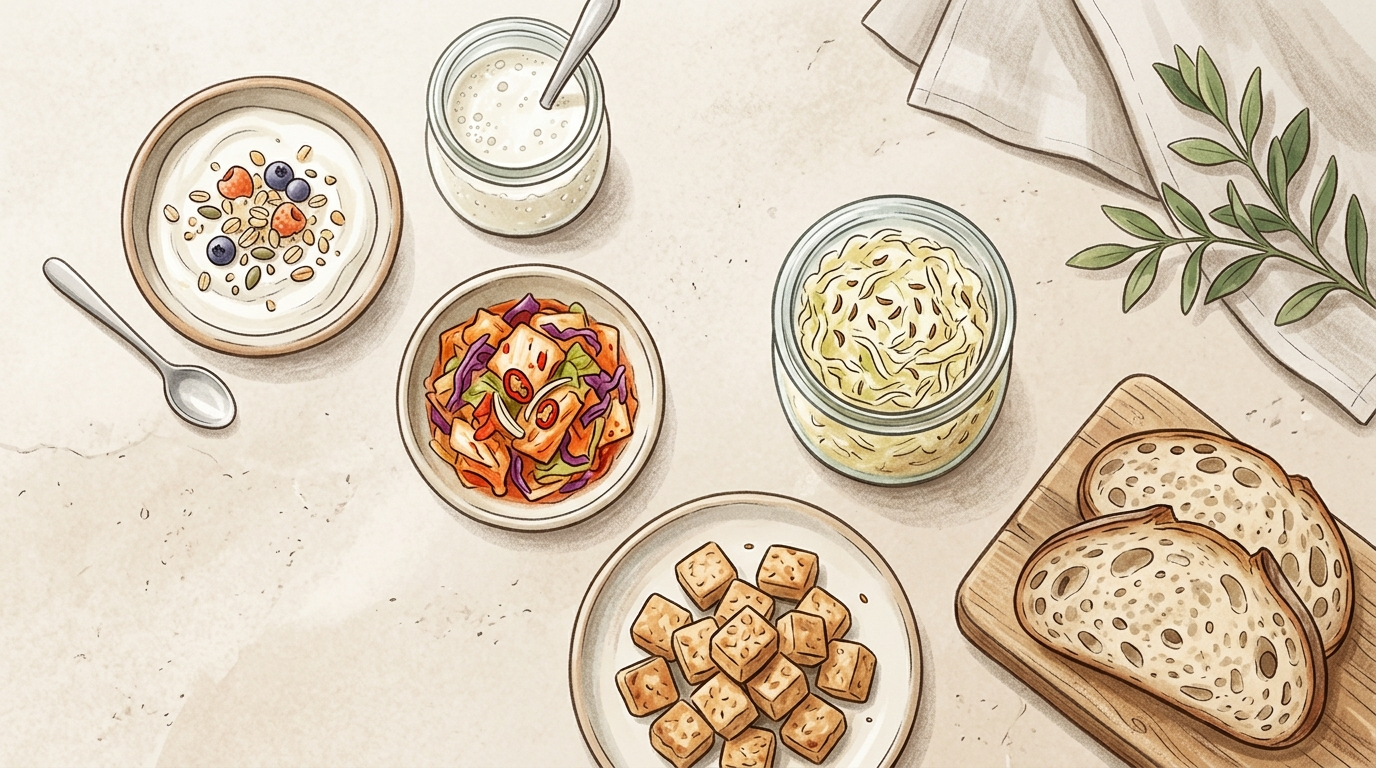
One serving of fermented food each day can be a reasonable way to add dietary variety, but evidence does not establish one serving as a universal gut-health dose. Choose a food you tolerate, confirm whether it still contains live cultures, start with a modest portion, and judge the habit by consistency and symptoms rather than hype.
How did we evaluate a daily fermented-food habit?
We prioritized randomized human trials, the International Scientific Association for Probiotics and Prebiotics consensus statement, and studies that clearly identified the food, serving size, duration, and measured outcome carefully. We separated fermented foods from probiotics because fermentation does not guarantee that live microorganisms remain in the finished product or that a named strain has demonstrated a health benefit. We also distinguished a practical one-serving habit from research protocols that used several daily servings. The evidence is strongest for describing how fermented foods are made and how specific interventions changed measured microbiome or immune markers. Evidence is weaker for claiming that one serving per day improves symptoms in every person. We excluded testimonials, broad “detox” claims, and studies that could not separate fermentation from other food characteristics such as fiber, protein, sodium, or meal replacement.
Does one serving of fermented food daily improve gut health?
One daily serving is a practical starting point, not a clinically established minimum. A 17-week randomized study in 36 healthy adults compared a high-fermented-food diet with a high-fiber diet. The fermented-food group gradually increased intake to roughly six servings per day, and researchers observed higher microbiota diversity and lower concentrations of several inflammatory proteins; the Cell study did not test a one-serving prescription. A separate randomized trial provided 100 grams of fermented vegetables daily for eight weeks and found no between-group improvement in bacterial alpha diversity or several cardiovascular biomarkers, according to its PubMed record. These studies support continued research, but they do not prove that one serving reliably changes symptoms or the microbiome. The most defensible benefit of a daily habit is dietary variety with a repeatable, tolerable portion. Individual response depends on the food, processing, baseline diet, and health context.
What counts as one serving of fermented food?
A useful serving is a normal food portion that fits the meal and the label, not a universal microbiome dose. Examples include about 3/4 to 1 cup of yogurt or kefir, 1/4 to 1/2 cup of kimchi or refrigerated sauerkraut, 2 to 3 ounces of tempeh, or one slice of sourdough bread. These foods are not interchangeable. Yogurt and refrigerated fermented vegetables may retain live cultures, while baking sourdough and heat-processing shelf-stable products generally inactivate microorganisms. Fermentation can still alter flavor, acidity, texture, and digestibility even when living microbes do not survive. The ISAPP fermented-food consensus defines fermented foods by desired microbial growth and enzymatic conversion during production, not by a guaranteed probiotic effect. Use the manufacturer’s serving as a starting reference, then adjust for sodium, added sugar, lactose, portion tolerance, and the rest of the diet.
Which fermented foods still contain live cultures?
The package and processing method provide better clues than the word “fermented.” Refrigerated yogurt or kefir labeled with live and active cultures is more likely to deliver living microorganisms at purchase. Shelf-stable pickles commonly rely on vinegar or post-fermentation heat, and baked sourdough no longer contains the living starter community after the oven. Tempeh is fermented before cooking, so preparation changes viability. ISAPP distinguishes live cultures from probiotics: a microorganism qualifies as probiotic only when an adequate amount confers a demonstrated health benefit. “Live and active” therefore describes viability, not a product-specific clinical outcome. The comparison below helps match the food to the goal without assuming every fermented item produces the same effect.
| Food | Live cultures at eating? | What to check |
|---|---|---|
| Yogurt or kefir | Often | “Live and active cultures,” sugar, lactose |
| Refrigerated kimchi or sauerkraut | Often, but variable | Post-fermentation pasteurization, sodium |
| Sourdough bread | No after baking | Still fermented, but not a live-culture food |
| Shelf-stable pickles | Often no | Vinegar pickling and heat processing |
| Tempeh | Depends on cooking | Preparation and portion tolerance |
How should you start a daily serving without overdoing it?
Choose one familiar food and begin with half a normal serving for three to four days. Keep the rest of the diet reasonably stable, then note the food, portion, meal timing, bloating, stool pattern, reflux, and any skin or breathing symptoms. Increase to one serving only when the smaller amount feels comfortable. This one-variable approach cannot diagnose a condition, but it makes tolerance easier to interpret than adding yogurt, kimchi, kombucha, and supplements simultaneously. People who are sensitive to lactose may tolerate some yogurt better than milk, yet tolerance varies by product and portion. People watching sodium should compare refrigerated vegetable labels because kimchi and sauerkraut can differ substantially. Added sugar matters in flavored yogurt, kefir, and kombucha. Stop the experiment and seek medical advice for hives, swelling, breathing difficulty, faintness, persistent vomiting, blood in stool, or unexplained weight loss. Consistency is useful only when the food remains safe and comfortable.
Who may need a different approach to fermented foods?
Fermented foods are not automatically appropriate for every digestive pattern. People with a confirmed food allergy must avoid the relevant allergen even when fermentation changes its proteins. People with celiac disease need verified gluten-free choices rather than ordinary sourdough. Those with lactose intolerance may compare lactose-containing yogurt or kefir with lactose-free cultured products. Immunocompromised people, pregnant people, young children, and anyone considering home-fermented foods should follow clinician and food-safety guidance because contamination control matters. Histamine or other biogenic amines vary across fermented foods, but symptoms alone cannot confirm histamine intolerance. Reflux, irritable bowel syndrome, and inflammatory bowel disease also require individualized context; a strong-flavored or high-FODMAP fermented food may worsen symptoms without making fermentation inherently harmful. A registered dietitian can preserve fiber, protein, calcium, and overall variety when restrictions accumulate. For product-level comparisons, a separate guide can compare fermented foods with probiotic formats without treating them as equivalents.
What are common questions about eating fermented food daily?
Is kombucha a fermented food?
Yes. Kombucha is fermented tea, but sugar, alcohol, acidity, caffeine, and live-microbe content vary by product. A bottle is not automatically equivalent to yogurt, kefir, or fermented vegetables.
Are all pickles fermented?
No. Many shelf-stable pickles are acidified with vinegar rather than produced through active fermentation. The label and manufacturer’s processing information provide the best clues.
Do fermented foods replace dietary fiber?
No. Fermented foods and fiber perform different roles in the diet. Whole grains, legumes, vegetables, fruit, nuts, and seeds remain important sources of fermentable substrates and nutrients.
Is more than one serving better?
Not necessarily. The Stanford trial used a gradual high-intake intervention, but it did not establish an ideal dose for individuals. More can also increase sodium, added sugar, lactose, or digestive discomfort.
How quickly should I notice a difference?
No reliable timeline applies to every person or food. Track tolerance over at least one to two weeks, and avoid attributing a single good or bad day to the fermented food.
Does “live cultures” mean “probiotic”?
No. Live cultures describe viable microorganisms. A probiotic designation additionally requires evidence that identified microorganisms confer a health benefit in an adequate amount.
Leave a Reply