
Make your symptoms easier to assess: lead with the main problem, give a dated pattern, explain the effect on daily life, and bring medication and test records. Ask what explanations are being considered, what would change the plan, and when to follow up. If communication repeatedly fails, request documentation, another appointment, or a second opinion.
How did we evaluate ways to communicate symptoms clearly?
We evaluated appointment strategies by prioritizing guidance from the Agency for Healthcare Research and Quality, the National Institute on Aging, and the National Institute of Diabetes and Digestive and Kidney Diseases. We focused on steps that improve information transfer: a prioritized concern list, symptom timing, functional impact, medication reconciliation, questions, written next steps, interpreters, and support people. We excluded claims that a specific test is always required, that normal results make symptoms unreal, or that confrontation guarantees better care. We also avoided treating every disagreement as dismissal because clinicians may be separating urgent conditions from lower-risk possibilities under time and evidence constraints. The central limitation is that clear communication cannot force a diagnosis, test, referral, or particular conclusion. It can make the clinical record more complete, expose misunderstandings earlier, and create a follow-up plan that identifies what happens if symptoms persist, change, or develop warning signs.
What should you say at the start of the appointment?
Open with one concise problem statement that combines symptom, duration, trajectory, and impact. For example: “For eight weeks I have had upper abdominal burning four evenings a week, it is becoming more frequent, and it now wakes me and limits what I eat.” This format gives the clinician a timeline and a functional consequence before the conversation branches into theories. Add the most important warning sign, medication change, or prior test next. Avoid starting with ten possible diagnoses gathered online; those ideas can come later as questions. The National Institute on Aging recommends prioritizing three or four concerns and raising the most important items first. Best for a short visit: one primary concern, one sentence about impact, and two key questions. Best for several unrelated problems: ask which issue can be addressed today and schedule another visit for the rest. A focused opening is not minimizing your experience; it is organizing it for clinical use.
Which symptom details make your story easier to assess?
Useful symptom details answer when, where, how often, how long, how severe, what changed, and what occurs alongside the problem. Record a representative week rather than reconstructing months from memory. For digestive symptoms, note meal timing, bowel frequency and form, vomiting, swallowing difficulty, bleeding, fever, weight change, nighttime symptoms, menstrual or pregnancy context, recent travel, antibiotics, and whether pain stays fixed or moves. Describe severity through function: missed work, interrupted sleep, reduced food intake, stopped exercise, or repeated urgent-care visits. Bring relevant reports and a full list of prescriptions, nonprescription medicines, vitamins, herbs, and supplements with doses. AHRQ advises patients to explain symptoms and health history and bring every medicine category to the appointment. Best for recurrent symptoms: a one-page dated log. Best for visible changes: photographs with dates when appropriate. Best for prior testing: the actual report, not only “everything was normal.” Specific observations give the clinician evidence without requiring you to identify the diagnosis yourself.
How can you ask for the clinician’s reasoning without starting a fight?
Ask questions that reveal the working model and the decision threshold. “What explanations fit this pattern?” invites a differential rather than a yes-or-no verdict. “What makes the dangerous causes less likely?” clarifies safety reasoning. “What result would change the plan?” tests whether a proposed investigation is actionable. “If we do not test today, what should I watch for and when should I return?” converts reassurance into follow-up criteria. Repeat the plan in your own words and ask whether you understood it correctly. The National Institute on Aging recommends saying when an explanation is unclear and using teach-back in your own words. Best for uncertainty: ask for the leading possibilities and why. Best for a declined test or referral: ask what clinical findings would justify it later. Best for a trial treatment: ask the goal, duration, side effects, and stop rule. Respectful specificity makes disagreement visible without turning the appointment into a contest over authority.
What should a useful follow-up plan contain?
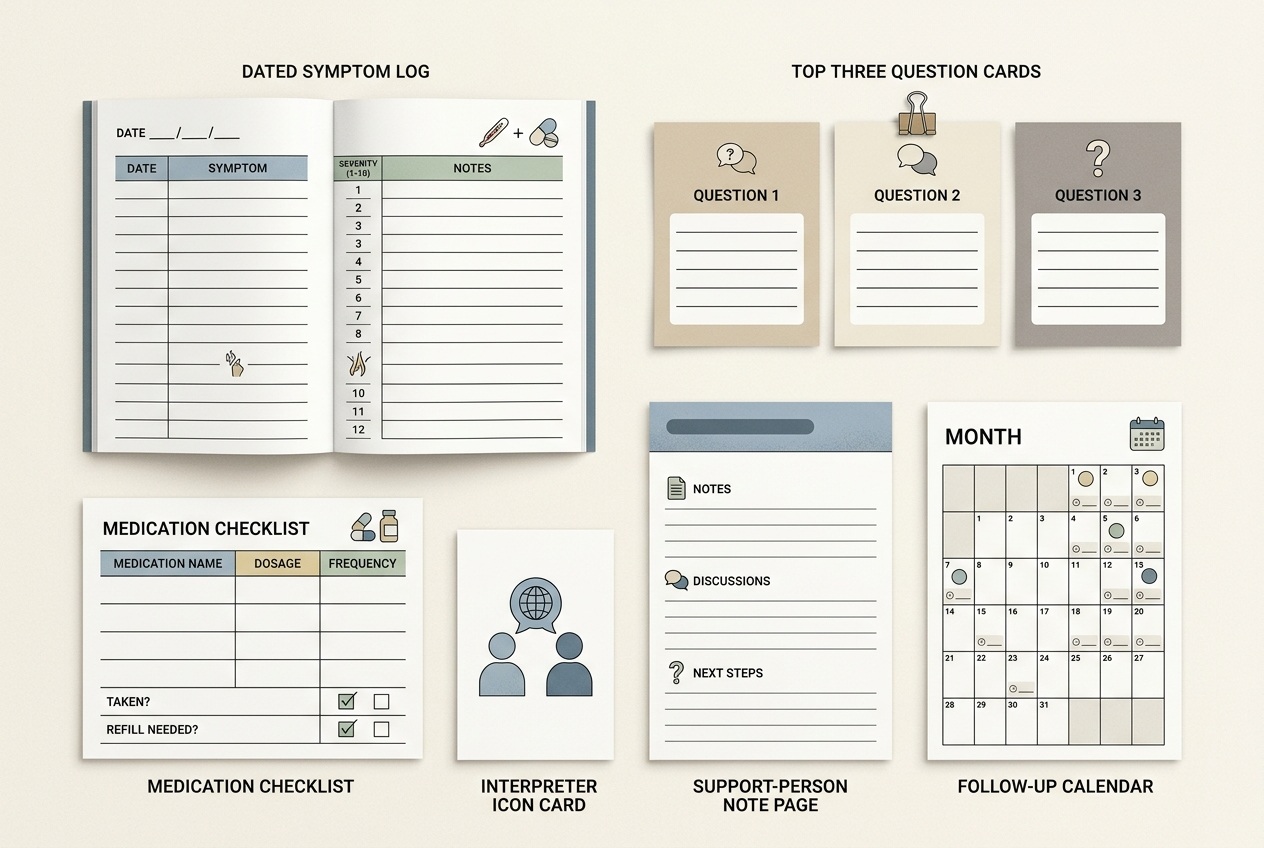
A useful plan names the action, expected timeline, warning signs, and decision point. If the clinician recommends a medication trial, ask which symptom it targets, how long to use it, what side effects matter, and what counts as failure. If the plan is observation, ask when persistence becomes meaningful and whether you should call, message, or schedule. If testing is ordered, confirm who communicates results and what happens if results are normal but symptoms continue. Request the after-visit summary and correct factual errors in the medication list, symptom duration, or history through the office’s established process. The NIA preparation guide recommends bringing records, updating clinicians about health changes, and using a support person for notes when helpful. Best for a complex visit: a written summary with owners and dates. Best for a new symptom during the wait: the office’s escalation instructions. “Come back if worse” becomes useful only when “worse” and the next contact are defined.
When should you request an interpreter, support person, or accommodation?
Request support when language, hearing, vision, memory, anxiety, pain, fatigue, or appointment complexity makes information harder to exchange. Ask the office for a qualified interpreter before the visit rather than relying on a child or an untrained person for sensitive medical details. A trusted adult can take notes, help recall the timeline, and confirm the plan, but you can still request private time with the clinician. Bring hearing aids, glasses, communication devices, or written questions that reduce avoidable friction. Tell the clinician directly what helps: slower speech, face-to-face positioning, plain language, written instructions, or brief pauses. The National Institute on Aging advises requesting an interpreter and explaining hearing or vision needs. Best for language access: a professional interpreter booked in advance. Best for memory or emotional overload: a note-taking support person. Best for sensitive issues: private time plus an interpreter if needed. Accommodation requests are part of accurate communication, not evidence that a symptom is more or less serious.
What can you do if you still feel dismissed?
First, identify the specific gap: Was the symptom history recorded incorrectly, was a warning sign not discussed, was the reasoning unclear, or was there no follow-up plan? State the gap plainly and ask for correction or clarification. If time ended, request a second appointment focused on the unresolved issue. You can also ask whether another clinician, primary-care practice, gastroenterologist, dietitian, pharmacist, or other relevant professional is the better next setting. Obtain copies of visit notes, laboratory results, imaging reports, procedure reports, and medication lists so another clinician sees the same evidence. A second opinion can reassess the pattern without requiring accusations about the first visit. Best for a factual record error: use the health system’s amendment process. Best for persistent unexplained symptoms: a scheduled reassessment with new data. Best for repeated communication failure or loss of trust: another qualified clinician. Emergency warning signs should go to urgent or emergency care rather than waiting for a routine second opinion.
When do digestive symptoms need urgent care instead of a better script?
Communication preparation should never delay urgent assessment. Chest pain, trouble breathing, fainting, confusion, vomiting blood, black or bloody stool, a rigid or very tender abdomen, inability to keep fluids down, severe dehydration, inability to pass stool or gas with swelling, or sudden severe pain needs prompt care. Progressive swallowing difficulty, unintentional weight loss, persistent vomiting, fever, anemia, or rapidly worsening symptoms also deserves timely medical review. For reflux-like symptoms, NIDDK lists chest pain, swallowing problems, painful swallowing, nausea, and possible complication symptoms as reasons to seek medical help. Best for a stable recurring symptom: prepare a timeline for a scheduled visit. Best for a new warning sign: use the urgent pathway your health system provides. Best for uncertainty about immediate risk: contact an emergency service, nurse line, or urgent-care clinician rather than relying on an online checklist. A polished symptom summary helps, but safety takes priority over presentation.
What questions do people ask about being heard at a medical appointment?
Being heard does not require perfect language, medical vocabulary, or a self-diagnosis. The goal is a shared record of what is happening, why it matters, what the clinician thinks, and what comes next. A short written timeline can protect against memory gaps. A prioritized question list can protect the main issue from being left until the final minute. Teach-back can expose misunderstanding before you leave. A support person or interpreter can reduce communication load without replacing your voice. Documentation can preserve normal and abnormal results for the next clinician. A second opinion can be appropriate when symptoms persist, reasoning remains unclear, or trust has broken down. None of these steps guarantees a particular test or diagnosis, but each makes the clinical process easier to evaluate and continue.
Should I bring a symptom diary?
Yes, if symptoms recur. Keep it brief and dated, with timing, location, severity, meals, bowel changes, medicines, associated symptoms, and effect on sleep, work, or eating.
Can I ask for a test directly?
You can ask whether a test fits and what result would change management. Also ask about limitations, risks, cost, alternatives, and what would justify testing later if it is not recommended now.
Should I record the appointment?
Ask permission and follow local law and office policy. Written notes, an after-visit summary, or a support person may provide a simpler record when recording is not permitted.
What if my tests are normal but symptoms continue?
Normal results answer specific questions; they do not erase symptoms. Ask what those results make less likely, what possibilities remain, what to track, and when reassessment or referral becomes appropriate.
Is asking for a second opinion rude?
No. A second opinion is a standard way to revisit diagnosis, testing, or management, especially when symptoms persist or the plan remains unclear. Bring complete records so the review adds information rather than repeating missing history.
How do I correct an inaccurate visit note?
Contact the office or health-information department and ask about the record-amendment process. Identify the exact factual statement, provide the correction and supporting dates, and keep a copy of the request.
Clear symptom descriptions, prioritized questions, complete medication records, and written follow-up criteria can make a medical visit more productive. When communication repeatedly fails, documentation, another focused appointment, or a second opinion can move the process forward without delaying urgent care for warning signs.
Leave a Reply