
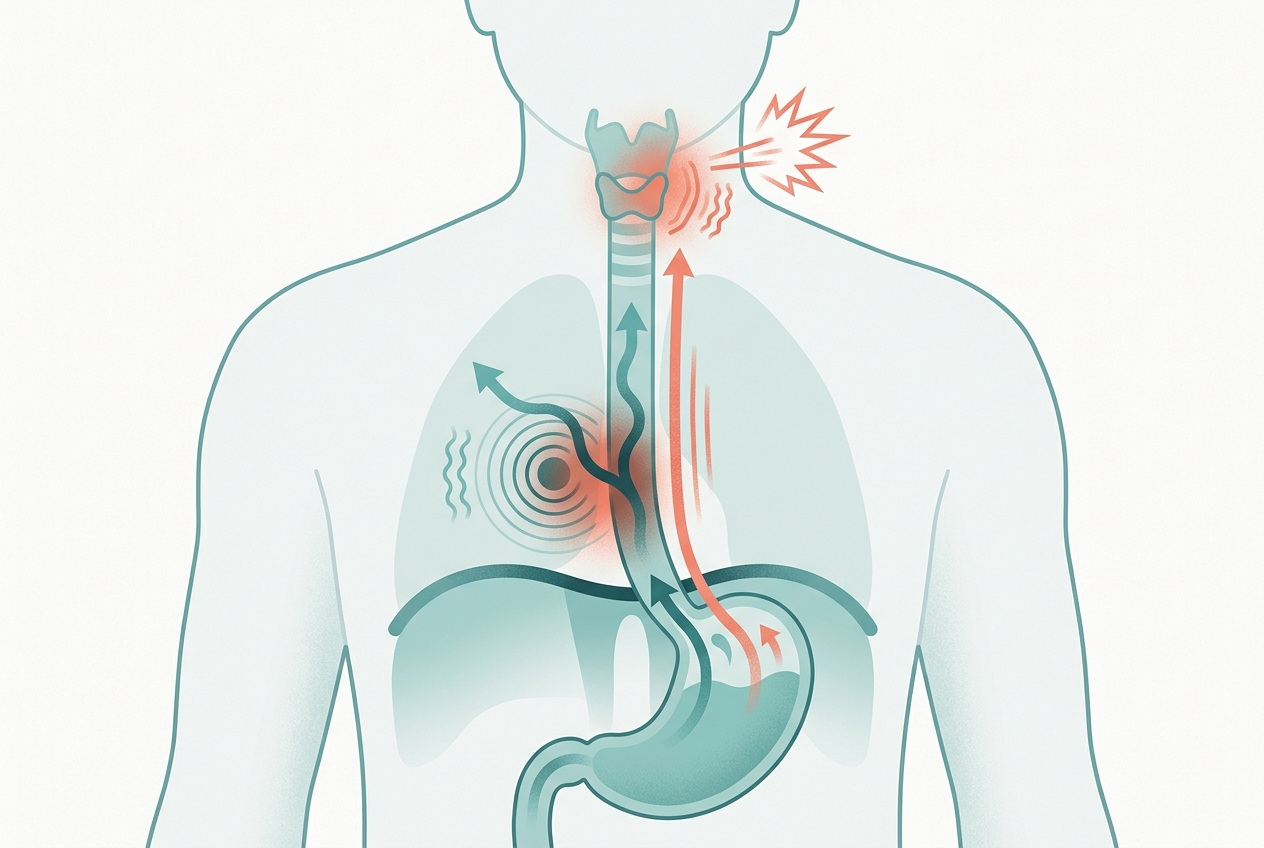
GERD and “silent reflux” describe overlapping but different symptom patterns. GERD commonly causes heartburn or regurgitation in the esophagus. Laryngopharyngeal reflux describes suspected reflux reaching the throat and voice box, where it may coincide with hoarseness, cough, throat clearing, or a lump sensation. Throat symptoms alone do not prove reflux.
How did we evaluate GERD and silent reflux?
We prioritized the American College of Gastroenterology guideline, the 2026 San Diego Consensus on laryngopharyngeal symptoms, National Institute of Diabetes and Digestive and Kidney Diseases guidance, and an otolaryngology professional statement. Guideline-level evidence received more weight than symptom quizzes, throat photographs, food-trigger lists, and personal response to an acid-suppressing medicine. We separated established gastroesophageal reflux disease from laryngopharyngeal symptoms because cough, hoarseness, mucus, globus, and throat clearing have multiple possible causes. We also separated symptom association from objective reflux evidence and avoided treating the label “silent reflux” as a diagnosis by itself. The evidence remains imperfect: no single symptom, examination finding, or short treatment response proves that stomach contents caused an isolated throat complaint. This article therefore compares patterns, tests, and escalation signals rather than assigning a diagnosis from a checklist in ordinary practice.
What is the difference between GERD and silent reflux?
Gastroesophageal reflux disease involves troublesome reflux of stomach contents into the esophagus and commonly produces heartburn or regurgitation. Laryngopharyngeal reflux, often called silent reflux, describes suspected reflux that reaches or affects the larynx and pharynx. The throat-focused pattern may include hoarseness, chronic cough, repeated throat clearing, excess phlegm, globus sensation, or throat pain. The American Academy of Otolaryngology–Head and Neck Surgery notes that only about one-third of people suspected of laryngopharyngeal reflux report classic GERD symptoms, which explains the word “silent” (AAO-HNS). Silence does not mean harmlessness, and throat symptoms do not establish reflux. Allergy, asthma, infection, voice overuse, medication effects, nasal drainage, smoking, dry air, and laryngeal hypersensitivity can create similar complaints. GERD and laryngopharyngeal symptoms can coexist, but one label cannot be inferred automatically from the other. Their mechanisms can also overlap.
Which symptoms point more toward each pattern?
Heartburn behind the breastbone, sour or bitter regurgitation, and symptoms that worsen after meals or when lying down point more directly toward gastroesophageal reflux. NIDDK also lists chest pain, nausea, swallowing difficulty, chronic cough, and hoarseness among possible GERD-associated symptoms, while emphasizing that not every adult has heartburn (NIDDK). Voice change, throat clearing, cough, phlegm, globus, and throat discomfort point toward a laryngopharyngeal symptom cluster, not necessarily toward a reflux cause. The 2026 San Diego Consensus uses “laryngopharyngeal symptoms” as the broader term because these complaints can arise without objective reflux evidence (PubMed). Meal timing, posture, nasal symptoms, voice use, medicines, smoking exposure, and sleep context help distinguish patterns. A dated symptom log creates useful evidence; an isolated sensation does not. The pattern matters when it recurs consistently under similar conditions across multiple days.
Why are throat symptoms difficult to diagnose as reflux?
Throat tissues respond to numerous mechanical, inflammatory, allergic, infectious, and behavioral triggers. A red larynx, morning mucus, intermittent hoarseness, or improvement during acid suppression can therefore support a hypothesis without proving reflux. The American College of Gastroenterology guideline recommends evaluating non-GERD causes before attributing extraesophageal symptoms to reflux and cautions that endoscopy alone cannot establish reflux as the cause of chronic cough, asthma, or laryngopharyngeal symptoms (PubMed). The 2026 San Diego Consensus similarly reports that many people with laryngopharyngeal symptoms lack objective reflux evidence and may need evaluation for laryngeal behavior, respiratory disease, allergy, or another cause. This uncertainty is not dismissal. It is a reason to match the test to the symptom pattern. A throat complaint deserves a throat-aware evaluation, while classic regurgitation deserves an esophageal history and targeted reflux assessment. Diagnostic humility matters.
How can clinicians test GERD and laryngopharyngeal symptoms?
Clinicians often begin with symptom history, medication review, physical examination, and a search for warning signs. NIDDK says esophageal pH monitoring is the most accurate method for detecting acid in the esophagus; catheter-based testing can also assess nonacid reflux, while upper endoscopy evaluates the lining and alternative structural problems (NIDDK). An ear, nose, and throat specialist may use laryngoscopy to inspect the larynx, but nonspecific redness or swelling cannot prove that reflux caused the finding. Gastroenterology testing may include pH or pH-impedance monitoring, endoscopy, and selected motility testing. Best for classic symptoms without alarm signs: a clinician-led initial plan. Best for persistent isolated throat symptoms: evaluation for reflux and non-reflux causes. Best before invasive treatment or prolonged uncertain therapy: objective testing chosen for the actual presentation. Different patterns require different tests and sometimes different specialists.
What low-risk steps can clarify the pattern?
A two-week record can connect symptoms with meals, bedtime, position, voice use, nasal symptoms, caffeine, alcohol, smoking exposure, and medicines without forcing a diagnosis. Record heartburn, regurgitation, cough, hoarseness, throat clearing, globus, swallowing difficulty, and sleep interruption separately. Keep meal size and the meal-to-bed interval visible because a late large meal can differ from a daytime voice-use trigger. Do not eliminate many foods simultaneously; broad restriction can hide the pattern and reduce dietary adequacy. Elevating the upper body during sleep and avoiding lying down soon after eating may fit a nocturnal reflux pattern, while hydration, humidification, allergy review, or voice care may fit a throat pattern. If comparison of retail options becomes appropriate, use a separate evidence-based reflux-options guide rather than stacking products. Change one variable at a time and review persistent symptoms with a clinician.
When should reflux-like symptoms receive prompt medical care?
Chest pressure or pain can overlap with heart and lung emergencies, so new, severe, exertional, or unexplained chest symptoms require urgent assessment rather than self-diagnosis as reflux. NIDDK advises medical care for chest pain, persistent vomiting, swallowing problems, painful swallowing, digestive-tract bleeding, loss of appetite, or unexplained weight loss. Vomit containing blood or material resembling coffee grounds and black, tarry stool are bleeding signals. Progressive food sticking, recurrent choking, dehydration, fainting, severe abdominal pain, or breathing difficulty also warrants prompt attention. Persistent hoarseness requires evaluation, particularly with tobacco exposure, a neck mass, coughing blood, or worsening swallowing. A normal day followed by one sour taste is different from a progressive pattern that affects eating, sleep, breathing, or weight. Warning signs change the decision from “which reflux label fits?” to “which cause needs to be ruled out now?”
What are common questions about GERD and silent reflux?
Can silent reflux occur without heartburn?
Yes. Throat-focused symptoms may occur without heartburn or regurgitation, but the absence of heartburn does not prove that reflux caused the throat symptoms.
Is constant throat clearing proof of silent reflux?
No. Throat clearing can accompany nasal drainage, allergy, asthma, voice strain, dry air, medication effects, laryngeal hypersensitivity, infection, or reflux.
Can GERD and laryngopharyngeal reflux occur together?
Yes. Classic esophageal symptoms and throat symptoms can coexist, and the combined history may influence whether a clinician recommends reflux monitoring or another evaluation.
Does improvement with a proton pump inhibitor confirm reflux?
No. Symptom improvement can be informative, but placebo effects, natural fluctuation, and simultaneous behavior changes prevent a short medication response from proving causation.
Can an ear, nose, and throat examination diagnose silent reflux?
Laryngoscopy can identify inflammation, lesions, vocal-fold problems, and other findings. Its appearance alone generally cannot establish reflux as the cause of nonspecific redness or swelling.
Which specialist evaluates these symptoms?
A primary-care clinician can coordinate the first assessment. Gastroenterologists evaluate esophageal disease and reflux testing, while otolaryngologists evaluate persistent voice, throat, swallowing, and laryngeal symptoms.
What is the bottom line on GERD versus silent reflux?
GERD and silent reflux overlap, but they are not interchangeable diagnoses. Heartburn and regurgitation point more directly toward gastroesophageal reflux, while hoarseness, cough, throat clearing, phlegm, and globus form a laryngopharyngeal symptom cluster with many possible causes. Current guidelines warn against assigning reflux as the cause of isolated throat symptoms without considering alternatives. A useful evaluation separates esophageal symptoms from throat symptoms, records meal and position patterns, reviews medicines and exposures, and chooses testing according to the presentation. Esophageal pH or pH-impedance monitoring can document reflux, endoscopy can evaluate mucosal and structural problems, and laryngoscopy can identify throat findings without proving their cause. Warning signs such as chest pain, bleeding, swallowing difficulty, persistent vomiting, breathing problems, or unexplained weight loss require prompt medical care. The right label follows evidence; it should not precede it.
Leave a Reply