
Feeling unable to finish a morning bowel movement can come from hard stool, rushed timing, weak rectal sensation, or pelvic-floor muscles that do not relax together. Give the urge unhurried time after breakfast, use a footstool, avoid repeated straining, and seek medical evaluation if the pattern persists or includes warning signs.
How did we evaluate incomplete morning bowel movements?
We prioritized gastroenterology and colorectal guidelines that define constipation by stool form, frequency, difficulty, and incomplete evacuation rather than assuming that every daily bowel movement is normal or abnormal. We separated common self-care measures from clinician-directed tests because a bathroom routine cannot identify pelvic-floor dyssynergia, slow transit, a medication effect, or a structural problem. We favored recommendations supported by guideline panels and human motility research, while excluding detoxes, colon cleanses, social-media “emptying” tricks, and fixed claims about how many bowel movements every adult should have. We also treated morning timing as physiology, not proof of disease: colonic activity normally increases after waking and after meals, but work schedules can shorten the available response window. The evidence cannot determine one reader’s cause, so the practical goal is safer pattern tracking, less straining, and timely escalation when symptoms persist or warning signs appear.
What does incomplete evacuation actually mean?
Incomplete evacuation means the person still feels stool remains after a bowel movement, even when some stool has passed. The National Institute of Diabetes and Digestive and Kidney Diseases includes that feeling among constipation features alongside hard or lumpy stool, difficult passage, pain, and fewer than three weekly bowel movements. Frequency alone therefore misses important information: someone can pass stool every morning and still have constipation-related difficulty. Bristol Stool Form Scale types 1 and 2 point toward hard stool, while soft stool plus repeated attempts can suggest poor coordination, heightened rectal sensation, or another evacuation problem. A lingering sensation does not prove that stool is physically trapped, and repeated checking can amplify urgency and strain. Track stool form, time spent, urgency, straining, manual assistance, pain, and whether the sensation resolves later. That record gives a clinician more useful evidence than the statement “I went, but it did not feel complete.”
Why can the problem feel worse before work?
The colon becomes more active after waking and after eating, which makes morning bowel movements common. A review of circadian gastrointestinal physiology reports that colonic contractile activity rises after awakening and that the gastrocolic reflex can trigger an urge after food enters the stomach (PMC). A 2023 review likewise notes that human defecation peaks in the early morning and after meals (Journal of Clinical Investigation review). Work pressure can compress that natural window: skipping breakfast, delaying the urge, rushing, or repeatedly trying “just in case” may disrupt a consistent routine. Anxiety can heighten rectal sensation, but it should not be used to dismiss persistent symptoms. Shift work and irregular wake times can also move the expected pattern. The useful target is not forced emptying before a deadline; it is a repeatable schedule that gives the colon time to respond without prolonged sitting or straining.
What morning routine is reasonable to try first?
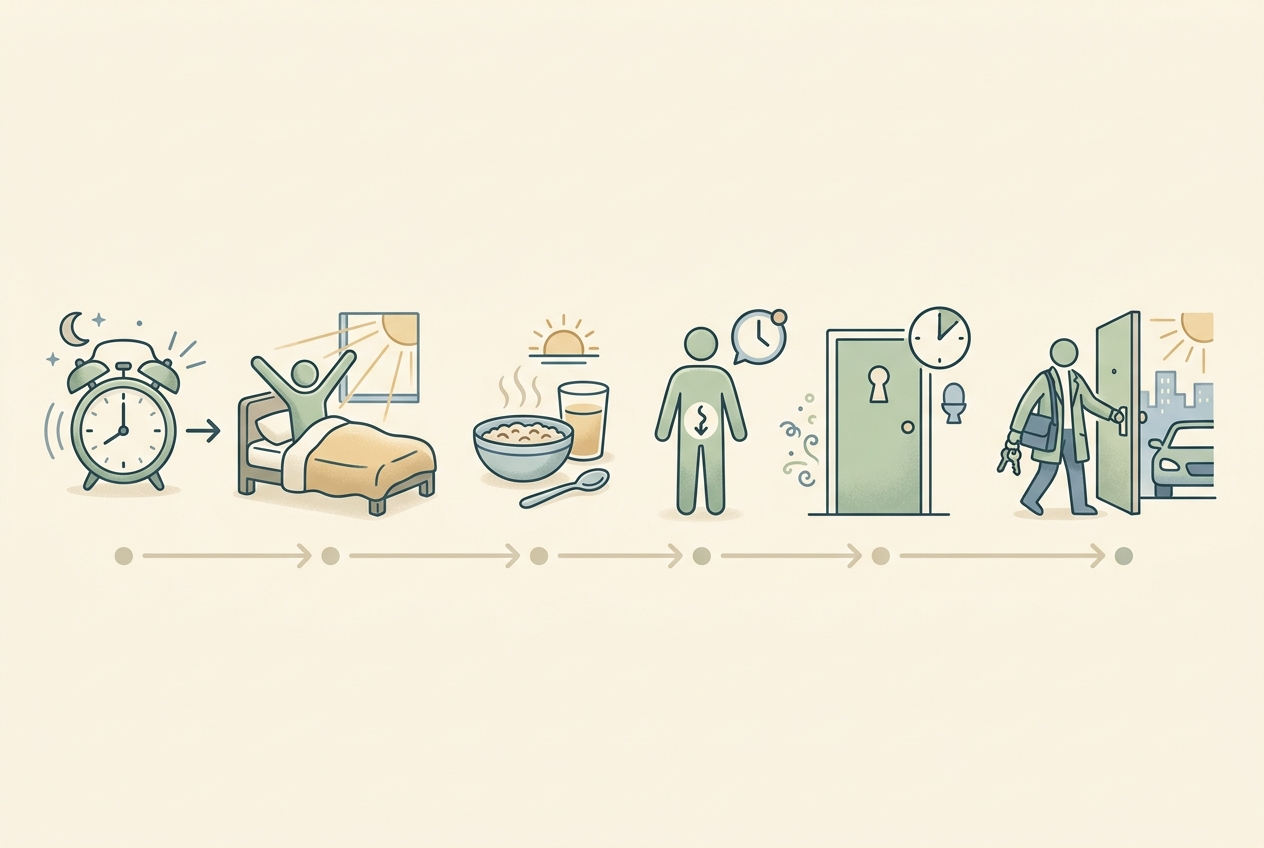
Start with regular wake, meal, fluid, and bathroom timing for one to two weeks while recording the result. Eat breakfast if it suits your health needs, because a meal can activate the gastrocolic response; then allow a short, unhurried bathroom window rather than several forced attempts. Place the feet on a low stool so the knees sit above the hips, lean slightly forward, relax the abdomen, and exhale instead of holding the breath. Leave the toilet if nothing happens after roughly five to ten minutes, because prolonged sitting and repeated straining add pressure without guaranteeing evacuation. Maintain ordinary hydration and increase dietary fiber gradually when appropriate; a sudden large fiber increase can worsen gas or discomfort. The 2024 American Society of Colon and Rectal Surgeons guideline supports dietary measures, adequate fluid intake, and fiber as initial management while recommending further evaluation when those steps fail.
What causes should a clinician consider when the feeling persists?
A clinician can separate stool consistency problems from outlet dysfunction, slow colonic transit, medication effects, and structural conditions. Constipating medicines can include opioids, anticholinergics, some iron or calcium products, and selected antidepressants, but prescriptions should not be stopped without guidance. Pelvic-floor dyssynergia occurs when the muscles needed for evacuation do not relax and coordinate effectively; soft stool does not rule it out. Rectocele, rectal prolapse, painful anal conditions, neurologic disorders, thyroid disease, and metabolic abnormalities can also change evacuation. The 2024 colorectal guideline recommends directed history and examination first, then anorectal physiology testing or dynamic imaging when dietary measures, fiber, and osmotic approaches fail and outlet dysfunction is suspected. A 2026 American Gastroenterological Association update advises evaluation for secondary causes and anorectal manometry with balloon-expulsion testing before labeling many adults as having refractory constipation. Persistent incomplete emptying deserves structured assessment, not endless self-experimentation.
When do pelvic-floor tests or biofeedback make sense?
Testing becomes more useful when soft stool remains difficult to pass, the person strains repeatedly, uses fingers or position changes to evacuate, or fails reasonable stool-softening and routine measures. Anorectal manometry measures rectal sensation, anal pressure, and muscle coordination; a balloon-expulsion test checks whether a small simulated stool can be expelled; defecography shows movement and structure during evacuation. These tests answer different questions and are usually chosen after history and examination. Pelvic-floor biofeedback uses pressure or muscle signals to retrain relaxation and coordinated pushing rather than simply strengthening the pelvic floor. The colorectal guideline considers biofeedback first-line care for symptomatic pelvic-floor dyssynergia, but generic Kegel exercises can be unhelpful when muscles are already overactive. No home symptom pattern confirms dyssynergia by itself. Ask a gastroenterologist, colorectal clinician, or appropriately trained pelvic-floor therapist whether testing fits the pattern, especially when incomplete evacuation continues despite soft, easy-to-pass stool.
What are common questions about incomplete morning evacuation?
These answers focus on observable patterns because the sensation of incomplete emptying has several possible mechanisms. One difficult morning can follow travel, dehydration, sleep disruption, a low-fiber day, stress, or a changed meal schedule; recurrence matters more than a single episode. Stool form and effort provide better clues than clock time alone. Repeated straining, prolonged toilet sitting, frequent suppository use, or manual assistance deserves discussion even when bowel movements occur daily. Keep a seven- to fourteen-day record that includes Bristol stool type, time of day, time on the toilet, urgency, pain, blood, medicines, fiber changes, and whether another bowel movement follows later. Seek prompt medical care for substantial bleeding, black stool, persistent vomiting, severe or worsening abdominal pain, fever, inability to pass stool or gas with swelling, fainting, or dehydration. Arrange non-urgent evaluation for a new persistent change, unexplained weight loss, anemia, nighttime symptoms, or a family history that changes colorectal screening needs.
Is it normal to have more than one bowel movement in the morning?
Yes, more than one morning bowel movement can occur because waking and meals stimulate colonic activity. The pattern matters when repeated trips are urgent, painful, disruptive, or accompanied by ongoing incomplete evacuation.
Should I keep sitting until I feel completely empty?
No. Prolonged sitting and repeated straining do not guarantee emptying and can increase anorectal pressure; leave after a short attempt and return when a natural urge appears.
Can a footstool help with bowel movements?
A footstool can improve posture by raising the knees above the hips and reducing the anorectal angle for some people. It cannot correct hard stool, pelvic-floor dyssynergia, or a structural problem by itself.
Can too much fiber make incomplete evacuation feel worse?
Yes. A rapid fiber increase can add bulk and gas before the bowel adapts, and some evacuation disorders remain difficult even with soft bulky stool; increase fiber gradually when appropriate.
Does coffee help incomplete evacuation?
Coffee can stimulate colonic activity in some adults, but it is not required and may worsen reflux, urgency, anxiety, or sleep. Breakfast and a consistent wake routine can support the morning gastrocolic response without caffeine.
When should I ask about pelvic-floor therapy?
Ask when stool is often soft but difficult to expel, straining is common, position changes or manual assistance are needed, or standard constipation measures have failed. A clinician can decide whether anorectal testing should come first.
What is the bottom line for a workday morning routine?
Morning incomplete evacuation is a constipation symptom, not proof that the bowel must be “fully emptied” before leaving home. Use a consistent wake-and-breakfast schedule, respond to a natural urge, raise the feet, relax the abdomen, limit toilet time, and avoid repeated forceful attempts. Track stool form and effort for one to two weeks so the pattern becomes measurable. Hard stool may respond to gradual dietary changes and guideline-directed constipation care, while soft stool with persistent straining can point toward an evacuation-coordination problem that needs assessment. Do not add multiple fibers, laxatives, suppositories, or supplements at once, because simultaneous changes hide which factor helped or worsened symptoms. Promptly escalate bleeding, black stool, severe pain, vomiting, swelling with inability to pass gas, fainting, or dehydration. Persistent disruption, manual assistance, unexplained weight loss, or failed self-care warrants a clinician’s review and, when appropriate, anorectal testing or pelvic-floor biofeedback.
Leave a Reply