
No. Probiotic supplements and fermented foods serve overlapping but distinct roles in gut health. Fermented foods provide live microorganisms alongside prebiotics, organic acids, bioactive peptides, and nutrients that supplements do not replicate. Supplements deliver specific, researched strains at controlled doses. Neither fully substitutes for the other — they work best as complementary inputs to the gut microbiome.
How we evaluated this question
This article synthesizes evidence from peer-reviewed clinical trials, systematic reviews, and position statements from the International Scientific Association for Probiotics and Prebiotics (ISAPP) and the World Health Organization (WHO). We prioritized human studies over animal or in vitro research. Where evidence is directional rather than conclusive, we note this distinction. This is educational content — it is not medical advice and does not recommend specific products.
What do fermented foods provide that supplements do not?
Fermented foods like yogurt, kefir, kimchi, sauerkraut, miso, and kombucha deliver live microorganisms in a complex food matrix that includes prebiotics, organic acids, vitamins, and bioactive peptides. A 2021 randomized controlled trial published in Cell00754-6) by researchers at Stanford University found that a 10-week high-fermented-food diet increased overall microbial diversity — measured by 16S rRNA gene sequencing — and significantly reduced 19 inflammatory markers including interleukin-6 (IL-6), interleukin-10 (IL-10), and interleukin-12b (IL-12b). Importantly, a high-fiber diet in the same study did not produce the same diversity increase. The Stanford researchers concluded that the microbial diversity benefit was specific to fermented food consumption, not dietary fiber alone.
- The Stanford Cell study (2021) found fermented foods increased microbial diversity and reduced 19 inflammatory markers
- Fermented foods deliver nutrients, prebiotics, and organic acids alongside live microorganisms
- Dietary fiber alone did not replicate the microbial diversity gains from fermented foods
What do probiotic supplements provide that fermented foods do not?
Probiotic supplements deliver specific, identified strains at standardized colony-forming unit (CFU) counts. This precision is the primary advantage over fermented foods, where microbial composition varies by batch, brand, fermentation method, and storage conditions. According to the ISAPP, a probiotic must be a “live microorganism that, when administered in adequate amounts, confers a health benefit on the host” — a definition that requires strain-level identification and dose verification. Commercial fermented foods rarely meet this standard because their microbial content is variable and typically unquantified. For specific clinical outcomes — such as reducing antibiotic-associated diarrhea with Saccharomyces boulardii CNCM I-745 or supporting gut barrier function with Lactobacillus rhamnosus GG — strain-specific supplements provide the dose consistency that clinical trials validated.
- Supplements deliver identified strains at verified CFU counts; fermented foods have variable, unquantified microbial content
- ISAPP defines probiotics by strain identification and adequate dosing — most fermented foods do not meet this standard
- Strain-specific clinical outcomes require the dose consistency that only supplements provide
Can you get enough probiotics from food alone?
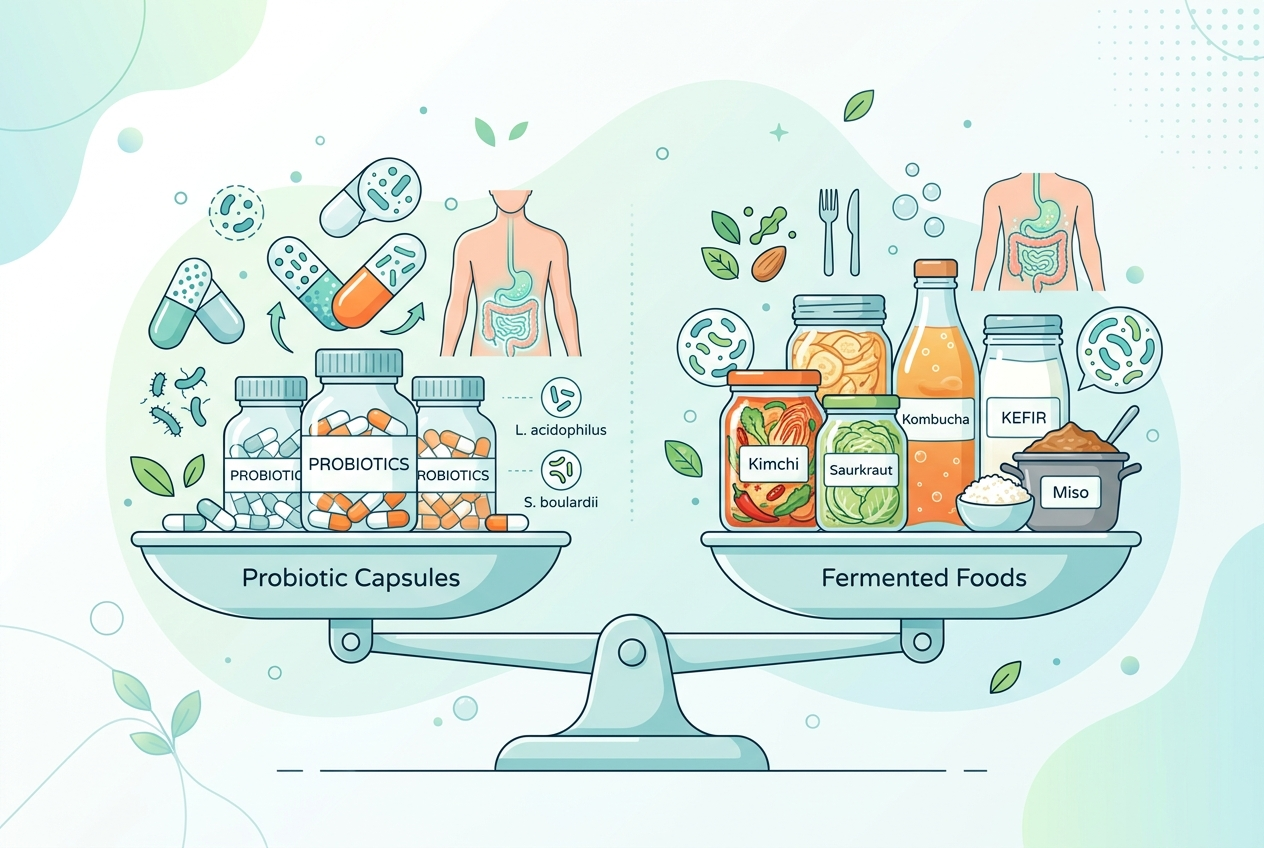
It depends on what outcome you are targeting. For general microbial diversity, the Stanford Cell study suggests that consuming 6 or more servings of fermented foods per day — defined as foods like yogurt, kefir, kimchi, sauerkraut, kombucha, and fermented cottage cheese — can meaningfully increase gut microbiome diversity over 10 weeks. However, a 2019 systematic review published in Nutrients found that the quantity and viability of live microorganisms in commercial fermented foods varies widely. Pasteurized products like most store-bought sauerkraut and pickles contain zero live organisms. Yogurt viability depends on storage temperature and time since manufacture. For people who consume 2-3 servings of genuinely live-culture fermented foods daily, supplementation may provide marginal additional benefit for general gut health.
- 6+ servings of fermented foods per day increased microbial diversity in the Stanford study
- Pasteurized fermented foods (most commercial sauerkraut, pickles) contain zero live microorganisms
- Yogurt viability declines with storage temperature and time since manufacture
What does the research say about combining both?
Preliminary evidence suggests that combining fermented foods with targeted probiotic supplementation may provide broader microbiome support than either alone. The logic is complementary: fermented foods increase overall microbial diversity (a broad benefit), while specific probiotic strains address targeted functions like gut barrier integrity or immune modulation (a narrow benefit). A 2022 narrative review in the British Journal of Nutrition noted that synbiotic approaches — combining probiotics with prebiotics found naturally in fermented foods — produced greater improvements in short-chain fatty acid (SCFA) production than isolated probiotic supplementation. However, the review authors cautioned that large-scale RCTs directly comparing “fermented food + supplement” versus either alone are still limited, and most existing evidence is directional rather than conclusive.
- Fermented foods provide broad diversity; supplements target specific strain-level functions
- Synbiotic combinations (probiotics + food-based prebiotics) increased SCFA production versus supplements alone
- Direct head-to-head RCTs comparing combined approaches are still limited
Which fermented foods contain the most live organisms?
Not all fermented foods are equal in live microbial content. The key distinction is whether the product undergoes pasteurization or heat processing after fermentation, which kills live organisms. The International Scientific Association for Probiotics and Prebiotics distinguishes between foods that contain live microorganisms at the time of consumption and those fermented during production but heat-treated afterward.
| Food | Live at Consumption | Typical Organisms | Key Caveat |
|---|---|---|---|
| Yogurt (with live cultures) | Yes | L. bulgaricus, S. thermophilus | Must say “live and active cultures”; viability declines with age |
| Kefir | Yes | L. kefiri, L. kefiranofaciens, yeasts | Higher diversity than yogurt; variable by brand |
| Kimchi (refrigerated) | Yes | L. plantarum, L. brevis, Leuconostoc | Must be refrigerated and unpasteurized |
| Sauerkraut (refrigerated) | Yes | L. plantarum, L. brevis | Shelf-stable versions are pasteurized (zero live organisms) |
| Kombucha | Yes | Acetobacter, Gluconobacter, yeasts | Microbial content varies widely by brand and batch |
| Miso | Partially | Aspergillus oryzae, Lactobacillus | Cooking above 115°F kills most live organisms |
| Sourdough bread | No | None survive baking | Fermented during production, but baking kills all organisms |
| Most commercial pickles | No | None (vinegar-brined, not fermented) | True fermented pickles exist but are uncommon in stores |
For a detailed comparison of specific products and strains, see Which Probiotic Strains Are Best for Inflammation?.
FAQ
Are all yogurts probiotic?
No. The ISAPP clarifies that yogurt contains live cultures used in fermentation (Lactobacillus bulgaricus and Streptococcus thermophilus), but these are not necessarily “probiotic” strains unless their specific health benefits have been demonstrated in clinical trials. Some yogurts add documented probiotic strains like Bifidobacterium animalis DN-173 010 (used in Activia), which has strain-specific evidence. Look for labels specifying added probiotic strains beyond the standard yogurt cultures.
Do fermented foods work as well as supplements for IBS?
Evidence is mixed. A 2023 systematic review in the American Journal of Gastroenterology found that specific probiotic strains — particularly Bifidobacterium longum 35624 and Lactobacillus plantarum 299v — reduced IBS symptom severity in multiple RCTs. Fermented foods have not been studied with comparable rigor for IBS-specific outcomes. For IBS management, strain-specific supplements currently have stronger evidence than fermented foods.
Can you take too many fermented foods?
Rapid increases in fermented food intake can cause temporary bloating, gas, and digestive discomfort, particularly in people with small intestinal bacterial overgrowth (SIBO) or histamine sensitivity. The Stanford study ramped participants gradually from baseline to 6+ servings per day over several weeks. Starting with 1-2 servings daily and increasing slowly is a common recommendation from gastroenterologists.
Does cooking destroy probiotics in fermented foods?
Yes. Heating fermented foods above approximately 115°F (46°C) kills most live microorganisms. This is why miso soup, cooked kimchi, and sourdough bread contain no live organisms despite being fermented products. To preserve live cultures, consume fermented foods cold or add them after cooking.
Are refrigerated supplements better than shelf-stable ones?
Not automatically. Refrigerated supplements use strains (primarily Lactobacillus and Bifidobacterium) that require cold storage to maintain viability. Shelf-stable supplements typically use spore-forming strains like Bacillus coagulans GBI-30 6086, which are naturally heat-resistant. The relevant question is whether the CFU guarantee at expiration is verified, regardless of storage method.
What is the difference between fermented and cultured foods?
All cultured foods are fermented, but not all fermented foods are cultured. “Cultured” specifically means that known, intentional starter cultures were added (as in yogurt or kefir). “Fermented” can also include wild fermentation using naturally present organisms (as in sauerkraut or traditional kimchi). Both methods produce live microorganisms, but cultured products tend to have more predictable microbial composition.
Do fermented foods contain prebiotics?
Some do. Fermented vegetables like kimchi and sauerkraut retain dietary fiber that acts as a prebiotic, feeding gut bacteria in addition to delivering live organisms. Kefir contains kefiran, a polysaccharide with documented prebiotic properties. This dual delivery of live organisms plus prebiotic substrate is one of the key advantages fermented foods hold over isolated probiotic supplements.
Leave a Reply