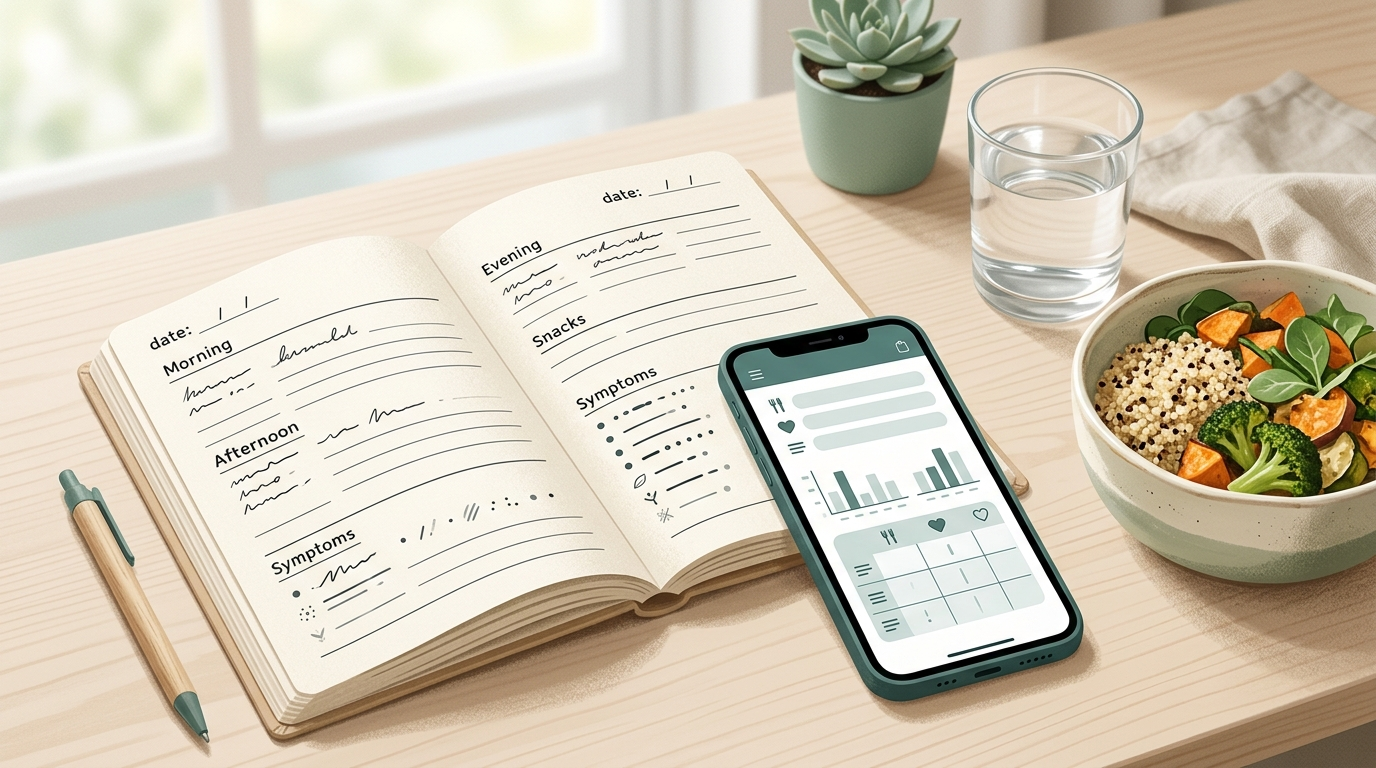
A free food-and-symptom tracker can be a paper diary, phone note, or spreadsheet. Record meal time, ingredients, approximate amount, symptoms, bowel pattern, medicines, sleep, stress, and menstrual timing when relevant. Track consistently before removing foods. A diary can reveal repeatable patterns, but it cannot diagnose an allergy, intolerance, or digestive disorder by itself.
How did we evaluate free food-symptom tracking methods?
We evaluated tracking methods by asking whether they capture enough detail to test a repeatable pattern without making daily logging burdensome. We prioritized guidance from the National Institute of Diabetes and Digestive and Kidney Diseases, the National Institute of Allergy and Infectious Diseases food-allergy guideline, and clinical references on food-and-symptom diaries over commercial sensitivity tests or automated trigger scores. We excluded any tool that labels a food as an allergy from correlation alone, encourages multiple long-term eliminations without reintroduction, hides the raw entries, or asks users to change several variables at once. No tracking format has been proven universally superior, so this method ranks completeness, repeatability, exportability, privacy, ease of use, and a defined review date; a clinician or registered dietitian should interpret persistent symptoms, nutritional risk, suspected allergy, or severe reactions.
What should a useful food-and-symptom diary record?
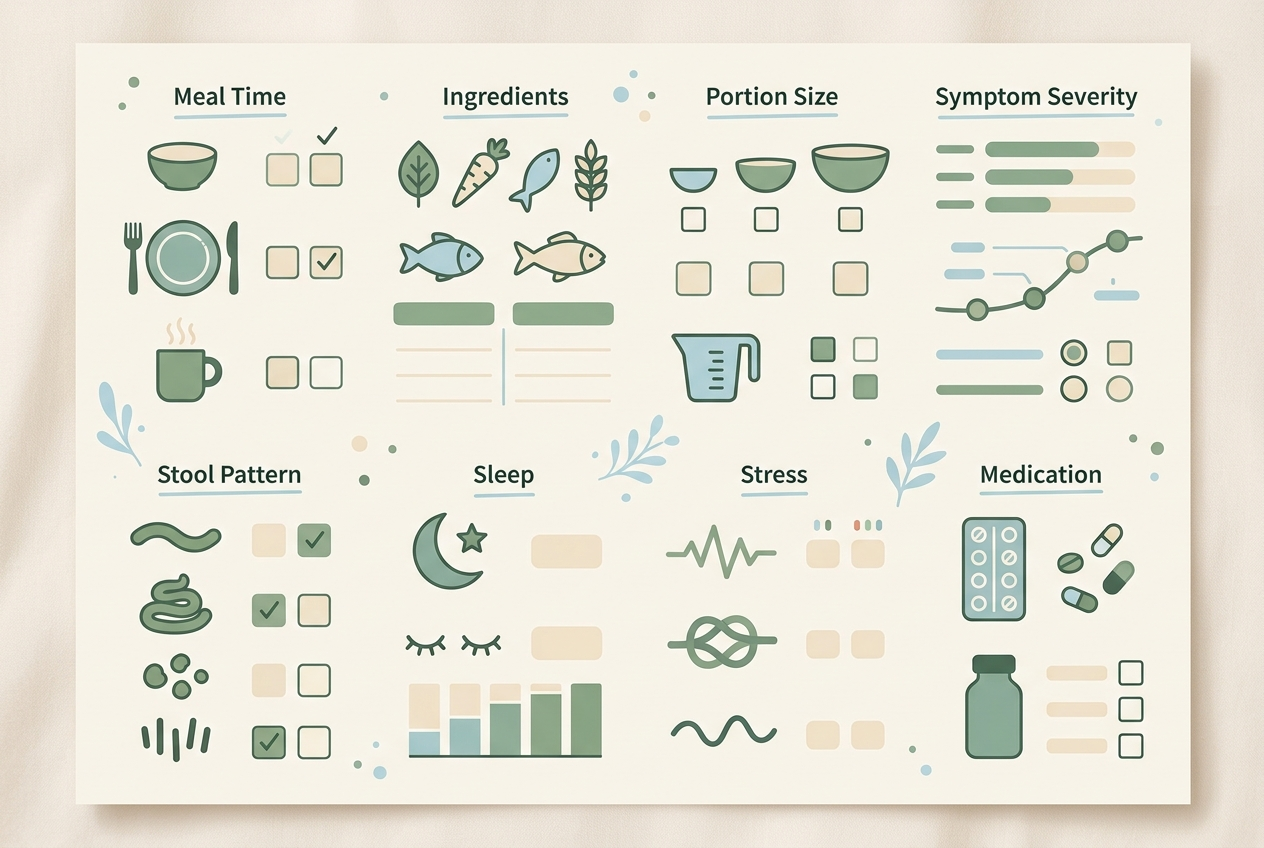
A useful diary records time before it records theories. For each meal or snack, note the clock time, ingredients, approximate portion, preparation method, drinks, and any unusually large amount of fat, fiber, caffeine, alcohol, or sugar alcohols. Record symptoms separately with onset time, location, severity on a consistent 0–10 scale, and duration. Bowel entries can use the seven-type Bristol Stool Form Scale plus urgency and frequency. Context variables matter because sleep, stress, exercise, menstruation, travel, illness, and medicines can alter digestion independently of food. Write exact observations such as “cramping began 90 minutes after lunch” instead of conclusions such as “wheat allergy.” A free spreadsheet works well when rows represent events and columns represent variables; a phone note or paper page works when it is completed more reliably. Consistent, modest detail produces more useful evidence than an elaborate diary abandoned after two days.
How can tracking avoid false food-trigger conclusions?
False conclusions arise when a diary records only the suspected food and ignores dose, timing, meal combinations, or non-food variables. One uncomfortable evening after onions does not establish that onions caused the symptom. Look for the same exposure followed by a similar symptom across separate days, then check whether the pattern disappears on days without that exposure. Consider total meal size, fat content, fiber dose, carbonated drinks, caffeine, sleep loss, stress, and menstrual timing before isolating one ingredient. Delayed symptoms also make memory unreliable, which is why timestamps matter. The NIAID-sponsored guideline reports that many self-reported food allergies do not hold up when formally evaluated. A diary creates a hypothesis for professional review; it does not confirm immune-mediated allergy. Avoid algorithmic certainty scores that cannot show how they weighted missing entries, co-occurring foods, or days when the suspected food caused no symptoms.
How long should someone track before changing the diet?
Two weeks of ordinary eating often captures weekday, weekend, and routine variation without creating an endless surveillance project. Track longer when symptoms are infrequent, but choose a review date before starting. The goal is a sufficient sample of exposures and non-exposures, not a perfect record of every bite. Do not remove several foods during the baseline period unless a clinician has already advised avoidance, because simultaneous changes erase the comparison. When one plausible pattern emerges, discuss a time-limited, one-variable test and a planned reintroduction with a qualified professional. NIDDK notes that dietary changes may need several weeks to evaluate and recommends dietitian involvement for structured approaches such as a low-FODMAP diet. A tracker should become simpler after it answers the defined question. If no repeatable pattern appears, that result is useful: it argues against blaming a single ingredient and supports a broader medical, medication, bowel-pattern, or lifestyle review.
When is self-tracking the wrong next step?
Self-tracking is the wrong next step when symptoms suggest an urgent allergic or medical problem. Trouble breathing, throat or tongue swelling, faintness, widespread hives, or a rapidly worsening reaction requires emergency care rather than another diary entry. Blood in stool, black stool, persistent vomiting, dehydration, fever, severe or localized abdominal pain, unexplained weight loss, anemia, nighttime symptoms, or a major change in bowel habits also warrants clinical assessment. A food diary should not delay testing for celiac disease, inflammatory conditions, infection, medication effects, or other causes. Avoid starting a gluten-free diet before celiac testing unless a clinician directs it, because removing gluten can alter diagnostic results. Children, pregnant people, older adults, and anyone with a history of an eating disorder or nutritional deficiency need extra caution with restriction. A free tracker is useful for stable, non-urgent pattern collection; it is not a safety screen or diagnostic substitute.
How should someone review the diary without over-restricting food?
Review the diary on a scheduled day instead of reacting after every uncomfortable meal. Count exposures to the suspected food, symptom-positive exposures, symptom-free exposures, typical onset time, and whether the relationship changes with portion size. Compare the candidate trigger with context variables such as sleep, stress, constipation, menstrual timing, meal size, and medicines. Prioritize one testable question, for example whether a large milk serving repeatedly precedes symptoms while smaller servings do not. The NCBI food-allergy overview explains that diaries can support evaluation, while supervised testing is often needed to confirm allergy. A registered dietitian can protect nutrient adequacy and design reintroduction when restriction is justified. Keep tolerated foods in the diet. The most informative outcome may be a threshold, preparation method, or meal combination rather than complete avoidance. Broad, permanent restriction based only on a software correlation creates more certainty than the data can support.
What should a free tracker template look like?
Use one row per meal, symptom, bowel movement, medicine, or major context event. Recommended columns are date, time, event type, food or drink, ingredients, approximate amount, preparation, symptom, severity 0–10, onset, duration, stool type, urgency, sleep, stress, exercise, menstrual timing, and notes. Keep the raw data visible and editable. A daily summary can add total fiber changes, unusually large meals, hydration, and the day’s main symptom, but it should not replace event-level timestamps. Color can improve scanning, yet automatic red “trigger” labels should remain off until a repeatable pattern is reviewed. Store only the health information needed for the project, use device security, and remove names or identifiers before sharing. Export the relevant date range as a simple document for an appointment. A useful free template makes uncertainty visible, including blank cells, symptom-free exposures, and days when the suspected food was absent.
What do people ask about food-and-symptom trackers?
Can a diary diagnose a food intolerance?
No. A diary can show a reproducible association and help a clinician choose the next test. Diagnosis depends on the condition and may require history, laboratory testing, breath testing, or supervised elimination and reintroduction.
Should every ingredient be logged?
Record enough detail to distinguish plausible exposures, especially sauces, sweeteners, dairy, wheat, onions, garlic, caffeine, and alcohol. Do not let perfection make the diary unusable; consistency matters more than reconstructing every trace ingredient.
Is a symptom score useful?
Yes, when the same 0–10 definition is used each time. Pair severity with onset and duration, because a number without timing cannot establish a meal relationship.
Should several foods be eliminated at once?
Usually not without professional guidance. Multiple simultaneous eliminations obscure which change mattered and can reduce fiber, calcium, energy, or overall dietary variety.
What if every meal seems to cause symptoms?
That pattern weakens the case for one specific food and raises questions about meal size, bowel motility, medication effects, constipation, visceral sensitivity, or another condition. A clinician should review persistent meal-linked symptoms.
How should the diary be shared at an appointment?
Bring a concise date range, a one-paragraph question, and the raw entries behind any summary. Highlight repeatable exposures and symptom-free counterexamples instead of presenting an app-generated diagnosis.
What is the bottom line for tracking food symptoms for free?
Choose the simplest tool you will complete: paper, a phone note, or a spreadsheet. Record timestamps, ingredients, portions, symptom severity, onset, duration, bowel pattern, medicines, sleep, stress, exercise, and menstrual timing when relevant. Keep ordinary eating stable long enough to observe a baseline, then review repeatable exposures and symptom-free counterexamples on a scheduled date. Do not let software convert correlation into an allergy label. Test one variable at a time only when the question is safe, specific, and compatible with nutritional needs, and plan reintroduction before restriction begins. Seek urgent care for breathing difficulty, swelling, faintness, blood in stool, dehydration, severe pain, or rapidly worsening symptoms. Use the diary as organized evidence for a clinician or registered dietitian, not as permission to remove an expanding list of foods. A good tracker narrows uncertainty; it does not manufacture certainty.
Leave a Reply