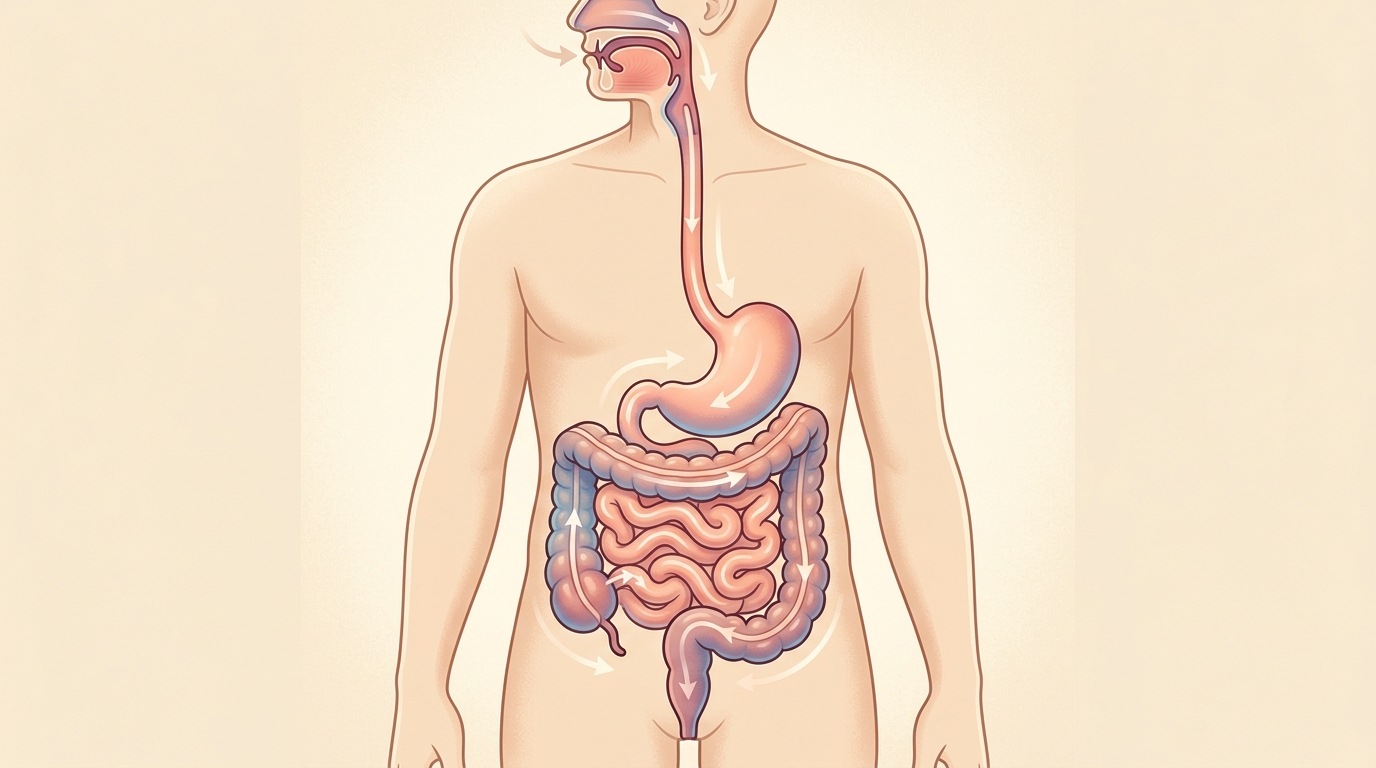
Digestion is a coordinated process that moves food, mechanically breaks it apart, chemically converts carbohydrates, proteins, and fats into absorbable units, transfers nutrients into blood or lymph, recovers water, and removes waste. The mouth, stomach, small intestine, pancreas, liver, gallbladder, colon, nerves, hormones, and gut microbes each perform distinct jobs.
How did we evaluate the current understanding of digestion?
We evaluated digestion as a sequence of measurable physiological functions rather than as a single event in the stomach. We prioritized the National Institute of Diabetes and Digestive and Kidney Diseases, National Library of Medicine reviews, and established human anatomy and physiology over commercial explanations, detox language, or microbiome speculation. We separated mechanical actions such as chewing and muscular mixing from chemical actions involving hydrochloric acid, bile, bicarbonate, and named enzymes, then distinguished digestion from absorption and waste formation. This framework is simplified because meal composition, nervous-system signaling, hormones, intestinal transit, and microbial metabolism overlap in real time. It still reflects the central scientific model: organs move food, enzymes and secretions reduce large molecules, intestinal cells transport usable components, the colon recovers water and handles undigested material, and coordinated control systems adjust the process from one meal to the next.
What happens to food in the mouth, esophagus, and stomach?
Chewing first reduces food into smaller particles, while saliva moistens the food and salivary amylase begins starch digestion. Swallowing moves the resulting bolus through the esophagus by peristalsis, a coordinated wave of smooth-muscle contraction rather than a simple fall caused by gravity. The lower esophageal sphincter opens, the stomach receives the bolus, and three muscle layers churn it with gastric secretions. Hydrochloric acid creates an acidic environment, pepsin starts protein digestion, gastric lipase contributes limited fat digestion, and protective mucus helps shield the stomach lining. An NCBI Bookshelf review describes the stomach as a reservoir that releases the partly processed mixture, called chyme, through the pyloric sphincter in controlled portions. The stomach does not absorb most nutrients. Its principal jobs are storage, mechanical mixing, chemical preparation, microbial defense, and paced delivery to the duodenum.
How does the small intestine digest and absorb most nutrients?
The duodenum receives acidic chyme, pancreatic bicarbonate, pancreatic enzymes, and bile delivered from the liver and gallbladder. Bicarbonate raises the pH, bile disperses fat into smaller droplets, pancreatic amylase continues carbohydrate digestion, proteases split proteins, and pancreatic lipase acts on fats. Brush-border enzymes on intestinal cells finish several reactions, including the breakdown of lactose, sucrose, maltose, and small peptides. The jejunum and ileum then absorb monosaccharides and amino acids mainly into blood, while many fat-derived molecules enter lymph before reaching circulation. Villi and microvilli create a large absorptive surface, and specific transport proteins move different nutrients across intestinal cells. A National Library of Medicine physiology review explains that digestion requires both mechanical and chemical processes, with most chemical digestion occurring in the small intestine. Vitamins, minerals, electrolytes, and water use their own transport routes, so “absorption” is not one universal pathway.
What do the pancreas, liver, gallbladder, nerves, and hormones control?
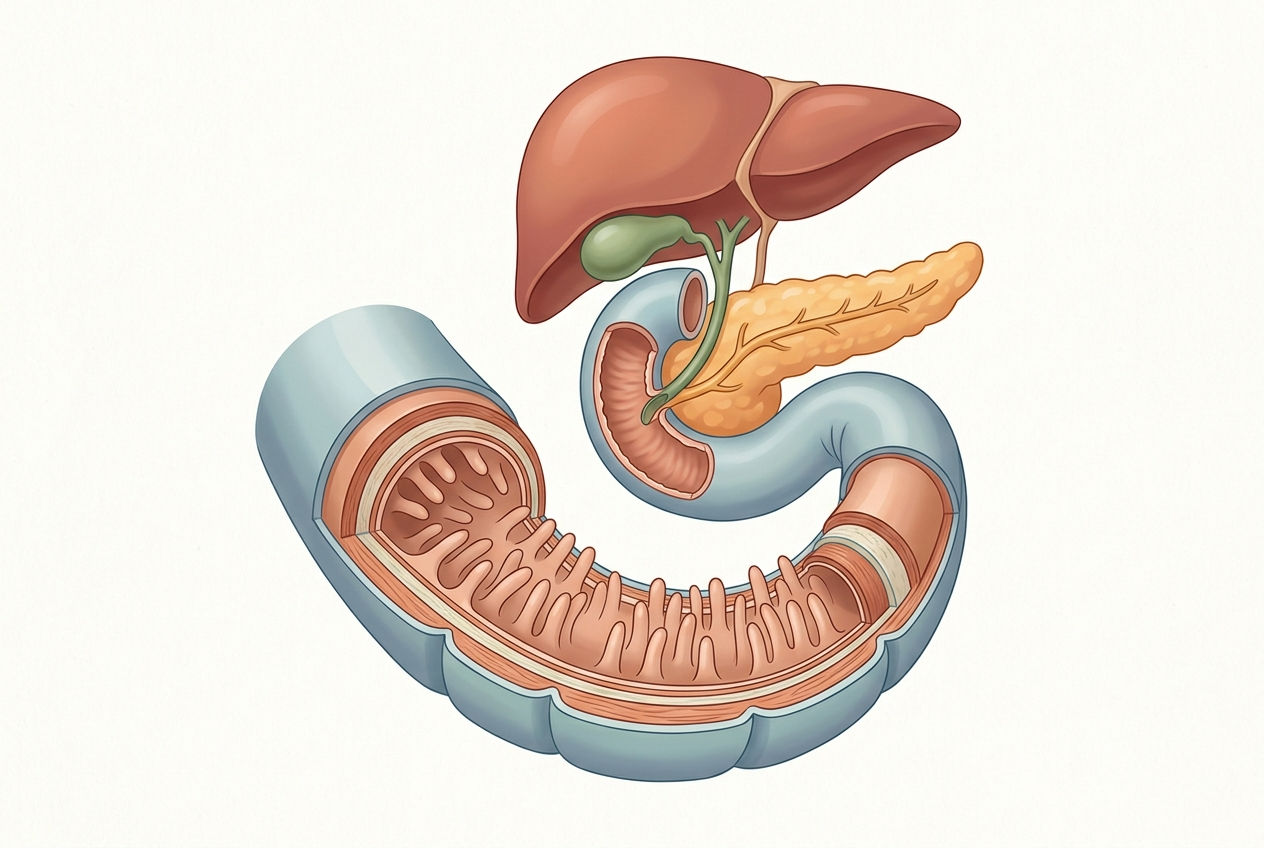
The pancreas supplies bicarbonate plus enzymes that act on carbohydrates, proteins, fats, and nucleic acids. The liver produces bile, the gallbladder stores and concentrates it, and the duodenum receives bile when a meal calls for fat handling. These accessory organs assist digestion even though food does not pass through them. The enteric nervous system coordinates local movement and secretion, while the brain, vagus nerve, and spinal pathways modify appetite, swallowing, motility, and sensation. Hormones add another control layer: gastrin supports gastric secretion, secretin promotes pancreatic bicarbonate, and cholecystokinin promotes pancreatic enzyme release and gallbladder contraction. The NIDDK overview of the digestive system describes nerves, hormones, bacteria, blood, and digestive organs as a working network. Digestion therefore changes with meal composition, stress state, medications, sleep timing, and prior intake because the control system continually adjusts rather than running at one fixed speed.
What happens in the large intestine and gut microbiome?
Material entering the large intestine includes water, electrolytes, fiber, resistant starch, microbial cells, shed intestinal cells, and compounds that escaped small-intestinal absorption. The colon absorbs additional water and electrolytes while muscular contractions mix and propel the contents toward the rectum. Gut microbes ferment some undigested carbohydrates and produce gases plus metabolites such as short-chain fatty acids. Human colon cells can use butyrate, one short-chain fatty acid, as an energy source, but microbial effects vary by substrate, community composition, transit time, and host physiology. Stool forms from water, bacteria, undigested material, cellular debris, and secretions; it is not simply “toxins” waiting to leave the body. The NIDDK gas resource explains that large-intestinal bacteria create gas when they break down carbohydrates that the stomach and small intestine did not fully digest. Some gas is therefore a normal consequence of microbial metabolism.
Why can the same food feel different from one day to the next?
Digestion reflects both the food and the condition of the digestive system when the meal arrives. Portion size changes stomach distention and emptying; fat, protein, fiber, and particle size change how quickly contents move; fluid intake affects stool consistency; and a previous meal can influence the next digestive response. Stress and sleep can alter autonomic signaling, sensation, and bowel patterns without changing the chemical composition of the food. Menstrual-cycle hormones, physical activity, medicines, alcohol, caffeine, and acute illness can also change motility or sensitivity. The gut microbiome responds to available substrates, but one uncomfortable meal does not prove that a microbial imbalance caused the symptom. A useful observation separates sensation from mechanism: bloating is a feeling of fullness, distention is measurable expansion, reflux is upward movement of stomach contents, and constipation describes stool frequency or passage difficulty. Repeated patterns provide more information than isolated reactions, especially when recorded with meal timing, ingredients, symptoms, and stool form.
What questions do people commonly ask about digestion?
Does digestion begin in the stomach?
No. Chewing and salivary amylase begin mechanical and chemical digestion in the mouth before swallowing moves food to the stomach. Saliva also lubricates food.
Is stomach acid always harmful?
No. Hydrochloric acid supports protein digestion and microbial defense, while mucus and bicarbonate protect the stomach lining from that acidic environment. Both functions matter.
Does the body absorb nutrients in the stomach?
The stomach absorbs only limited substances. The small intestine performs most nutrient absorption through villi, microvilli, enzymes, and specialized transport proteins. Different nutrients use different routes.
Do gut bacteria digest all food?
No. Human enzymes handle most digestible macronutrients, while colon microbes ferment selected carbohydrates and other material that reaches the large intestine. Their outputs depend on available substrates.
Is gas proof that digestion failed?
No. Some gas results normally from swallowed air and microbial fermentation, although persistent or changing symptoms can warrant medical evaluation. Pattern and context matter.
How long does digestion take?
There is no single universal time. Meal composition, stomach emptying, small-intestinal transit, colon transit, medicines, activity, and individual physiology all affect timing. Transit varies within one person.
Leave a Reply