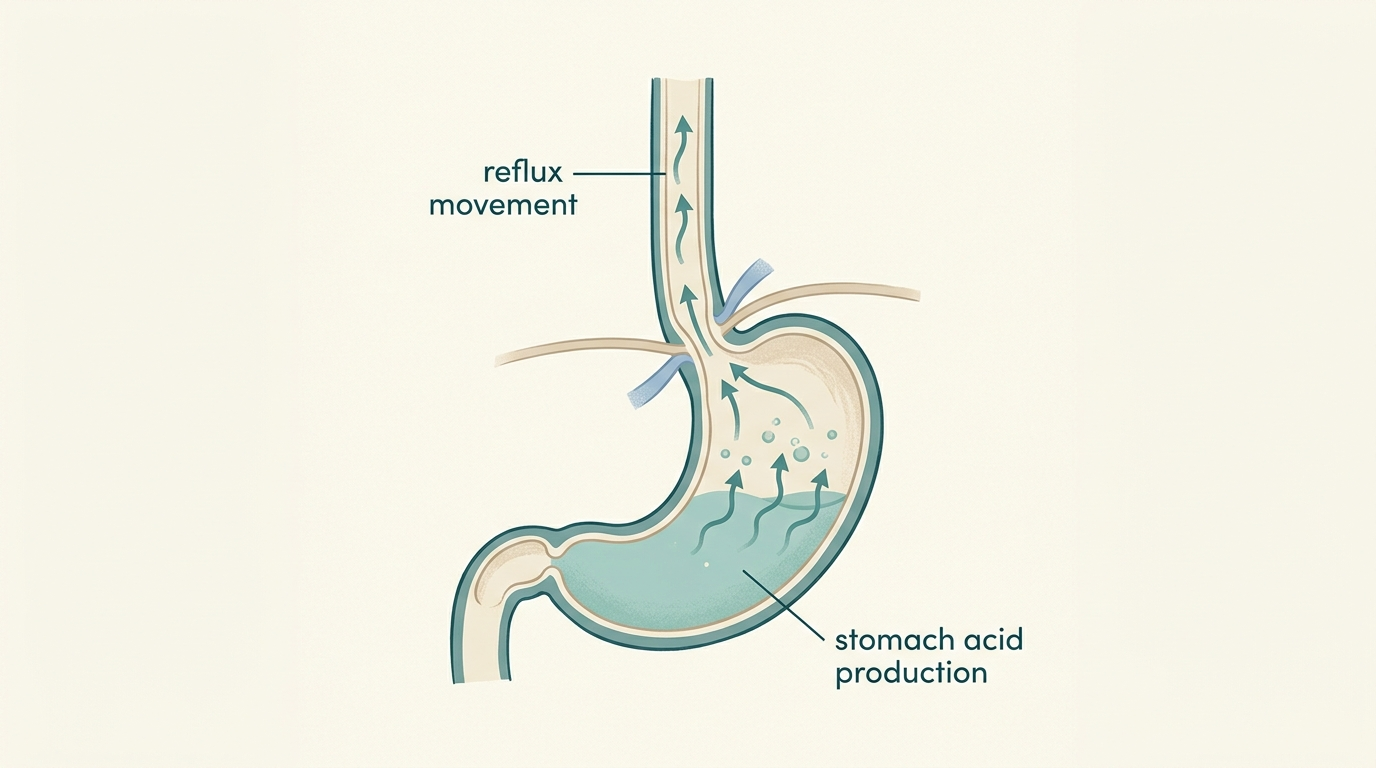
Symptoms cannot reliably tell you whether stomach acid is “too high” or “too low.” Burning, belching, fullness, nausea, and regurgitation can come from reflux mechanics, delayed emptying, functional dyspepsia, medicines, gastritis, or other causes. Avoid self-testing with vinegar or betaine hydrochloride; use a clinician’s history, medication review, and targeted testing when symptoms persist.
How did we evaluate low versus high stomach acid?
We evaluated the question by separating gastric acid production from reflux into the esophagus, because those processes are often confused online. National Institute of Diabetes and Digestive and Kidney Diseases guidance and American College of Gastroenterology guidelines received the most weight for reflux symptoms, diagnosis, and pH monitoring. An American Gastroenterological Association expert review informed the discussion of atrophic gastritis, Helicobacter pylori, and reduced acid production. We excluded the baking-soda timing test, vinegar response, burp tests, and supplement-response quizzes because they have not been validated as diagnostic tools. We also excluded the claim that one symptom proves either high or low acid. This framework has limits: a medical history can guide the next step, but endoscopy, biopsy, H. pylori testing, blood tests, or ambulatory reflux monitoring may be needed for a specific person. New chest pain or alarm symptoms require clinical assessment, not an online acid label.
Why can low and high stomach-acid stories sound so similar?
The same sensation can arise from different mechanisms. Heartburn describes burning behind the breastbone, while regurgitation describes stomach contents moving into the throat or mouth. Neither symptom directly measures how much acid the stomach produces. A weak or inappropriately relaxing lower esophageal sphincter can allow normal stomach contents to reflux upward. Reduced gastric acid, called hypochlorhydria, can occur with acid-suppressing medicine, autoimmune atrophic gastritis, or some patterns of H. pylori gastritis, but symptoms such as fullness, nausea, or belching remain nonspecific. Functional dyspepsia, constipation, swallowed air, food intolerance, and delayed gastric emptying can create similar discomfort without proving either acid state. The NIDDK symptom guide defines reflux through movement of stomach contents and lower-esophageal-sphincter function, not simply “too much acid.” Symptom overlap explains why a person may feel worse after an acidic drink without learning whether gastric acid production is high, low, or normal.
Does acid reflux mean your stomach makes too much acid?
Acid reflux does not automatically mean the stomach overproduces acid. Gastroesophageal reflux occurs when stomach contents cross into the esophagus, where the lining is less protected from acid exposure. The mechanical barrier includes the lower esophageal sphincter and diaphragm; meal size, body position, pregnancy, body weight, smoking, and some medicines can affect that barrier. Acid-suppressing drugs can reduce the acidity of refluxate and improve symptoms even when baseline production was not abnormally high. That treatment response is useful clinically, but it does not prove the original cause. The American College of Gastroenterology GERD guideline notes that persistent symptoms can involve ongoing acid reflux, weakly acidic reflux, nonacid reflux, reflux hypersensitivity, or another disorder. This distinction matters because escalating acid suppression, adding hydrochloric acid, or changing several products at once can obscure the pattern. Reflux is an exposure problem; gastric acid output is a production question. They overlap, but they are not synonyms.
How do clinicians distinguish reflux from reduced gastric acid?
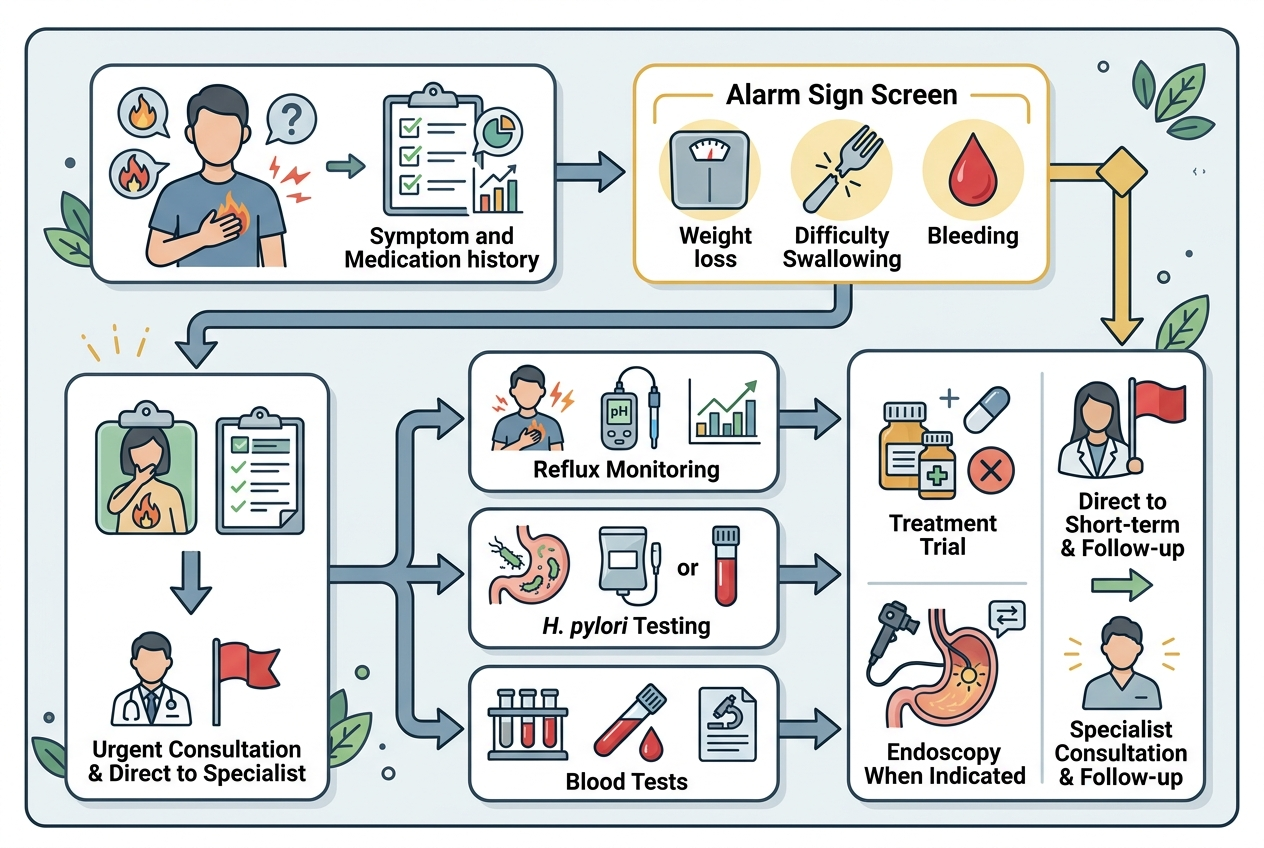
Clinicians start carefully with symptom timing, swallowing problems, medicines, prior stomach surgery, anemia history, weight change, diet, and family history. For suspected GERD, upper endoscopy can identify esophagitis or another structural problem, while ambulatory esophageal pH or pH-impedance monitoring measures when acid and nonacid material enter the esophagus. The NIDDK diagnosis guide describes esophageal pH monitoring as the most accurate method for detecting stomach acid in the esophagus. That test does not directly diagnose low gastric acid. Suspected atrophic gastritis may instead prompt blood counts, iron or vitamin B12 assessment, H. pylori testing, antibodies, endoscopy, and gastric biopsies. The AGA atrophic-gastritis review emphasizes histologic confirmation and evaluation for H. pylori. Best for confirming reflux: ambulatory reflux monitoring when indicated. Best for suspected gland loss: endoscopy with biopsies. Best for H. pylori: an appropriate breath, stool, or biopsy test.
Which do-it-yourself acid remedies should you avoid?
Avoid using symptom provocation as a home diagnosis. Apple-cider vinegar or lemon juice can irritate the mouth, teeth, throat, or esophagus and may worsen burning without revealing gastric acid output. Betaine hydrochloride adds acid and can be risky when someone has an ulcer, inflamed esophagus, gastritis, or uses medicines that affect bleeding or the stomach lining. Baking-soda burp timing is not a validated measure of stomach pH because swallowing technique, meal contents, gastric emptying, and ordinary air all change the result. Do not stop a proton pump inhibitor abruptly or add hydrochloric acid to “cancel it out” without discussing the plan with the prescriber. Rebound acid secretion can occur after acid suppression, and a symptom flare after stopping a medicine does not prove lifelong overproduction. Antacids, H2 blockers, proton pump inhibitors, alginates, and clinician-directed eradication therapy solve different problems. The safest experiment changes one low-risk behavior at a time while preserving a record of meals, timing, position, medicines, and symptoms.
What can you do safely while you arrange an evaluation?
Use measures that do not depend on guessing an acid level. Record meals, drinks, medicines, supplements, body position, sleep, bowel patterns, and symptom timing for one to two weeks. Smaller meals, slower eating, avoiding lying down for several hours after eating, and identifying personal triggers can reduce reflux exposure for some people without claiming to change acid production. Review over-the-counter medicines with a pharmacist, especially nonsteroidal anti-inflammatory drugs, iron, potassium, antibiotics, and products that irritate the upper digestive tract. Continue prescribed medicines unless the prescriber gives a change plan. Ask what question each test is meant to answer: reflux exposure, H. pylori, anemia, vitamin B12 status, stomach-lining changes, swallowing function, or delayed emptying. The best next step is mechanism-specific. Repeated regurgitation points toward reflux evaluation; unexplained anemia or vitamin B12 deficiency may justify a different workup; persistent post-meal fullness may require assessment beyond acid. A clean symptom log improves the visit without pretending to diagnose the cause.
When do upper-digestive symptoms need prompt care?
Seek urgent care for chest pressure or pain, trouble breathing, fainting, vomiting blood, material that resembles coffee grounds, black tarry stool, or severe rapidly worsening pain. Arrange prompt medical review for progressive trouble swallowing, pain with swallowing, persistent vomiting, unexplained weight loss, loss of appetite, anemia, or symptoms that continue despite appropriate over-the-counter measures. The NIDDK lists chest pain, gastrointestinal bleeding, swallowing difficulty, persistent vomiting, and unexplained weight loss among warning features that can accompany GERD complications or another serious condition. Do not use an “acid too low” explanation to dismiss those signals. New symptoms after starting a medicine also deserve a pharmacist or prescriber review, especially when the medicine can irritate the esophagus, change stomach acidity, or affect bleeding risk. Online pattern recognition can organize questions, but it cannot rule out heart disease, an ulcer, obstruction, eosinophilic esophagitis, severe inflammation, or another condition that needs direct examination.
For a detailed comparison of specific products and strains, see Low or High Stomach Acid? How to Compare Safe Next Steps.
What are the most common questions about stomach-acid levels?
Can belching prove low stomach acid?
No. Belching can reflect swallowed air, carbonation, reflux, meal size, gastric emptying, or functional digestive symptoms; it does not measure gastric pH.
Does heartburn prove high stomach acid?
No. Heartburn shows that the esophagus may be exposed or sensitive, but it does not establish excessive gastric acid production.
Is apple-cider vinegar a reliable test?
No validated clinical test diagnoses stomach-acid output by whether vinegar improves or worsens symptoms. Acidic liquids can also aggravate dental erosion or upper-digestive irritation.
Can proton pump inhibitors cause low stomach acid?
Proton pump inhibitors intentionally reduce gastric acid while they are active. That pharmacologic effect does not tell you whether your stomach produced too much acid before treatment.
How is H. pylori checked?
Clinicians commonly use a urea breath test, stool antigen test, or biopsy-based testing, depending on the situation. Medicines can affect test accuracy, so follow the ordering clinician’s preparation instructions.
What test measures reflux acid?
Ambulatory esophageal pH or pH-impedance monitoring measures reflux exposure in the esophagus. It answers a different question from direct gastric-acid production.
Should I try betaine hydrochloride before testing?
Do not use betaine hydrochloride as a diagnostic trial without professional guidance. Added acid can worsen an ulcer, gastritis, or esophageal injury and can complicate interpretation of symptoms.
The useful question is not “Which acid remedy should I try first?” It is “Which mechanism best fits the pattern, and what test would change the plan?” Preserve the pattern, avoid unvalidated acid challenges, and bring a medication list and symptom log to a clinician or pharmacist.
Leave a Reply