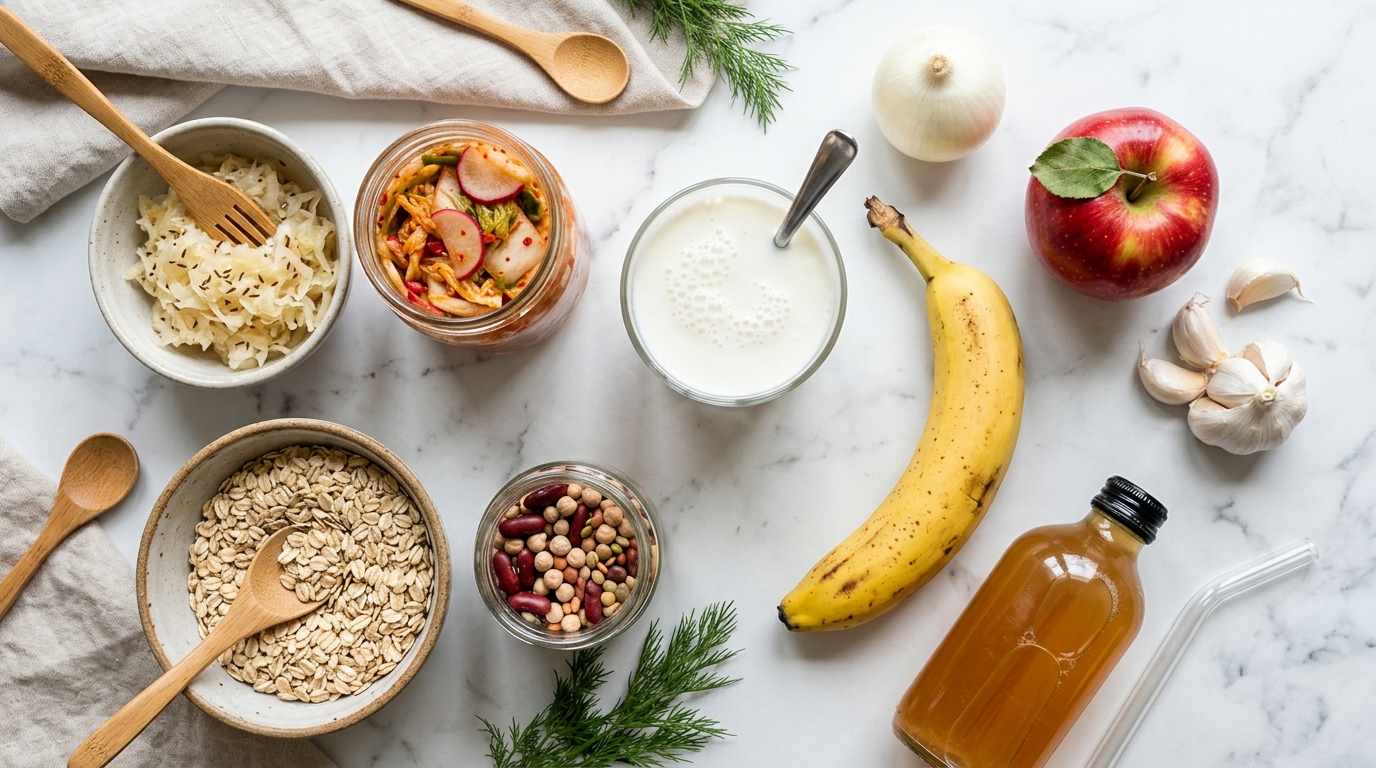
Kefir, refrigerated sauerkraut, kimchi, tempeh, miso, oats, beans, bananas, onions, garlic, and apples all support gut health through two distinct mechanisms. Fermented foods like kefir and kimchi deliver live microorganisms directly to the gut. Prebiotic foods like oats, beans, and garlic feed beneficial bacteria already living in the colon. Combining both categories daily provides broader microbiome support than any single food.
How we evaluated these foods
This article draws on human clinical trials, systematic reviews, and guidance from the International Scientific Association for Probiotics and Prebiotics (ISAPP), the Harvard T.H. Chan School of Public Health, and the American Gastroenterological Association (AGA). We prioritized foods available in standard U.S. supermarkets, not specialty stores. We separated fermented foods (which add live organisms) from prebiotic foods (which feed existing bacteria) because the mechanisms and evidence base differ. Where research supports dietary patterns rather than individual foods, we note that distinction.
Which supermarket fermented foods contain live microorganisms?
Not all fermented foods deliver live organisms at the time of consumption. The critical variable is whether the product undergoes pasteurization or heat treatment after fermentation. A 2021 randomized controlled trial published in Cell00754-6) by Stanford University researchers found that consuming six or more servings of fermented foods per day for 10 weeks increased overall gut microbial diversity — measured via 16S rRNA gene sequencing — and reduced 19 inflammatory markers including interleukin-6 (IL-6) and C-reactive protein (CRP). The ISAPP clarifies that while fermented foods contribute living microbes, most do not meet the technical definition of “probiotic” because their strain identity and dosage are unverified.
| Food | Live at Consumption | Key Organisms | What to Check on the Label |
|---|---|---|---|
| Kefir | Yes | L. kefiri, L. kefiranofaciens, yeasts | Look for “live and active cultures” |
| Sauerkraut (refrigerated) | Yes | L. plantarum, L. brevis, Leuconostoc | Must be refrigerated and unpasteurized; shelf-stable versions have zero live organisms |
| Kimchi (refrigerated) | Yes | L. plantarum, L. brevis, L. sakei | Refrigerated only; pasteurized kimchi is biologically inert |
| Tempeh | Partially | Rhizopus oligosporus | Raw tempeh has live cultures; cooking kills them but retains nutritional benefits |
| Miso | Partially | Aspergillus oryzae, Lactobacillus | Adding miso after cooking (below 115°F) preserves some live organisms |
| Kombucha | Variable | Acetobacter, Gluconobacter, yeasts | Unpasteurized only; microbial content varies widely by brand and batch |
| Shelf-stable pickles | No | None (vinegar-brined) | Most commercial pickles are not fermented; true lacto-fermented pickles are rare |
- Kefir provides the most consistent live-culture option in standard supermarkets
- Refrigeration and the absence of pasteurization are the two most reliable indicators of live content
- The Stanford Cell study (2021) found fermented food intake increased microbial diversity and reduced 19 inflammatory markers
Which supermarket foods act as prebiotics?
Prebiotic foods contain non-digestible fibers that selectively feed beneficial bacteria in the colon, stimulating production of short-chain fatty acids (SCFAs) — particularly butyrate, propionate, and acetate. According to the Harvard T.H. Chan School of Public Health, these SCFAs serve as the primary energy source for colonocytes and support gut barrier integrity. A 2019 systematic review published in Nutrients found that diverse dietary fiber intake consistently improved microbial composition more reliably than any single isolated prebiotic compound. Oats supply beta-glucan. Beans and lentils supply resistant starch and fermentable fiber. Onions, garlic, and leeks contribute inulin and fructooligosaccharides (FOS). Bananas provide resistant starch (especially when slightly underripe). Apples supply pectin.
| Food | Primary Prebiotic Fiber | Mechanism | Serving Note |
|---|---|---|---|
| Oats | Beta-glucan | Feeds Bifidobacterium, increases SCFA production | 1/2 cup dry provides ~2g beta-glucan |
| Beans and lentils | Resistant starch, fermentable fiber | Colonic fermentation produces butyrate | Start with 1/4 cup to assess tolerance |
| Onions and garlic | Inulin, FOS | Selectively feeds Bifidobacterium and Lactobacillus | Cooked retains prebiotic activity; raw may cause gas |
| Bananas | Resistant starch (higher when less ripe) | Fermented in colon to butyrate and acetate | Slightly green bananas have more resistant starch than fully ripe |
| Apples | Pectin | Supports microbial diversity in the lower gut | Eat with skin for maximum pectin content |
| Leeks | Inulin | Similar mechanism to onions and garlic | Milder flavor alternative to raw garlic |
- Fiber diversity matters more than any single “best” prebiotic food according to the 2019 Nutrients review
- Oats, beans, onions, garlic, bananas, and apples are the most accessible supermarket prebiotic sources
- Sensitive digestion may require gradual portion increases rather than large initial servings
How should you combine fermented and prebiotic foods?
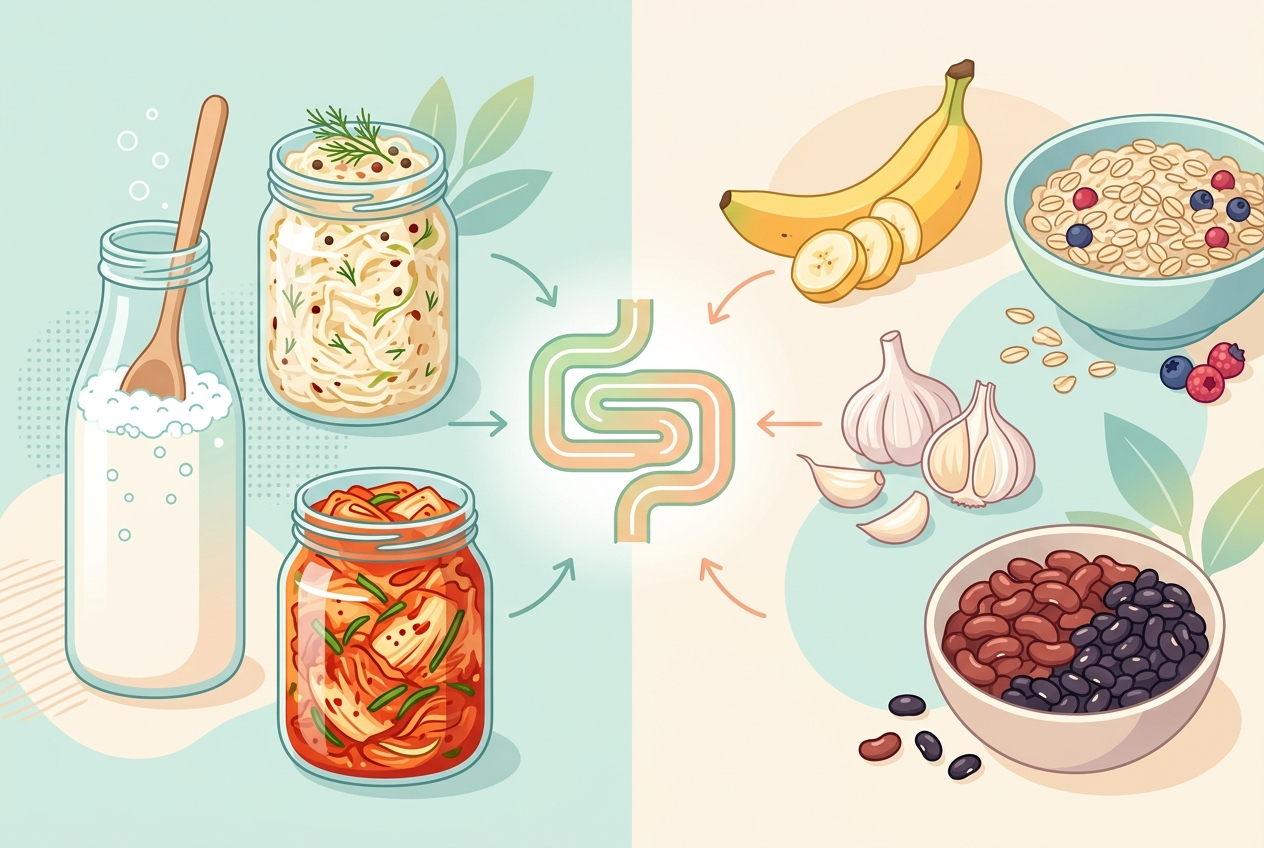
The most practical approach is pairing one fermented food with one fiber-rich food in the same day — kefir with oats, sauerkraut alongside beans, or kimchi with rice and vegetables. Fermented foods deliver external microorganisms and fermentation metabolites directly, while prebiotic foods provide the substrates that resident colonic bacteria use for SCFA production. A 2022 narrative review published in the British Journal of Nutrition found that synbiotic intake (combining live organisms with prebiotic fiber) produced greater SCFA output than either intervention alone, though the authors noted that large-scale randomized trials comparing combined versus isolated approaches remain limited. The ISAPP and the World Gastroenterology Organisation both frame dietary diversity as more impactful than any single functional food.
- Pairing fermented foods with prebiotic foods creates broader microbiome support than either category alone
- Synbiotic combinations increased SCFA production versus isolated approaches in a 2022 British Journal of Nutrition review
- Consistency matters more than intensity — small daily pairings outperform occasional large servings
What label details distinguish real gut-health foods from marketing?
Several label signals separate evidence-supported options from products using “gut health” as a marketing claim. For fermented foods, the FDA does not regulate the term “probiotic” on food labels, so the terms “live and active cultures,” “raw,” “unpasteurized,” and refrigerator placement are more reliable indicators than front-of-package health claims. The National Yogurt Association’s Live & Active Cultures seal requires 100 million cultures per gram at manufacture, but this does not guarantee viability at consumption. For prebiotic foods, the most trustworthy signal is the ingredient list itself — whole oats, whole beans, and whole garlic cloves do not need a “prebiotic” label to deliver prebiotic fiber. Products that add isolated prebiotic fibers like inulin or chicory root extract provide some benefit but lack the food matrix complexity of whole food sources.
- “Live and active cultures,” “raw,” and “unpasteurized” are more reliable than front-of-package health claims
- The FDA does not regulate the word “probiotic” on food labels
- Whole foods with intact fiber matrices provide more reliable prebiotic effects than isolated fiber additives
FAQ
Is kefir better than yogurt for gut health?
Kefir typically contains a more diverse microbial community than yogurt — including both bacteria and beneficial yeasts — because it uses a symbiotic culture of bacteria and yeasts (SCOBY) rather than the two-strain starter (L. bulgaricus and S. thermophilus) standard in yogurt production. A 2020 review in Nutrition Research Reviews found that kefir consistently demonstrated greater microbial diversity than yogurt, though direct head-to-head clinical trials comparing health outcomes remain limited.
Can you eat too many fermented foods?
Yes. Rapid increases in fermented food intake can cause temporary bloating, gas, and digestive discomfort, particularly in individuals with histamine sensitivity or small intestinal bacterial overgrowth (SIBO). The Stanford Cell study ramped participants gradually to six or more servings per day over several weeks. Starting with one to two servings daily and increasing over two to three weeks is the most common gastroenterologist recommendation.
Do canned or shelf-stable fermented foods have any gut benefits?
Canned sauerkraut, pasteurized kimchi, and shelf-stable pickles contain zero live microorganisms because heat processing kills all bacteria. They retain some nutritional value (fiber, vitamins) but provide none of the live-culture benefits associated with fresh fermented foods. If the product is stored at room temperature on a standard grocery shelf, it almost certainly contains no living organisms.
Are fermented foods safe during pregnancy?
The American College of Obstetricians and Gynecologists (ACOG) does not prohibit fermented foods during pregnancy, but recommends caution with unpasteurized products due to Listeria risk. Pasteurized fermented foods like most commercial yogurt and pasteurized kefir are generally considered safe. Unpasteurized options like raw sauerkraut or raw kombucha carry a small but nonzero contamination risk.
How much fiber per day supports gut health?
The Academy of Nutrition and Dietetics recommends 25 grams per day for women and 38 grams per day for men, though most Americans consume only 15 grams. For prebiotic-specific effects, research suggests that 5 to 10 grams of prebiotic fiber daily (from food sources like onions, garlic, oats, and beans) is sufficient to measurably shift microbial composition within two to four weeks.
Does cooking destroy the prebiotic fiber in foods?
No. Unlike live organisms, prebiotic fibers like inulin, beta-glucan, and resistant starch are heat-stable and survive normal cooking temperatures. Cooked onions, garlic, oats, and beans retain their prebiotic properties. The exception is resistant starch in bananas, which decreases as bananas ripen and soften regardless of cooking.
What is the difference between probiotic foods and prebiotic foods?
Probiotic foods contain live microorganisms that can temporarily colonize the gut. Prebiotic foods contain non-digestible fibers that feed bacteria already resident in the colon. Both support gut health, but through different mechanisms. Eating both categories — sometimes called a synbiotic dietary pattern — provides broader microbiome support than either alone.
Leave a Reply