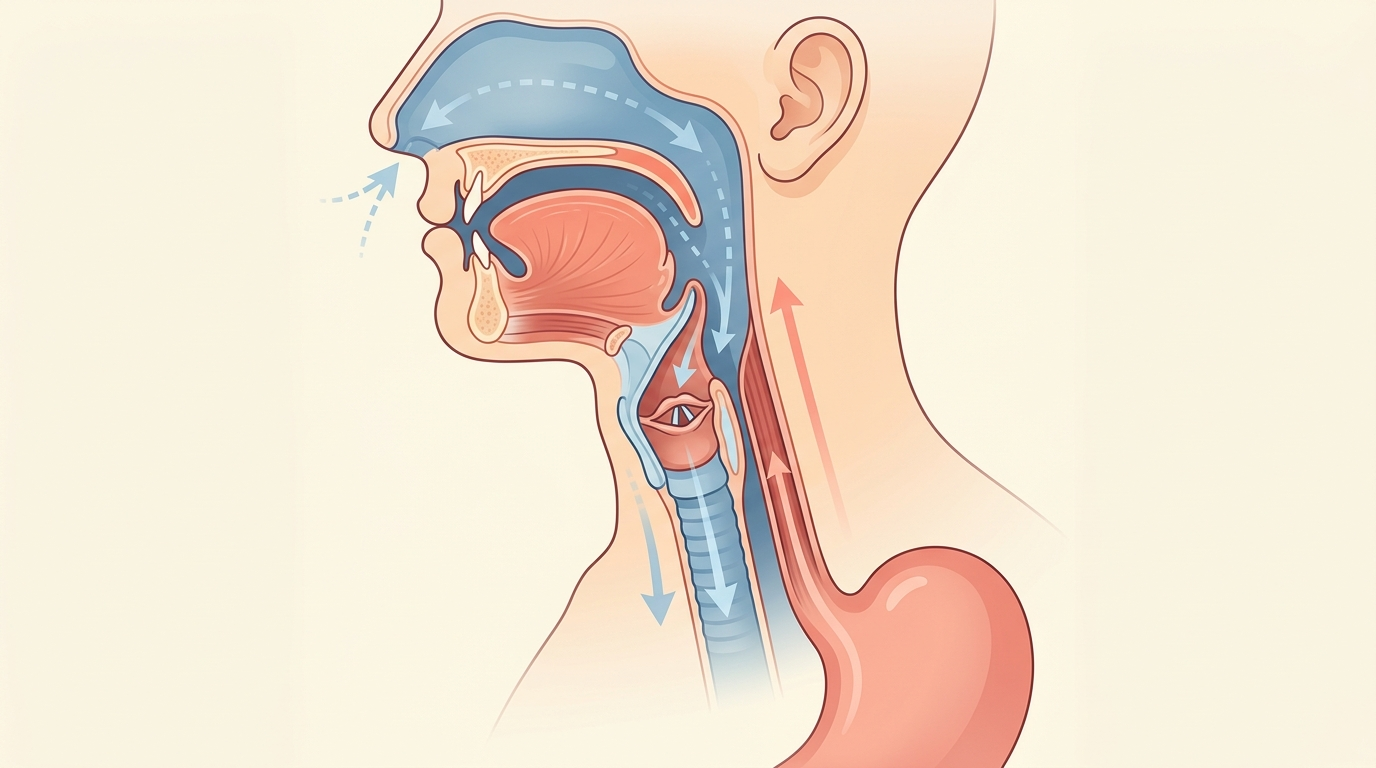
Vocal cord dysfunction—now often called inducible laryngeal obstruction—and GERD can coexist, but neither condition proves the other. ILO causes temporary narrowing at the larynx, often during inhalation; GERD moves stomach contents into the esophagus. Symptom timing, laryngoscopy during an episode, and reflux evaluation help clinicians separate them and treat each documented problem.
How did we evaluate the connection between VCD and GERD?
We evaluated vocal cord dysfunction, inducible laryngeal obstruction, and gastroesophageal reflux by prioritizing respiratory and laryngology consensus statements, diagnostic studies, government digestive-health guidance, and patient education from professional medical organizations. We separated association from causation because reflux can irritate the throat, ILO can occur without reflux, and the two conditions can share cough, throat tightness, voice changes, or breathing discomfort. We excluded testimonials, symptom-only diagnoses, and claims that acid suppression confirms the cause of every throat symptom. We also distinguished classic GERD, which commonly includes heartburn or regurgitation, from laryngeal symptoms that have several possible causes. Evidence remains incomplete: ILO terminology and diagnostic pathways have evolved, while extra-esophageal reflux symptoms do not map neatly to one test. This article explains the diagnostic logic, not an individual diagnosis, and persistent breathing or swallowing symptoms need clinical assessment.
What is vocal cord dysfunction or inducible laryngeal obstruction?
Inducible laryngeal obstruction describes inappropriate, temporary narrowing of the larynx in response to a trigger. The European Respiratory Society and European Laryngological Society statement uses ILO as the broader term for a group of presentations previously labeled vocal cord dysfunction or paradoxical vocal fold motion. Episodes can produce sudden throat tightness, noisy inhalation, shortness of breath, voice change, or a sensation that air cannot move through the throat. Symptoms often start and stop quickly, and breathing tests may look normal between episodes. Exercise, strong odors, smoke, cold air, respiratory infections, voice use, and emotional stress can act as triggers in different people. ILO can mimic asthma, coexist with asthma, or be confused with other airway problems. The disorder concerns laryngeal movement, not damaged vocal cords or a permanently blocked airway. That distinction explains why capturing the larynx during symptoms matters.
What is GERD, and how can it affect the throat?
Gastroesophageal reflux occurs when stomach contents move upward into the esophagus; GERD describes a recurring pattern that causes troublesome symptoms or complications. The NIDDK symptom guide lists heartburn and regurgitation as common symptoms, while chest discomfort, nausea, swallowing difficulty, cough, and hoarseness can also occur. Throat symptoms do not prove that reflux reached the larynx because postnasal drainage, infection, allergy, voice overuse, asthma, medication effects, and ILO can create similar complaints. Clinicians sometimes use the term laryngopharyngeal reflux when reflux is suspected above the esophagus, but symptom questionnaires alone cannot establish the mechanism. A person can have classic GERD without ILO, ILO without GERD, or both. The strongest clue is a consistent relationship among meals, body position, regurgitation, heartburn, throat events, and objective testing—not the presence of one nonspecific symptom. That uncertainty makes objective pattern-matching important.
How can VCD and GERD symptoms overlap?
Both conditions can involve cough, throat clearing, hoarseness, chest or throat tightness, and symptoms that feel alarming. ILO usually points toward abrupt inspiratory difficulty, noisy breathing from the throat, a clear trigger, and relatively rapid recovery. GERD more often points toward burning behind the breastbone, sour or bitter regurgitation, symptoms after meals, and worsening when lying down or bending. These are patterns, not diagnostic rules. Reflux-related irritation may lower the threshold for a laryngeal episode in some people, but an episode that follows a meal does not prove acid caused it. Anxiety can follow sudden breathing difficulty and amplify the experience without being the sole cause. Asthma generally creates lower-airway narrowing and commonly affects exhalation, while ILO centers on the upper airway and often affects inhalation. Because overlap is real, a useful history records which phase of breathing is difficult, whether sound comes from the throat or chest, episode duration, meals, exercise, odors, and response to treatment.
How do clinicians distinguish ILO from GERD and asthma?
Clinicians begin with the symptom pattern, medical history, medication response, physical examination, and possible competing diagnoses. A 2023 international Delphi consensus identified laryngoscopy with provocation as the diagnostic gold standard for VCD/ILO because the larynx must be observed during a representative episode. Exercise-triggered symptoms may require continuous laryngoscopy during exercise. Spirometry and flow-volume loops can support evaluation, but normal results between attacks do not exclude ILO. Asthma testing may include bronchodilator response, bronchial challenge, or inflammatory markers, depending on the situation. GERD often starts with clinical assessment; the NIDDK diagnosis guide explains that endoscopy and esophageal pH monitoring may be used when complications, alternative diagnoses, or uncertain treatment response matter. A specialist may also reproduce odor, exercise, or voice triggers under controlled conditions when appropriate. One test cannot answer every part of an overlapping presentation.
How are ILO and GERD treated differently?

ILO management commonly emphasizes respiratory retraining, laryngeal control techniques, trigger recognition, and care from a speech-language pathologist or multidisciplinary airway team. The American Thoracic Society patient guide describes laryngoscopy as the best way to identify VCD and notes that breathing-control techniques require practice. GERD management may include meal timing, weight management when appropriate, avoiding individual triggers, elevating the head during sleep for selected nighttime patterns, and clinician-directed medicines. Acid suppression treats acid exposure; it does not directly retrain abnormal laryngeal closure. Breathing exercises address ILO mechanics; they do not stop regurgitation. When both conditions are documented, clinicians may treat both and track separate outcomes, such as fewer regurgitation episodes and faster recovery from inspiratory attacks. Improvement with one therapy supports its target but does not automatically prove the entire original diagnosis. The treatment plan should follow the demonstrated mechanism.
What can someone track before an appointment?
A compact episode log can make an appointment more productive. Record the date, time, duration, activity, recent meal, body position, odor or temperature exposure, stress level, and whether breathing in or breathing out felt harder. Note throat noise, wheezing, heartburn, sour taste, regurgitation, coughing, hoarseness, swallowing difficulty, and how quickly the episode resolved. Record inhaler use, reflux medicine timing, and whether either changed the event. A phone audio or video recorded safely during a non-emergency episode can sometimes help a clinician understand the sound and breathing pattern, but recording should never delay care. Keep the log descriptive instead of labeling each event “reflux,” “asthma,” or “VCD.” Labels can bias memory; observations preserve diagnostic value. Bring medication bottles, prior test reports, and a list of exercise or workplace exposures. Two weeks of structured detail usually communicates more than months of generalized symptom recall.
Which warning signs need urgent assessment?
Emergency evaluation is appropriate for severe or rapidly worsening breathing difficulty, blue or gray lips, fainting, confusion, inability to speak, drooling, suspected choking, facial or tongue swelling, or symptoms that do not improve as expected. Chest pressure with sweating, nausea, jaw or arm pain, or major shortness of breath can represent a cardiac emergency rather than reflux. Trouble swallowing with food impaction, vomiting blood, black stool, unplanned weight loss, recurrent aspiration, or progressive swallowing difficulty also requires prompt medical attention. A prior diagnosis of ILO, asthma, or GERD should not be used to explain away a new pattern automatically. Children, pregnant people, older adults, and people with significant heart, lung, neurologic, or immune conditions may need a lower threshold for assessment. A familiar breathing exercise can be useful only when a clinician has taught it for a confirmed pattern and the current episode matches that pattern. Diagnostic confidence should never outrank safety.
What questions do people ask about VCD and GERD?
Can GERD cause vocal cord dysfunction?
Reflux may act as a laryngeal irritant or trigger in some people, but association does not prove that GERD caused ILO. Objective assessment should separate documented reflux from other laryngeal triggers and comorbid conditions.
Does VCD feel like acid reflux?
The sensations can overlap, especially when throat tightness, cough, or hoarseness dominate. Inspiratory difficulty and throat noise point more toward ILO, while burning and regurgitation point more toward GERD, but neither pattern is conclusive alone.
Can VCD be mistaken for asthma?
Yes. ILO can mimic asthma and can also coexist with asthma, which is why treatment response and laryngoscopy during symptoms matter.
Will a normal breathing test rule out VCD?
No. Spirometry can be normal when the larynx is not actively narrowing, so provoked or symptom-time laryngoscopy may be needed.
Does a proton pump inhibitor prove reflux caused throat symptoms?
No. Improvement can be informative, but response to acid suppression does not by itself prove that every throat or breathing symptom came from reflux.
Who evaluates suspected ILO?
Evaluation may involve an otolaryngologist, pulmonologist, allergist, gastroenterologist, and speech-language pathologist. The team depends on whether breathing, voice, exercise, asthma, swallowing, or reflux features dominate.
For a detailed comparison of specific products and strains, see Possible GERD? How OTC Reflux Options Compare.
What is the bottom line about VCD and GERD?
Vocal cord dysfunction or inducible laryngeal obstruction and GERD are distinct conditions that can coexist and imitate parts of each other. ILO produces temporary laryngeal narrowing and often causes abrupt inspiratory symptoms; GERD produces troublesome reflux and commonly causes heartburn or regurgitation. Cough, hoarseness, and throat tightness sit in the overlap and therefore carry less diagnostic weight by themselves. The cleanest evaluation captures the breathing pattern, documents meal and trigger timing, tests asthma when appropriate, views the larynx during a representative episode, and evaluates reflux when the history or treatment response remains uncertain. Treatment should then follow the documented mechanism: laryngeal control therapy for ILO, reflux-directed care for GERD, and separate management when both are present. Severe, new, or persistent breathing and swallowing symptoms require medical assessment rather than self-diagnosis. That separation prevents one label from swallowing the entire story.
Leave a Reply