Author: Dr. Sarah Chen, RDN

  • Can Acid Reflux Cause a Swollen Tongue?

    Can Acid Reflux Cause a Swollen Tongue?

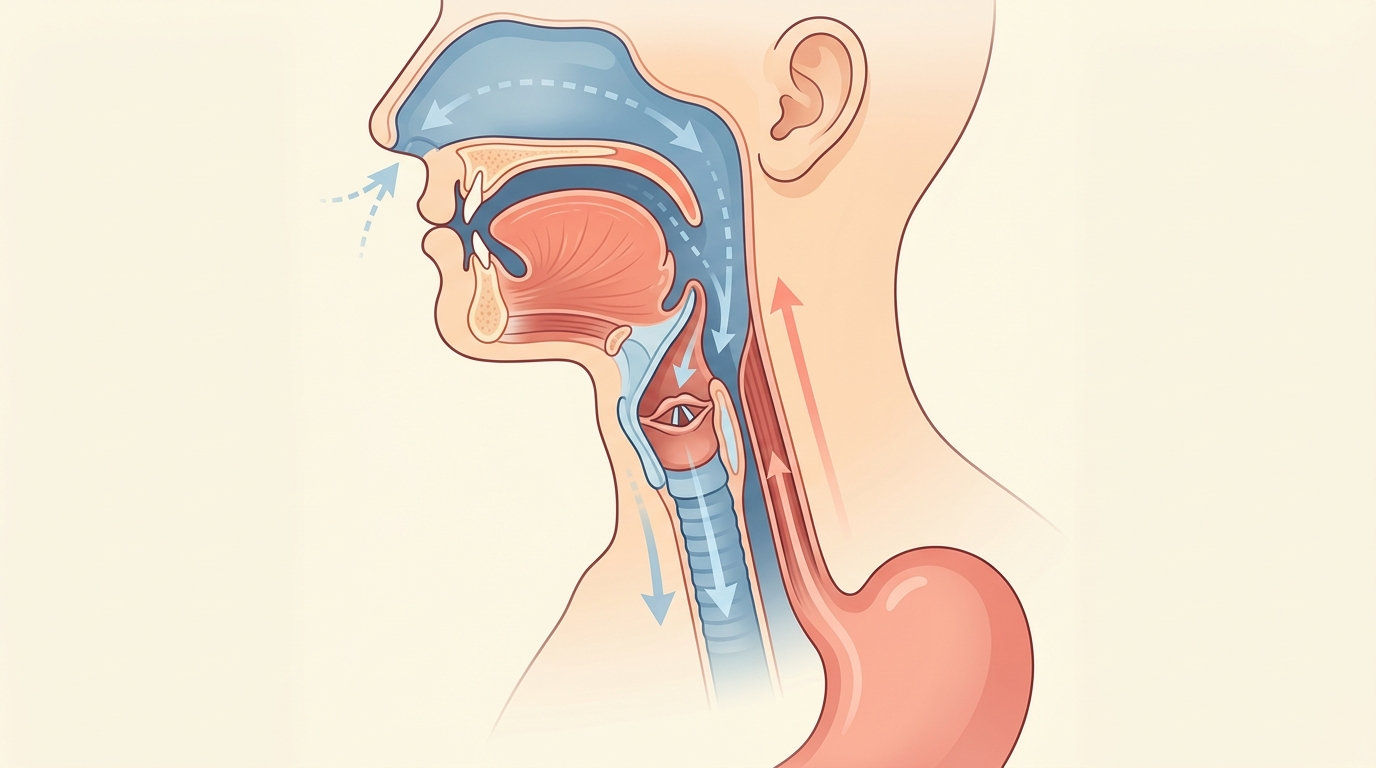
    A swollen tongue is not a typical acid-reflux symptom. Reflux can cause sour taste, throat irritation, cough, or hoarseness, but visible tongue enlargement needs a separate explanation. Sudden swelling with breathing trouble, throat tightness, faintness, wheezing, or trouble swallowing is an emergency because the airway can narrow quickly.

    How did we evaluate whether reflux can cause tongue swelling?

    We compared the established symptom pattern of gastroesophageal reflux with emergency-medicine and allergy guidance on tongue edema. Government health references and consensus documents received more weight than anecdotes that connect two symptoms only because they occurred together. NIDDK lists heartburn, regurgitation, chest pain, nausea, swallowing difficulty, cough, and hoarseness among GERD symptoms; visible tongue swelling is not part of that typical pattern (NIDDK). We separated subjective sensations—burning, coating, dryness, or a “thick” feeling—from objectively enlarged tissue because they require different decisions. We also prioritized airway safety over diagnostic speculation. A photo or symptom description cannot distinguish allergic, medication-related, hereditary, infectious, traumatic, or dental causes reliably. This article therefore explains patterns and urgency, not a home diagnosis. Sudden swelling, recurrent episodes, new medicine exposure, and swallowing or breathing changes require qualified medical assessment.

    Is acid reflux a likely cause of a swollen tongue?

    Acid reflux is an unlikely primary explanation for true tongue swelling. GERD moves stomach contents into the esophagus and sometimes the throat or mouth, producing heartburn, regurgitation, sour taste, cough, hoarseness, or swallowing discomfort. Those sensations can make the tongue or throat feel irritated without creating measurable tongue edema. A coated tongue, burning mouth, dry mouth, dental irritation, oral thrush, and muscle tension can also feel like swelling even when tongue size is unchanged. Conversely, angioedema enlarges deeper tissues and can affect the lips, tongue, mouth, pharynx, or larynx. A 2024 international consensus defines angioedema as intermittent localized swelling of subcutaneous or submucosal tissue and emphasizes that multiple mechanisms exist (DANCE consensus). Timing matters: reflux often follows meals or lying down, while allergic swelling may begin rapidly after food, medicine, latex, or a sting. Coexistence does not establish causation, so visible swelling should not be dismissed as “just reflux.”

    What can cause sudden tongue swelling?

    Sudden tongue swelling raises concern for angioedema, which can be driven by histamine or bradykinin. Histamine-mediated episodes may follow foods, medicines, insect stings, or latex and can occur with hives, itching, wheezing, vomiting, dizziness, or low blood pressure. Bradykinin-mediated angioedema may occur with angiotensin-converting enzyme inhibitors such as lisinopril, even after long-term use, or with hereditary or acquired C1-inhibitor disorders. The mechanisms matter because they do not respond to identical treatments. An emergency-medicine review notes that airway angioedema can be fatal and identifies tongue edema as a higher-risk anatomical presentation (PubMed). Infection, dental disease, trauma, burns, tongue biting, and local irritation can also enlarge tissue. A new mouth product or supplement may be temporally relevant, but timing alone does not prove allergy. Do not deliberately re-expose yourself to a suspected trigger. Bring the package, medication list, and episode timeline to the clinician evaluating the swelling.

    How can you tell true swelling from irritation or a thick-tongue feeling?

    True swelling changes the tongue’s size, contour, movement, or fit inside the mouth. Objective clues include new tooth impressions, difficulty keeping the tongue behind the teeth, altered speech, drooling, trouble swallowing saliva, visible asymmetry, or simultaneous lip and facial swelling. A burning, sour, dry, coated, tingling, or “lump in the throat” sensation can feel dramatic without producing the same visible enlargement. Compare the current appearance with a prior photo only if doing so does not delay emergency care. Note whether the change began over minutes, hours, or days and whether hives, itching, fever, dental pain, mouth ulcers, new foods, new medicines, or recent dental work appeared with it. Reflux timing—after a large meal or lying flat—may explain sour taste or throat burning but does not safely explain away enlargement. Persistent macroglossia has a different differential from a brief angioedema episode and requires examination. The useful distinction is objective change versus sensation, not whether the symptom feels mild or severe.

    Which tongue-swelling signs require emergency action?

    Call emergency services for tongue swelling accompanied by difficulty breathing, wheezing, noisy breathing, throat tightness, inability to swallow saliva, blue or gray lips, fainting, confusion, or rapidly increasing facial or mouth swelling. Do not drive yourself if the airway may be changing. MedlinePlus warns that severe angioedema can cause life-threatening airway blockage and treats breathing difficulty as an emergency (MedlinePlus). The 2023 anaphylaxis practice parameter also identifies upper-airway mucosal swelling involving the tongue, pharynx, uvula, or larynx as a serious feature (AAAAI). If you have a prescribed epinephrine auto-injector and your action plan says to use it, follow that plan and call emergency services. Antacids do not treat angioedema. Antihistamines do not reliably treat bradykinin-mediated swelling. Apparent improvement should not override urgent instructions when breathing, swallowing, voice, or consciousness has changed.

    What information helps a clinician identify the cause?

    A concise timeline is more useful than a long list of theories. Record the exact start time, speed of progression, duration, and whether the tongue returned fully to baseline. List every prescription, over-the-counter medicine, supplement, food, dental product, and exposure used before the episode. Highlight ACE inhibitors, nonsteroidal anti-inflammatory drugs, antibiotics, and any newly started product, but do not stop prescribed medicine without urgent clinical direction unless an emergency professional instructs you. Note hives, itching, abdominal pain, vomiting, wheezing, voice change, drooling, fever, dental pain, mouth sores, and family history of unexplained swelling. Photograph visible changes only when safe. Record whether reflux symptoms occurred separately or at the same time. A pattern of recurrent swelling without hives can prompt evaluation for nonhistaminergic or hereditary mechanisms, while rapid swelling with hives points toward a different pathway. No single home observation confirms the mechanism; the goal is to preserve details that disappear after the episode resolves.

    What questions do people ask about reflux and a swollen tongue?

    Start with two questions: Is the tongue objectively larger, and is the airway changing? Then ask what happened immediately before the episode, which medicines are involved, whether hives or itching appeared, and whether previous episodes followed the same pattern. Reflux belongs lower in the decision tree because its established symptoms center on heartburn, regurgitation, sour taste, swallowing discomfort, cough, and hoarseness. Sudden edema belongs higher because tongue involvement can threaten the airway. A clinician may examine the mouth, throat, teeth, skin, and breathing; review medicines; and decide whether allergy, angioedema, infection, trauma, or another condition requires testing. Recurrent episodes may require allergy or immunology follow-up. Persistent enlargement may require dental, ear-nose-throat, endocrine, or other evaluation depending on findings. The safest question is not “Can reflux do this?” but “What explanation best accounts for the timing, visible change, associated symptoms, and risk?”

    Can GERD make your tongue feel thick?

    GERD can create sour taste, throat irritation, cough, or swallowing discomfort that a person may describe as thickness. A visibly enlarged tongue is not a typical GERD feature and needs separate assessment.

    Can an antacid reduce tongue swelling?

    Antacids reduce stomach acidity; they do not treat allergic or bradykinin-mediated angioedema. Do not use symptom relief after an antacid as proof that swelling was caused by reflux.

    Can lisinopril cause tongue swelling after years of use?

    ACE-inhibitor angioedema can occur even after long-term treatment. Tongue or throat swelling while taking an ACE inhibitor warrants urgent medical evaluation and specific medication review.

    Does tongue swelling always come with hives?

    No. Histamine-mediated angioedema may include hives, but bradykinin-mediated forms often do not, so the absence of itching does not make tongue swelling harmless.

    Can oral thrush look like tongue swelling?

    Oral thrush can cause white patches, soreness, burning, or altered taste and may create a swollen sensation. An examination distinguishes surface changes from deeper tissue edema.

    What if the swelling went away on its own?

    Resolution does not identify the cause. A first episode, medication-associated episode, or recurrent unexplained episode still deserves medical review because a future event can behave differently.

    What is the bottom line on reflux and tongue swelling?

    Acid reflux can irritate the throat and mouth, but true tongue enlargement is not a routine GERD symptom. Treat sudden visible swelling as a separate problem until a qualified professional identifies the cause. Emergency warning signs include breathing difficulty, noisy breathing, throat tightness, drooling, trouble swallowing saliva, faintness, confusion, and rapidly increasing mouth or facial swelling. Angioedema can follow allergic exposure, medicines such as ACE inhibitors, or hereditary and acquired bradykinin pathways; infection, trauma, dental disease, and other conditions can also produce swelling. The absence of hives does not exclude danger. Keep a complete medication and exposure list, preserve photos when safe, and record the onset and associated symptoms. Reflux timing may explain sour taste or burning, but it cannot rule out an airway problem. When tongue size is visibly changing, safety comes before finding a digestive explanation.
  • GERD vs Hiatal Hernia vs H. Pylori vs Anxiety: How Doctors Tell Them Apart

    GERD vs Hiatal Hernia vs H. Pylori vs Anxiety: How Doctors Tell Them Apart

    Symptoms alone cannot reliably distinguish GERD, a hiatal hernia, Helicobacter pylori infection, and anxiety-related gut symptoms because they overlap. Regurgitation favors GERD; a hernia requires imaging or endoscopy; H. pylori requires breath, stool, or biopsy testing; and anxiety may amplify symptoms without excluding a physical condition. Red flags need prompt medical assessment.

    How did we evaluate GERD, hiatal hernia, H. pylori, and anxiety?

    We compared each condition by mechanism, characteristic symptom pattern, objective test, and the findings that symptoms cannot establish. National Institute of Diabetes and Digestive and Kidney Diseases guidance carried the most weight for GERD, dyspepsia, peptic ulcers, endoscopy, and pH monitoring. MedlinePlus sources defined hiatal-hernia anatomy and H. pylori test options. We treated timing, posture, meals, and stress as clues rather than proof because the four categories can coexist. We excluded online acid tests, symptom quizzes, response to antacids as a diagnosis, and the assumption that normal endoscopy means symptoms are imaginary. Anxiety can change symptom intensity through gut-brain signaling, while reflux, a hernia, and H. pylori remain physical questions that may need separate testing. This framework helps organize a clinician visit; it cannot diagnose chest pain, upper-abdominal pain, trouble swallowing, or persistent indigestion remotely.

    Why do these four problems feel so similar?

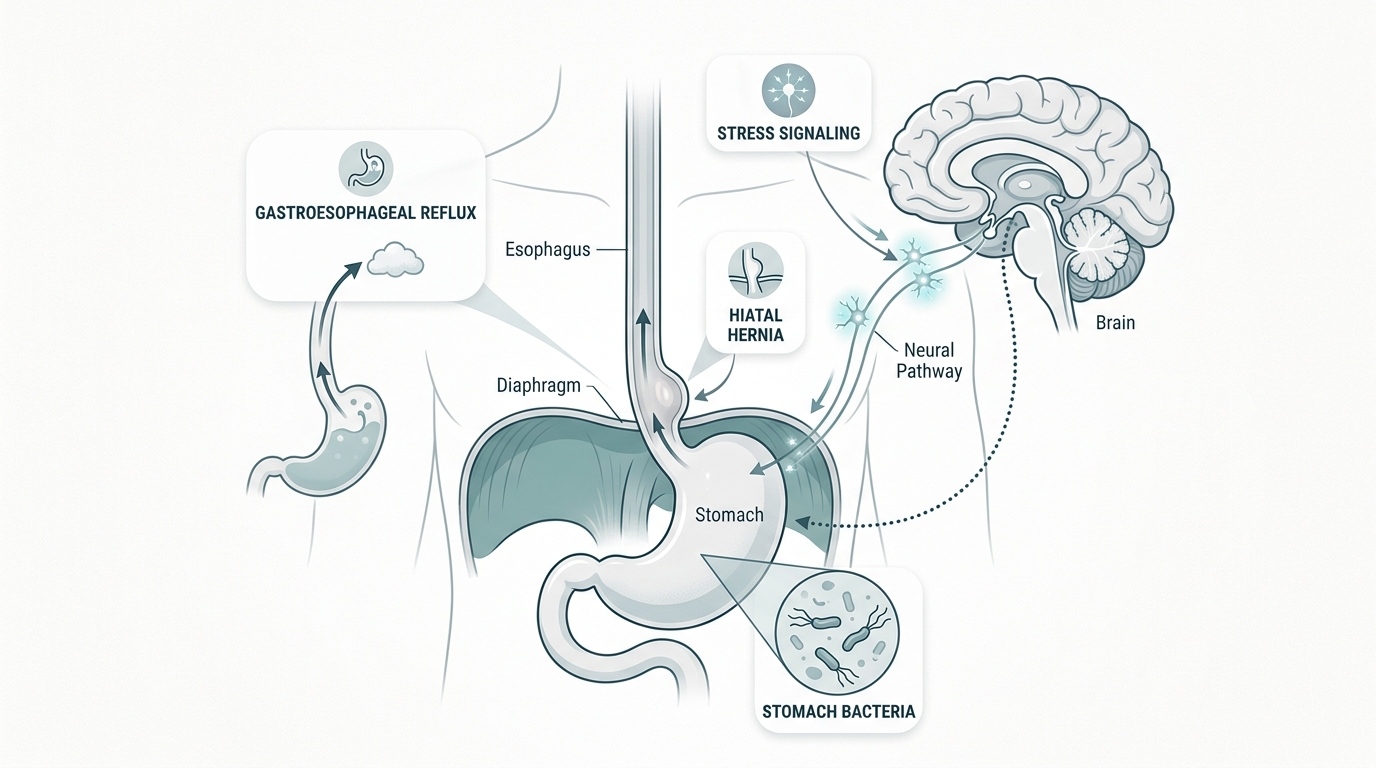
    The esophagus, stomach, diaphragm, and nervous system can generate overlapping sensations in the same upper-abdominal and chest region. GERD moves stomach contents into the esophagus and commonly causes heartburn or regurgitation. A hiatal hernia changes anatomy by moving part of the stomach through the diaphragm, which can make reflux easier but may cause no symptoms itself. H. pylori infects the stomach lining and can cause gastritis or peptic ulcers, yet most infected people have no symptoms. Anxiety changes attention, muscle tension, breathing, and the perception of internal signals; it can intensify nausea, fullness, belching, or burning without producing an H. pylori test or anatomical hernia. One person can also have more than one category at once. The key distinction is therefore not “which symptom belongs to which label?” It is “which mechanism needs confirmation, and which test can confirm it?” Symptom patterns guide testing, but they do not replace it.

    Which clues point more toward GERD?

    GERD becomes more likely when burning rises behind the breastbone, sour or bitter material returns to the throat or mouth, and symptoms follow meals, bending, or lying down. The NIDDK symptom guide identifies heartburn and regurgitation as common features, while also noting cough, hoarseness, nausea, chest pain, and swallowing problems. Those additional symptoms are less specific because heart, lung, throat, and motility problems can resemble reflux. Improvement with an antacid or acid-suppressing medicine supports acid sensitivity but does not prove GERD, identify a hiatal hernia, or exclude H. pylori. Best clue for classic GERD: recurrent regurgitation linked to meals or posture. Best confirmation when the diagnosis remains uncertain: ambulatory esophageal pH monitoring, sometimes combined with impedance. New chest pressure, shortness of breath, sweating, or pain radiating to the arm or jaw requires urgent evaluation rather than a reflux assumption.

    Which clues point more toward a hiatal hernia?

    A hiatal hernia cannot be confirmed by how heartburn feels. It describes anatomy: the upper stomach moves through the diaphragm into the chest. Many small sliding hernias cause no direct symptoms, while larger hernias may contribute to reflux, chest or upper-abdominal pressure, early fullness, regurgitation, or swallowing difficulty. MedlinePlus explains that clinicians often discover a hiatal hernia during tests for reflux, chest pain, or abdominal pain, including a barium swallow or upper endoscopy. Symptoms that worsen after a large meal, while bending, or when lying down can fit both GERD and a hernia, so posture does not distinguish them. Best clue for a structural problem: persistent swallowing difficulty, marked post-meal pressure, or a prior imaging finding. Best confirmation: imaging or endoscopy selected by a clinician. A hernia finding also does not prove that every symptom comes from the hernia; reflux testing may still be needed when the relationship remains unclear.

    Which clues point more toward H. pylori?

    H. pylori becomes a stronger question when discomfort centers in the upper abdomen and includes persistent burning or aching, early fullness, nausea, reduced appetite, or a history of gastritis or peptic ulcer. None of those symptoms is specific. MedlinePlus notes that most people with H. pylori have no symptoms, while symptomatic infection may resemble ordinary dyspepsia. Sour regurgitation into the mouth favors GERD more than H. pylori, but one condition does not exclude the other. Best clue for testing: ongoing dyspepsia, ulcer history, unexplained iron deficiency in an appropriate clinical context, or a clinician’s risk assessment. Best noninvasive confirmation: a urea breath test or stool antigen test. Proton-pump inhibitors, bismuth, and antibiotics can produce false-negative results, so medication timing must follow clinical instructions. A blood antibody test may reflect a past infection and is less useful for proving active infection or confirming eradication after treatment.

    Which clues point more toward anxiety or a gut-brain interaction?

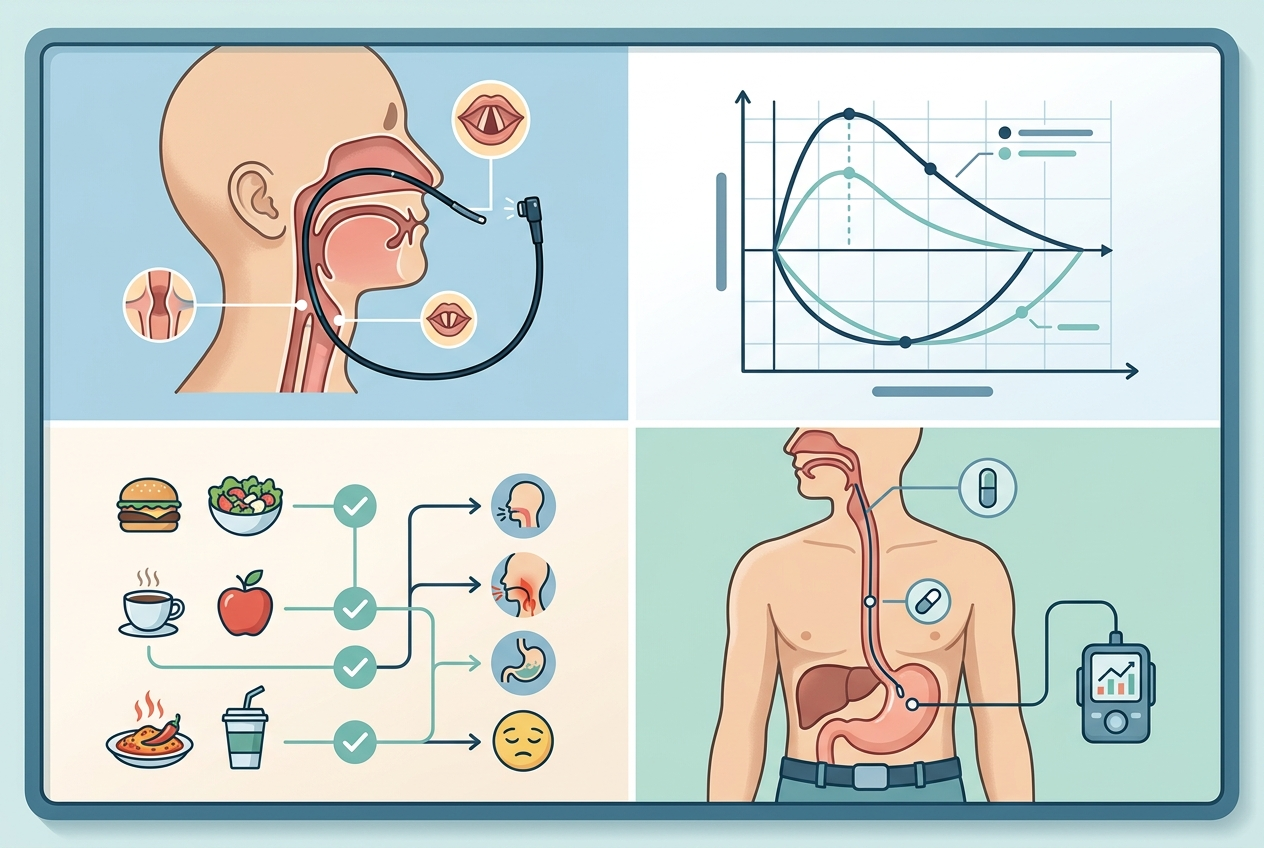
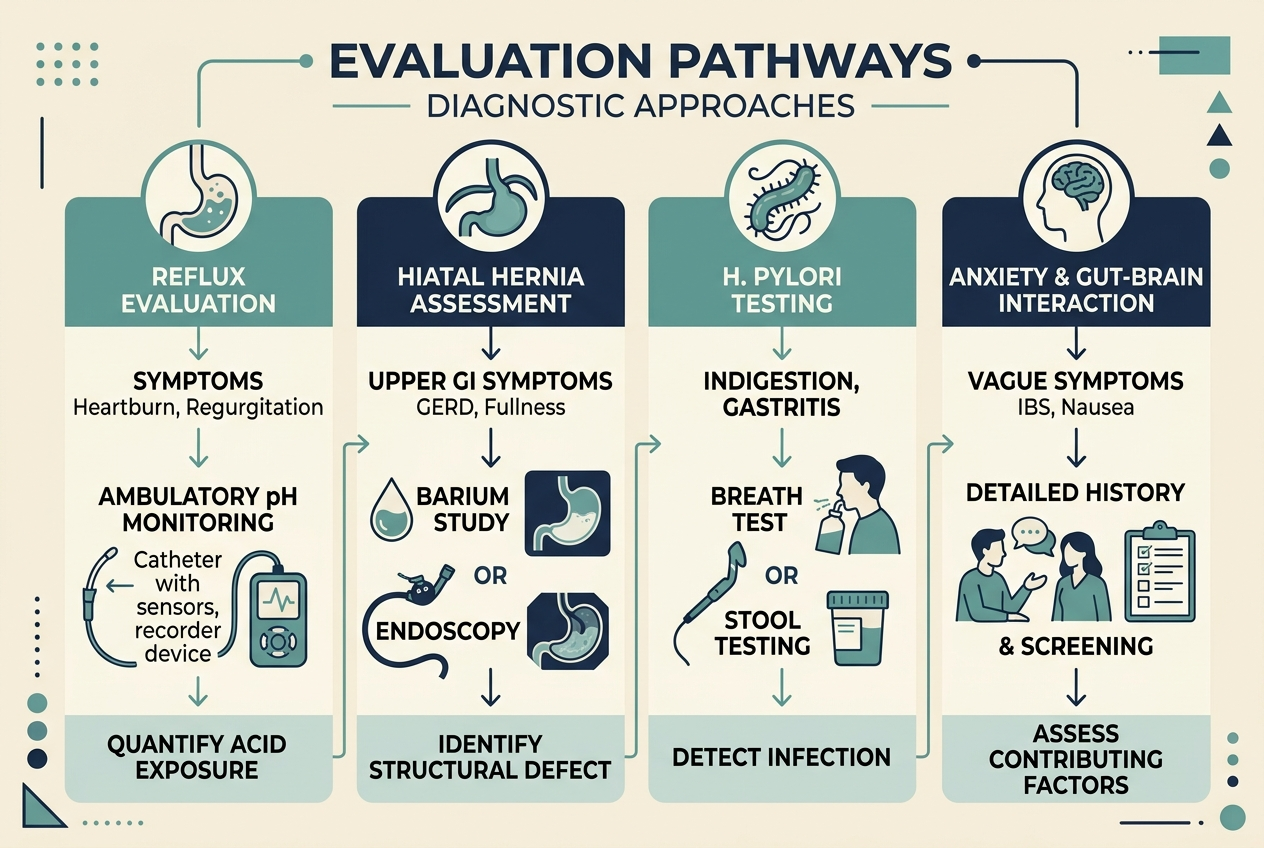
    Diagnostic pathways for GERD, hiatal hernia, H. pylori infection, and anxiety-related gut symptoms.
    Diagnostic pathways for GERD, hiatal hernia, H. pylori infection, and anxiety-related gut symptoms.

    Anxiety becomes relevant when symptoms reliably intensify during threat, rumination, panic, poor sleep, or rapid breathing and ease when arousal settles. Belching, chest tightness, nausea, fullness, and abdominal discomfort can all change with autonomic activation and heightened interoception. That pattern does not mean the symptoms are fabricated. NIDDK describes functional dyspepsia as chronic indigestion without another digestive disease that explains it and identifies it as a disorder of gut-brain interaction. Best clue for a gut-brain contribution: symptom intensity tracks stress more closely than meals or posture after appropriate medical assessment. Best confirmation: there is no single anxiety-versus-stomach test; clinicians use history, validated mental-health screening, and targeted digestive evaluation. Anxiety can coexist with GERD, a hiatal hernia, or H. pylori. A symptom diary should therefore track meals, posture, sleep, bowel changes, medicines, and stress without using one stressful episode to dismiss persistent physical symptoms.

    Which tests actually separate these possibilities?

    Testing should answer a specific mechanism question. Ambulatory pH monitoring measures reflux reaching the esophagus and is the most direct test for uncertain GERD. Upper endoscopy examines the esophagus, stomach, and duodenum for inflammation, ulcers, narrowing, and other abnormalities; it can also obtain biopsies. A barium upper-GI series can show swallowing mechanics and a hiatal hernia. Urea breath testing and stool antigen testing identify active H. pylori infection, while biopsy testing may be used during endoscopy. The NIDDK GERD diagnosis guide explains that clinicians often begin with symptoms and history, then test when warning signs, alternative diagnoses, or treatment failure raise uncertainty. Best test for acid exposure: pH monitoring. Best test for anatomy: imaging or endoscopy. Best test for active H. pylori: breath or stool antigen. Best assessment for anxiety: clinical screening alongside, not instead of, appropriate digestive evaluation.

    Question Most direct evaluation What it cannot prove alone
    Is reflux reaching the esophagus? Ambulatory pH or pH-impedance monitoring Whether anxiety contributes to symptom intensity
    Is there a hiatal hernia? Barium study or upper endoscopy Whether the hernia causes every symptom
    Is active H. pylori present? Urea breath or stool antigen test Whether reflux is also present
    Does gut-brain signaling contribute? History and validated clinical screening That physical disease is absent

    Which warning signs need prompt medical attention?

    Do not self-sort severe or progressive symptoms into GERD, hernia, H. pylori, or anxiety. Seek urgent help for chest pressure with shortness of breath, sweating, fainting, or pain spreading to the arm, jaw, neck, shoulder, or back. Vomiting blood, material resembling coffee grounds, black tarry stool, sudden severe abdominal pain, a rigid abdomen, or repeated vomiting can signal bleeding or another emergency. Arrange prompt clinical assessment for trouble or pain with swallowing, food sticking, unexplained weight loss, persistent loss of appetite, iron-deficiency anemia, jaundice, progressive abdominal swelling, or symptoms that continue despite appropriate over-the-counter measures. NIDDK lists bleeding, swallowing problems, persistent vomiting, chest pain, and unintended weight loss among symptoms that require medical review. Anxiety may coexist with emergencies and should never be used to explain away a new red flag. A clear timeline, medication list, family history, and prior test results help a clinician choose the safest next step.

    What questions do people ask about reflux, hernias, H. pylori, and anxiety?

    The questions usually focus on whether one symptom or home experiment can settle the diagnosis. It cannot. Heartburn and regurgitation provide pattern evidence for GERD, while imaging establishes a hiatal hernia and breath, stool, or biopsy testing establishes H. pylori. Normal endoscopy does not exclude all reflux because pH monitoring measures exposure over time, and it does not make a gut-brain disorder imaginary. Stress-linked symptoms do not prove anxiety is the only cause, just as temporary relief from antacids does not identify the full mechanism. The six answers below separate useful clues from diagnostic shortcuts. Bring a clinician a timeline that includes meal timing, posture, regurgitation, upper-abdominal pain, swallowing, bowel changes, medicines, sleep, and stress. That record can focus testing while reducing the temptation to repeat unsupported online acid tests or change several treatments at once.

    Can GERD and a hiatal hernia occur together?

    Yes. A hiatal hernia can make reflux easier, but many hernias are asymptomatic and GERD can occur without a hernia. Testing should establish both anatomy and reflux when the distinction matters.

    Can H. pylori cause acid reflux?

    H. pylori primarily affects the stomach lining and can cause gastritis or ulcers. It does not reliably explain classic regurgitation, so a positive test does not automatically establish the cause of reflux symptoms.

    Can anxiety cause real chest burning or nausea?

    Yes. Gut-brain signaling, muscle tension, breathing patterns, and heightened interoception can create real physical symptoms. Clinicians should still assess new or concerning chest and digestive symptoms on their own merits.

    Does a normal endoscopy rule out GERD?

    No. Endoscopy can show inflammation or complications, but many people with reflux have no visible erosions. Ambulatory pH or pH-impedance monitoring can evaluate reflux exposure when uncertainty remains.

    Can a home stomach-acid test diagnose the problem?

    No. Baking-soda timing, betaine challenges, saliva tests, and symptom quizzes do not distinguish these four categories reliably. They can delay appropriate breath, stool, imaging, endoscopic, or pH testing.

    Which doctor should evaluate these symptoms?

    A primary-care clinician can review red flags, medicines, and initial testing. A gastroenterologist may be appropriate for persistent symptoms, swallowing problems, uncertain GERD, suspected ulcer disease, or the need for endoscopy or reflux monitoring.

    What is the clearest way to tell these conditions apart?

    Use symptoms to choose a test, not to declare a diagnosis. Recurrent regurgitation and posture-linked burning support GERD, but pH monitoring confirms uncertain reflux. A hiatal hernia is an anatomical finding shown by imaging or endoscopy. H. pylori is an infection shown by a properly prepared breath, stool antigen, or biopsy test. Anxiety and disorders of gut-brain interaction are evaluated through history and clinical screening after red flags and relevant physical causes receive appropriate attention. Multiple categories can coexist, so the goal is not to force every symptom into one label. Record the pattern, review medicines, and ask what mechanism each proposed test will answer. Seek prompt care for chest pressure, bleeding, persistent vomiting, swallowing difficulty, unintended weight loss, severe abdominal pain, fainting, or black stool. A staged evaluation is more reliable than online quizzes, home acid tests, or repeated treatment trials.

  • Why Can Your Throat Feel Like Hot Air?

    Why Can Your Throat Feel Like Hot Air?

    A feeling of hot air in the throat can come from reflux reaching the upper esophagus, dry or irritated throat tissue, mouth breathing, inhaled irritants, or heightened laryngeal sensitivity. The sensation alone cannot identify the cause. Its timing, triggers, accompanying symptoms, and persistence determine whether simple monitoring or medical evaluation makes sense.

    How did we evaluate a hot-air feeling in the throat?

    We evaluated this symptom by separating a person’s description from a medical diagnosis. We prioritized the National Institute of Diabetes and Digestive and Kidney Diseases for established reflux symptoms, peer-reviewed reviews for laryngopharyngeal reflux, and federal guidance for swallowing and breathing emergencies. We looked for evidence that explains mechanisms without treating a vague sensation as proof of one disease. We excluded social-media diagnoses, unverified remedy claims, food-sensitivity lists, and rules that assume every throat sensation comes from stomach acid. This method supports three useful questions: whether the feeling follows meals or lying down, whether the throat is being dried or irritated, and whether warning signs are present. It cannot determine the cause for one person because reflux, infection, allergy, medication effects, airway irritation, and sensory hypersensitivity can overlap. A clinician may need the history, examination, and selective testing to distinguish them.

    Why can reflux create a hot-air sensation in the throat?

    Reflux can expose the esophagus or throat area to stomach contents, producing sensations that people describe as warm, burning, sour, airy, or rising. The NIDDK guide to GERD symptoms describes heartburn that rises toward the throat and regurgitation that reaches the throat or mouth. Those established patterns make reflux one plausible explanation, especially when the sensation follows a meal, bending, exercise, or lying down. However, the phrase “hot air” is not a standard diagnostic sign, and the absence of classic heartburn does not settle the question. Throat symptoms may accompany cough, hoarseness, sour taste, repeated throat clearing, or swallowing discomfort. Frequency also matters. The strongest clue is a repeatable cluster rather than the temperature-like feeling alone. Even then, reflux can coexist with dry air, nasal congestion, medication effects, or irritation from smoke and vaping.

    Why does the sensation not prove laryngopharyngeal reflux?

    Laryngopharyngeal reflux, often shortened to LPR, is commonly proposed when throat symptoms occur without typical heartburn. Yet the diagnosis is difficult because throat clearing, globus, cough, hoarseness, and burning are nonspecific. A 2024 review in Gastroenterology & Hepatology notes that laryngeal symptoms do not have a single diagnostic gold standard. A separate 2023 diagnostic review describes limitations in symptoms, laryngoscopy findings, and reflux testing. Therefore, a hot-air feeling cannot confirm LPR, and a short response or nonresponse to an acid-reducing medicine does not prove the diagnosis by itself. Specialist interpretation therefore matters for persistent cases. Clinicians consider the full pattern, competing explanations, medication history, and whether objective testing would change management. This distinction matters because repeated empiric treatment can delay evaluation of nasal, pulmonary, allergic, infectious, neurologic, or voice-use factors that may produce similar sensations.

    What non-reflux factors can create a similar throat feeling?

    Dryness and local irritation can make inhaled air feel unusually warm even when its temperature is normal. Mouth breathing from nasal congestion increases airflow across throat tissue, while dehydration, heated indoor air, prolonged speaking, smoke, vaping aerosols, fragrances, and occupational dust can add irritation. A respiratory infection or allergy can also alter mucus, swallowing, and sensory perception. Some medicines reduce saliva or promote reflux, so the medication timeline matters. Sensory nerves in the larynx can become unusually responsive after infection, repeated coughing, or irritation; this mechanism is sometimes discussed as laryngeal hypersensitivity. These possibilities are explanations, not self-diagnoses. Their clues often differ: dryness may improve with hydration or humidification, an irritant pattern may follow a place or exposure, and an infection may include fever, congestion, or soreness. Persistent one-sided pain, a neck mass, progressive voice change, or worsening swallowing requires examination rather than environmental troubleshooting.

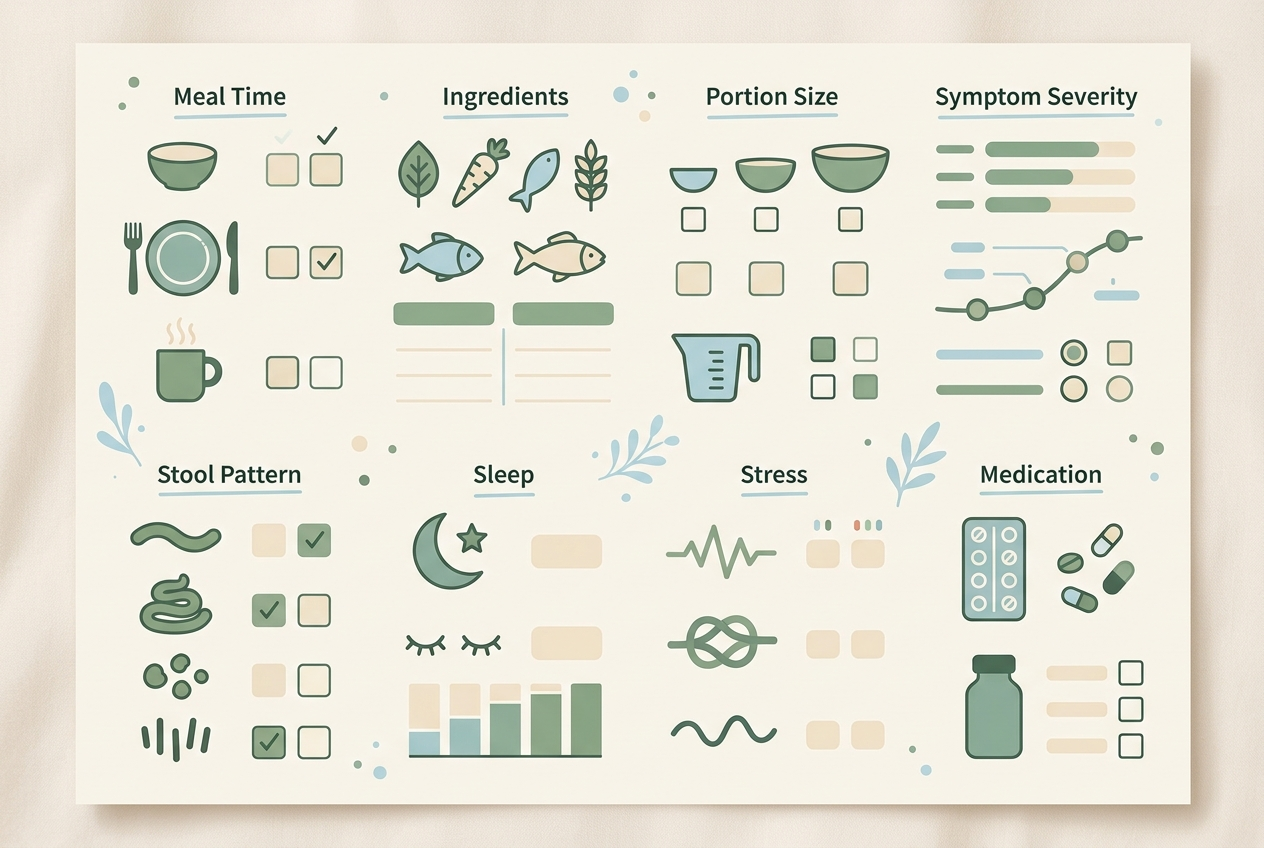
    What pattern details should you track?

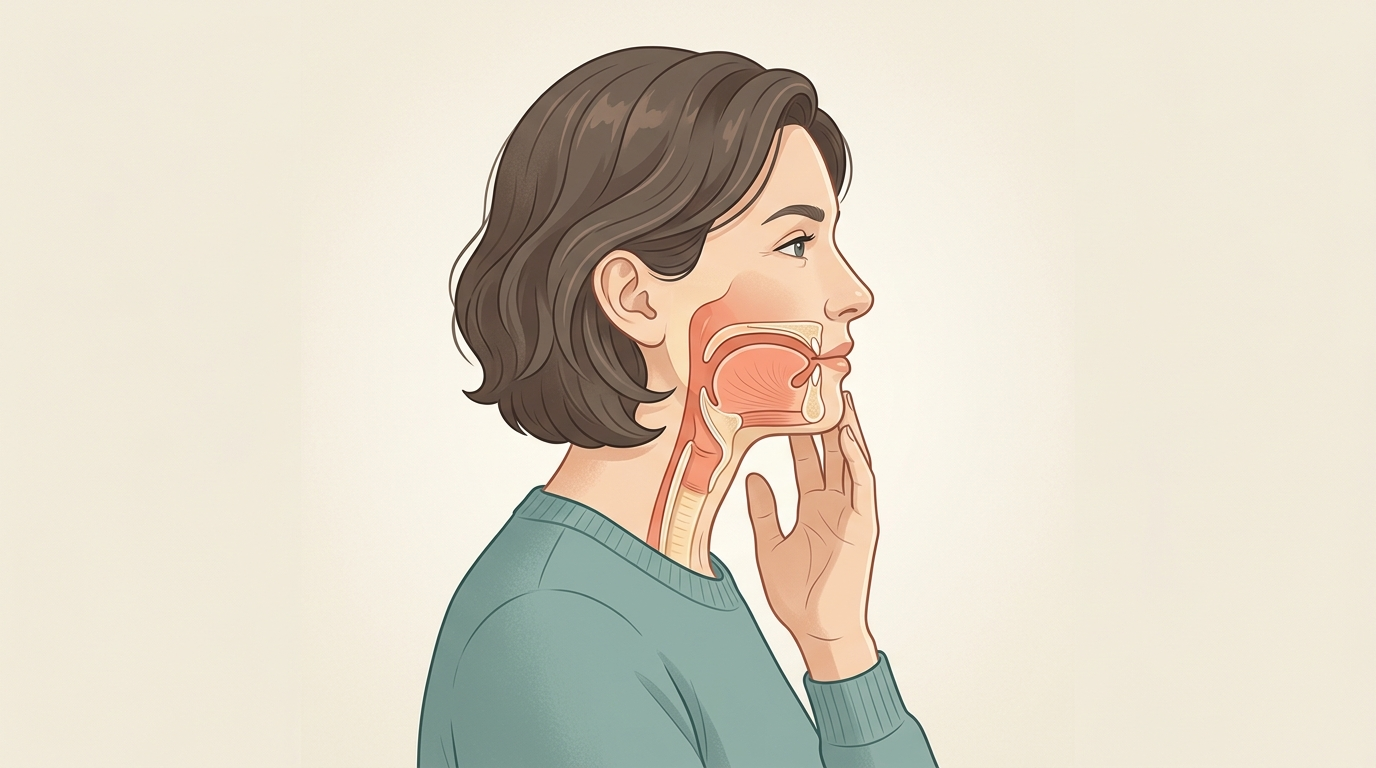
    Diagram comparing reflux, dryness, irritants, and warning signs linked with a warm throat sensation.
    Diagram comparing reflux, dryness, irritants, and warning signs linked with a warm throat sensation.

    Track the sensation for several days using time, duration, intensity, meals, body position, activity, and accompanying symptoms. Record whether it appears after acidic or large meals, while lying down, during exercise, in a heated room, after speaking, or around smoke, aerosols, dust, or fragrance. Note sour taste, belching, chest burning, cough, hoarseness, throat clearing, nasal congestion, fever, wheezing, breathlessness, pain, and swallowing difficulty. Add medication changes, nicotine use, alcohol, caffeine, hydration, and bedtime because each can clarify a pattern without proving causation. A simple log is more useful than repeatedly checking the throat or eliminating many foods at once. Change only one low-risk variable at a time, such as avoiding late meals or improving room humidity, so the result remains interpretable. Bring the log and a complete medication list to a clinician if the sensation persists, recurs frequently, or interferes with eating, sleep, breathing, or speaking.

    What low-risk steps may reduce an uncomplicated sensation?

    Low-risk steps should match the observed pattern rather than assume a diagnosis. Sip fluids, reduce direct exposure to smoke or vaping aerosols, and use reasonable indoor humidity if dry air is an obvious trigger. If symptoms cluster after meals or at bedtime, smaller evening meals and remaining upright for a few hours after eating may reduce reflux exposure. The NIDDK treatment overview also lists smoking cessation, meal changes, and head elevation among clinician-recommended lifestyle measures for GERD. Avoid starting multiple restrictive diets, herbal products, or acid-suppressing medicines simultaneously because that makes benefit and side effects hard to interpret. Over-the-counter medicines can interact with conditions and other drugs, and persistent symptoms deserve medical guidance instead of indefinite self-treatment. These measures are appropriate only when breathing and swallowing are normal and no alarm features are present. They do not replace evaluation for recurrent, progressive, or unexplained symptoms.

    When does a hot-air feeling in the throat need medical care?

    Call emergency services for trouble breathing, a rapidly closing or swelling throat, blue or gray lips, fainting, or food stuck in the airway. The MedlinePlus dysphagia guide specifically directs people with an obstructed airway and breathing difficulty to call 911. Chest pain also warrants prompt assessment because reflux and heart problems can feel similar. Arrange medical care for painful or progressive swallowing, persistent vomiting, blood or coffee-ground material in vomit, black stools, unexplained weight loss, a neck lump, persistent hoarseness, or symptoms that do not improve. NIDDK lists swallowing problems, bleeding signs, persistent vomiting, weight loss, and chest pain among reasons to see a doctor when GERD is suspected. New symptoms after a medicine, food, or insect sting may represent an allergic emergency if swelling, hives, dizziness, or breathing difficulty occurs. Safety depends on associated signs, not the “hot air” description alone.

    What questions do people ask about a hot-air throat sensation?

    People usually ask whether the feeling is acid reflux, whether it can happen without heartburn, and whether anxiety makes it imaginary. A useful answer preserves two truths: physical sensations are real, and the words used to describe them are not diagnostic tests. Timing and associated symptoms narrow the possibilities more effectively than the adjective “hot.” A clinician may examine the mouth, nose, throat, lungs, neck, and swallowing function, then decide whether reflux testing, allergy review, voice assessment, or another evaluation is justified. Objective testing is not automatically necessary for a brief, mild episode without warning signs. It becomes more relevant when symptoms persist, recur despite reasonable changes, or affect eating, breathing, sleep, or voice. The answers below provide practical boundaries, not a diagnosis. Breathing trouble, throat swelling, chest pain, food impaction, bleeding, progressive swallowing difficulty, or fainting should bypass online troubleshooting and receive prompt care.

    Can reflux feel like warm air instead of heartburn?

    Yes, people can describe reflux-related throat sensations in different ways, including warmth, burning, sour fluid, or a rising feeling. The description is compatible with reflux but cannot confirm it without the surrounding pattern.

    Can LPR happen without a sour taste?

    LPR is often considered when throat symptoms occur without classic heartburn or sour regurgitation. Because those symptoms are nonspecific, their absence or presence does not establish the diagnosis on its own.

    Can anxiety cause a hot feeling in the throat?

    Stress can change breathing, muscle tension, swallowing awareness, and sensory attention, which may amplify a throat sensation. That does not make the feeling imaginary, and new or persistent symptoms should not be assigned to anxiety before warning signs and physical causes are considered.

    Can dry air make the throat feel hot?

    Yes, low humidity and mouth breathing can dry throat surfaces and make normal airflow feel irritating or warm. Hydration and reasonable humidification may help when the pattern clearly tracks a dry environment.

    Should you take an antacid to test whether it is reflux?

    One response to an antacid cannot prove reflux, and no response cannot reliably exclude it. Ask a clinician or pharmacist about safety if symptoms recur, especially if you take other medicines or have kidney, heart, or gastrointestinal conditions.

    How long should you monitor the sensation?

    A brief, mild episode without warning signs can be tracked for patterns and low-risk triggers. Seek medical advice sooner if it recurs frequently, worsens, lasts despite simple changes, or interferes with swallowing, breathing, speaking, eating, or sleep.

    For a detailed comparison of specific products and strains, see Why Does My Probiotic Smell Like Cheese or Mint?.

    What is the bottom line on feeling hot air in the throat?

    A hot-air feeling in the throat is a symptom description, not a diagnosis. Reflux can create a rising warm or burning sensation, but dry air, mouth breathing, irritants, infection, allergy, medication effects, and laryngeal sensitivity can feel similar. Look for a repeatable pattern involving meals, position, environment, cough, voice, nasal symptoms, or sour taste, and record it instead of changing many variables at once. Mild symptoms without warning signs may justify hydration, irritant avoidance, reasonable humidity, and meal-timing adjustments. Persistent, recurrent, progressive, or function-limiting symptoms deserve clinical review because throat complaints have overlapping causes and LPR has no single definitive symptom. Trouble breathing, throat swelling, chest pain, food stuck in the airway, fainting, bleeding, weight loss, or worsening swallowing requires prompt care. The associated signs determine urgency far better than the word “hot” alone.

  • Why Can Bowel Habits Change After Campylobacter?

    Why Can Bowel Habits Change After Campylobacter?

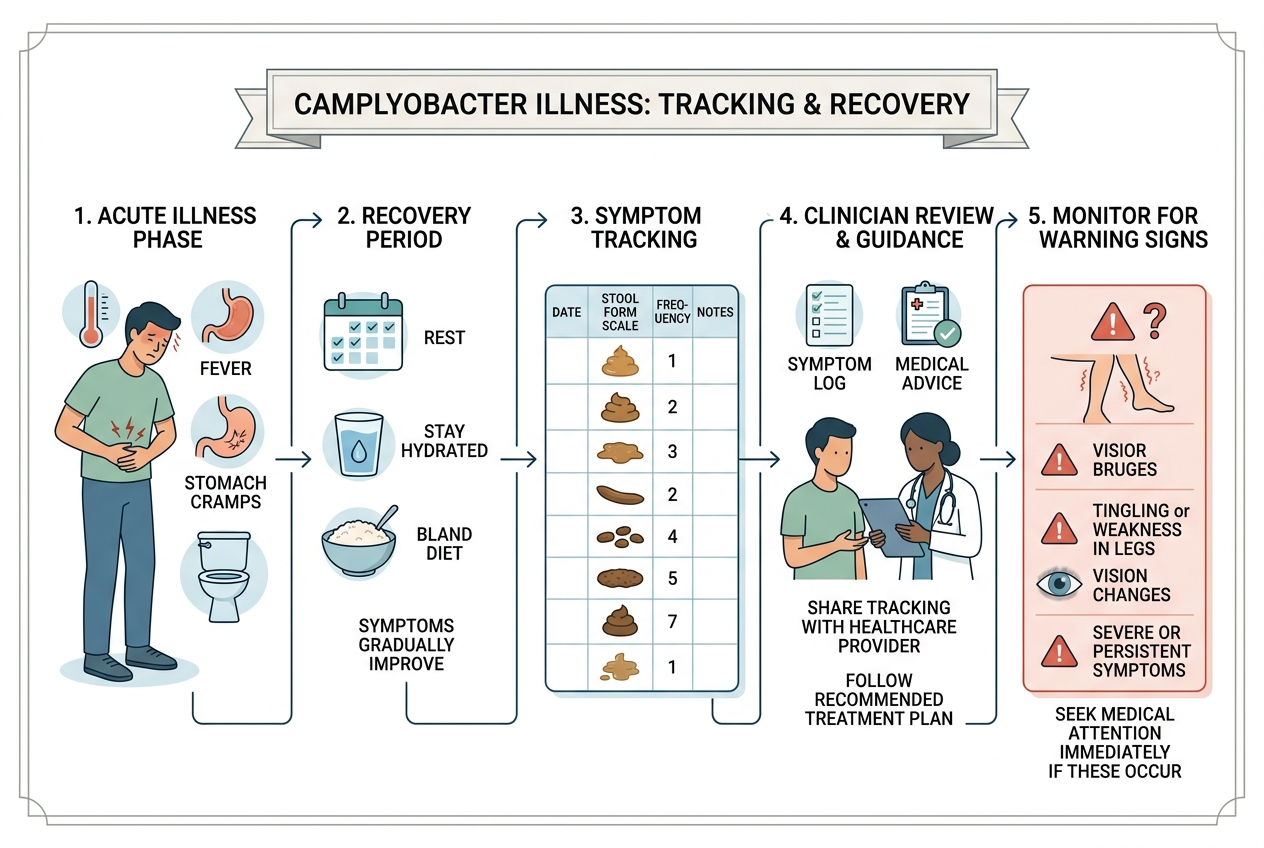
    Campylobacter can change bowel habits after acute diarrhea ends. The intestine may need time to recover, and some people develop post-infectious irritable bowel syndrome, with diarrhea, constipation, urgency, pain, or mixed stools. Persistent or worsening changes need medical review, especially with blood, fever, dehydration, weight loss, weakness, or tingling.

    How did we evaluate bowel changes after Campylobacter infection?

    We evaluated bowel changes after Campylobacter by prioritizing public-health guidance, culture-confirmed cohort studies, symptom timelines, and clearly defined post-infectious outcomes. The Centers for Disease Control and Prevention supplied the acute illness course and urgent warning signs, while peer-reviewed cohorts supplied longer-term risk estimates and stool-pattern data. We excluded anecdotes, microbiome test interpretations, restrictive diet claims, and supplement claims that did not distinguish recovery symptoms from recurrent infection or another condition. We also treated every percentage as population evidence rather than a forecast for one person, because illness severity, age, baseline bowel pattern, medications, and follow-up methods differ among studies. This method can explain why diarrhea, constipation, urgency, or mixed stools sometimes appear after campylobacteriosis. It cannot determine whether one person’s current symptoms represent post-infectious irritable bowel syndrome, ongoing infection, medication effects, inflammatory disease, or an unrelated problem; that distinction requires clinical assessment.

    Why can bowel habits change after Campylobacter infection?

    Campylobacter infection causes intestinal inflammation during acute gastroenteritis, and the digestive tract may remain sensitive after the organism is no longer causing the initial illness. The CDC Campylobacter symptom guide states that diarrhea, fever, and stomach cramps usually begin two to five days after exposure and usually end within seven days. A later change in stool frequency or consistency does not prove that Campylobacter remains active. Post-infectious irritable bowel syndrome can follow bacterial gastroenteritis and can produce abdominal pain with diarrhea, constipation, or a mixed pattern. Food intake, hydration, reduced activity, antibiotics, and temporary avoidance of familiar foods can also change the Bristol Stool Form Scale pattern during recovery. These mechanisms can overlap, so one unusually loose or firm stool has limited diagnostic value. The useful signal is a repeated pattern: when it began, how often it happens, whether pain improves after a bowel movement, and whether alarm features accompany it.

    How common is post-infectious IBS after Campylobacter?

    Post-infectious irritable bowel syndrome is a recognized complication, but estimates depend on the population and the study definition. A U.S. insurance-claims cohort of 4,143 Campylobacter cases found a one-year IBS incidence of 33.1 per 1,000 cases versus 5.9 per 1,000 matched controls, with an adjusted hazard ratio of 4.6 (American Journal of Gastroenterology study). A separate Minnesota cohort surveyed people six to nine months after culture-confirmed infection and found that 301 of 1,418 respondents without prior IBS met study criteria for post-infectious IBS; mixed and diarrhea-predominant patterns were most common (Clinical Gastroenterology and Hepatology study). That 21% estimate should not be applied to every infection because survey response, illness severity, and case selection affect prevalence. The consistent conclusion is directional: Campylobacter increases later IBS risk, but most people still do not receive that diagnosis.

    What bowel-pattern details should you track after infection?

    Track stool form, frequency, urgency, abdominal pain, nighttime symptoms, meals, medications, and hydration for one to two weeks instead of labeling every change as a relapse. The Bristol Stool Form Scale gives a repeatable description from hard type 1 stools to watery type 7 stools. Record whether pain is related to bowel movements, whether diarrhea wakes you from sleep, and whether symptoms occur without eating. Note antibiotic start and stop dates because antimicrobial exposure can alter stool patterns and can create separate clinical questions. Record fever, visible blood, black stool, vomiting, dizziness, reduced urination, and unintentional weight change because those details affect urgency. A log should support a clinician visit, not become a reason for increasingly restrictive eating. Daily entries are more useful than memory because mixed patterns can hide inside an average. Bring laboratory results, the original Campylobacter test date, medication list, and the symptom log to a primary-care or gastroenterology appointment.

    What can support recovery while bowel habits are unsettled?

    Diagram of Campylobacter recovery, bowel symptom tracking, and warning signs for medical review.
    Diagram of Campylobacter recovery, bowel symptom tracking, and warning signs for medical review.

    Fluids, regular meals, and gradual food normalization support recovery better than a sudden collection of supplements or an extreme elimination diet. During ongoing diarrhea, water alone may not replace sodium and glucose losses; an oral rehydration solution uses defined proportions to improve fluid absorption. After vomiting and severe diarrhea settle, familiar foods in smaller portions can make intake easier while preserving energy and protein. Fiber changes should be gradual because a rapid increase in fermentable fiber can increase gas, while an abrupt low-fiber pattern can change stool bulk. Alcohol, very large high-fat meals, and heavy caffeine may worsen urgency for some people, but individual tolerance matters more than a universal banned-food list. Antibiotics should not be restarted, extended, or borrowed without a clinician because the CDC clinical overview notes that most infections are self-limited and treatment decisions depend on illness severity and resistance considerations. Recovery support does not replace reassessment when symptoms persist.

    When do bowel changes after Campylobacter need medical care?

    Seek prompt medical advice when diarrhea or vomiting lasts more than two days, stool or urine contains blood, fever exceeds 102°F, or dehydration causes dark urine, little urination, intense thirst, dry mouth, dizziness, or lightheadedness. Those thresholds come from current CDC guidance and apply to the acute illness, while persistent nighttime diarrhea, progressive pain, repeated vomiting, or unintentional weight loss also deserve evaluation. Campylobacter can rarely precede Guillain-Barré syndrome, so new tingling or weakness that begins in both legs and moves upward needs urgent assessment. Older adults, pregnant people, young children, and people with weakened immune systems have a higher risk of severe illness. A change from diarrhea to constipation does not cancel warning signs, and a prior IBS diagnosis should not automatically explain new bleeding, fever, or neurologic symptoms. Emergency care is appropriate for severe dehydration, fainting, confusion, breathing difficulty, rapidly progressing weakness, or inability to keep fluids down.

    What questions come up after Campylobacter changes bowel habits?

    Questions after Campylobacter usually involve timing, recurrence, food tolerance, testing, and post-infectious IBS. The central distinction is between a short recovery fluctuation and a sustained pattern that changes daily function. Stool appearance alone cannot make that distinction, and smell cannot identify a pathogen. A clinician combines symptom duration, exposure history, medication use, fever, bleeding, hydration, examination, and selective testing. Repeating a stool test may be useful in some situations, but it is not an automatic step for every loose stool after recovery. The six answers below summarize practical boundaries while preserving uncertainty safely. They do not establish a diagnosis or a treatment plan. A person with severe pain, bloody stool, dehydration, high fever, nighttime symptoms, weight loss, pregnancy, immune suppression, or neurologic symptoms should use direct medical guidance rather than a generic recovery timeline.

    Can Campylobacter cause constipation after diarrhea?

    Constipation can appear during recovery when intake, hydration, movement, medications, or the underlying bowel pattern changes. Constipation alone does not prove post-infectious IBS, and persistent pain or alarm features need assessment.

    How long can bowel changes last after Campylobacter?

    Acute symptoms usually resolve within about one week, but post-infectious bowel changes can last longer. A sustained pattern over weeks or months should be reviewed instead of assumed to be normal recovery.

    Does a negative stool test rule out post-infectious IBS?

    Post-infectious IBS is not diagnosed by finding Campylobacter in stool. It describes an ongoing bowel-symptom pattern after the acute infection, so evaluation uses symptom criteria and rules out competing explanations when appropriate.

    Can Campylobacter come back?

    Reinfection is possible after a new exposure, while persistent symptoms can also have noninfectious causes. Similar symptoms do not prove the same organism returned; testing decisions depend on the clinical context.

    Should you take probiotics after Campylobacter?

    Evidence depends on the exact organism, dose, timing, and outcome, and no generic probiotic can be assumed to prevent post-infectious IBS. People with weakened immunity or serious illness should ask a clinician before using live-microorganism supplements.

    What should you bring to a medical appointment?

    Bring the original test date, antibiotic details, current medications, stool-frequency and Bristol-type notes, food changes, fever readings, hydration signs, and any bleeding or weight change. A concise timeline helps separate acute infection, recovery, and a new persistent pattern.

    What is the bottom line on Campylobacter and changed bowel habits?

    Campylobacter can be followed by temporary bowel instability or a longer post-infectious IBS pattern, but neither outcome can be confirmed from stool appearance alone. Most acute infections resolve within about seven days, while population studies show that later IBS risk is higher after laboratory-confirmed infection than in uninfected comparison groups. Track the pattern, restore fluids and familiar foods gradually, and use a clinician to evaluate symptoms that persist, worsen, or interfere with daily life. Blood, high fever, dehydration, weight loss, nighttime diarrhea, severe pain, repeated vomiting, weakness, or tingling changes the decision from observation to prompt medical care. A normal recovery timeline cannot be promised for one person because baseline bowel habits, illness severity, age, medications, and other conditions change the course. The safest interpretation pairs a short symptom log with clear thresholds for professional review rather than assuming every change is either harmless or recurrent infection.

  • Why Do Fans or Air Conditioning Trigger a Dry Cough?

    Why Do Fans or Air Conditioning Trigger a Dry Cough?

    A dry cough near a fan or air conditioner can come from direct cool airflow, low humidity, dust or allergens moved by the air, or sensitive airways. Reflux may contribute to chronic cough but does not specifically explain a fan trigger. Move out of the airflow, check indoor conditions, and seek care for persistent or breathing-related symptoms.

    How did we evaluate coughing near a fan or air conditioner?

    We evaluated the pattern by separating four questions: whether airflow changes the throat or airways, whether the device moves indoor pollutants, whether an underlying condition lowers the cough threshold, and whether warning signs require prompt care. Guidance from the National Heart, Lung, and Blood Institute, Environmental Protection Agency, National Institute of Diabetes and Digestive and Kidney Diseases, and National Library of Medicine received more weight than personal anecdotes or claims that air conditioning directly causes one disease. We excluded the assumptions that every fan cough is an allergy, every chronic cough is reflux, or adding humidity is always safe. The evidence describes known cough triggers and indoor-air controls; it cannot diagnose a specific room, HVAC system, or person. Timing, airflow direction, humidity, visible dust or moisture, wheeze, nasal symptoms, meal timing, medication use, and cough duration help distinguish patterns. New breathing difficulty overrides any home experiment.

    Why can moving air trigger a dry cough?

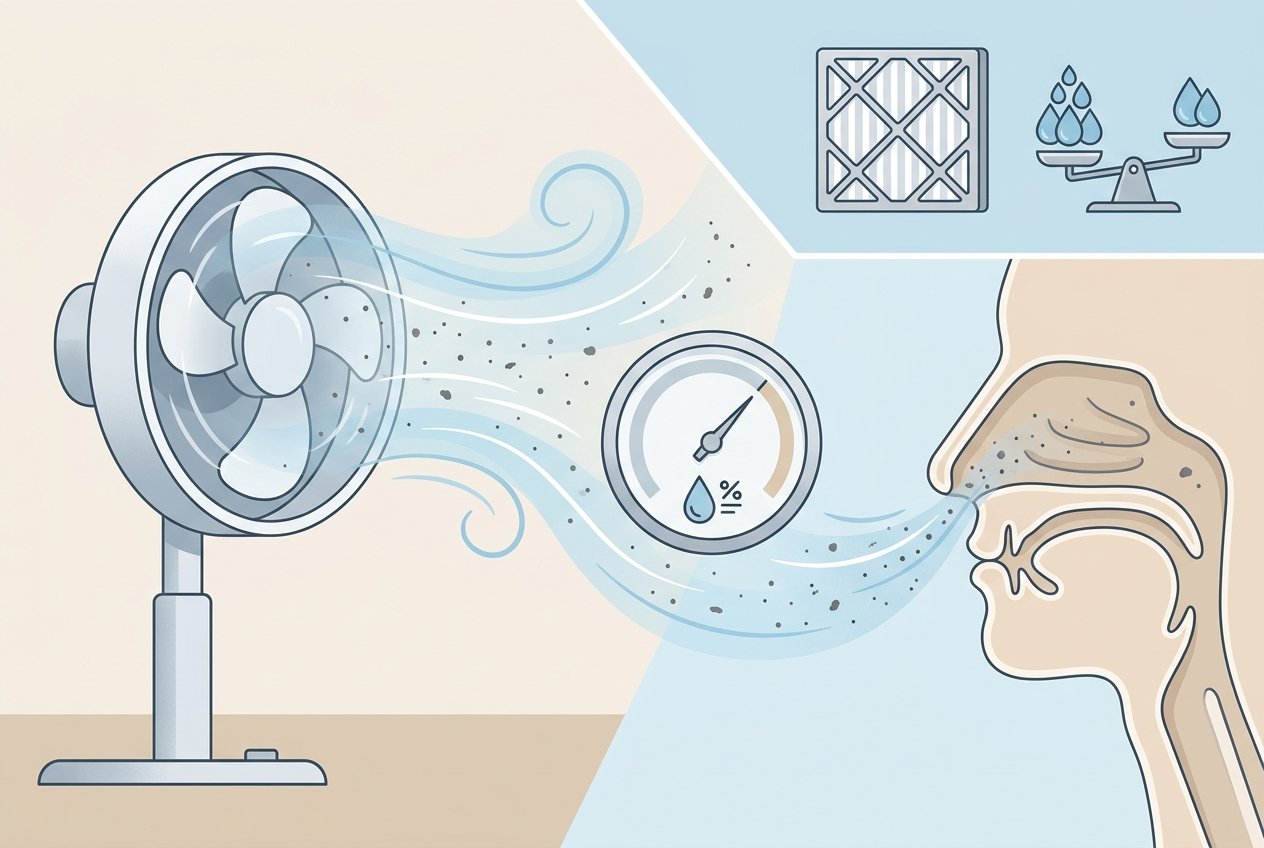
    Direct airflow increases evaporation from the surface of the nose, mouth, and throat, which can make an already sensitive airway feel dry or ticklish. Cool air can also provoke cough or chest tightness in people with airway hyperresponsiveness. A fan adds another variable: it can resuspend settled dust, pet dander, pollen, cleaning residue, or other particles from bedding, carpets, shelves, and blades. An air conditioner can reduce humidity, but a poorly maintained filter, drain pan, or duct can also accompany dust or moisture problems. None of these pathways means that the appliance created a chronic disease. The most informative clue is reproducibility: symptoms start in the direct stream, improve after moving away, and return under similar conditions. Even then, the response only identifies an exposure pattern. Infection, asthma, allergic rhinitis, medication effects, smoke, reflux, and other causes can lower the cough threshold and make ordinary airflow noticeable.

    How can you tell whether airflow, dust, or humidity matters most?

    Change one variable at a time. First, keep the room and temperature the same but redirect the fan or vent away from the face and upper body. If the cough improves, direct airflow becomes more plausible. Next, inspect fan blades, vent grilles, the accessible filter, and nearby surfaces for dust; follow the manufacturer’s cleaning and replacement instructions rather than spraying fragrance or disinfectant into the air stream. Measure relative humidity with a hygrometer for several days. The EPA indoor-air guide recommends roughly 30% to 50% indoor humidity because very damp rooms support mold and dust mites, while very dry air can feel irritating. Note whether symptoms also occur during vacuuming, bed-making, pet exposure, outdoor pollen days, or in another building with air conditioning. A portable air cleaner may reduce some particles, but it does not identify the source or replace moisture control, cleaning, and ventilation.

    Could asthma or allergies explain the pattern?

    Asthma can present with cough, wheeze, shortness of breath, or chest tightness, and symptoms often vary over time. The NHLBI lists very cold air, poor air quality, dust mites, mold, pet allergens, pollen, infections, stress, and exercise among recognized triggers. Allergic rhinitis or nonallergic nasal irritation can also send mucus toward the throat and produce repeated throat clearing or cough. A fan may expose the pattern by moving cool air or particles; it does not prove which condition is present. Record whether the cough occurs at night, during exercise, after laughter, with seasonal nasal symptoms, or alongside wheeze. A clinician may use history, lung examination, spirometry, peak-flow patterns, or allergy assessment rather than symptoms alone. Do not borrow another person’s inhaler or start repeated antihistamine use as a diagnostic test. New wheeze, reduced exercise tolerance, or recurring nighttime cough deserves medical assessment.

    Could acid reflux cause a cough that seems linked to air conditioning?

    Fan airflow, dust particles, humidity, and an HVAC filter shown as factors in a dry cough
    Fan airflow, dust particles, humidity, and an HVAC filter shown as factors in a dry cough

    Gastroesophageal reflux can accompany chronic cough or hoarseness even when heartburn is absent. The NIDDK lists chronic cough among possible mouth, throat, or lung-related GERD symptoms, but that association does not prove reflux causes an individual cough. A fan-specific response points first toward airflow, temperature, or moved particles unless episodes also track meals, lying down, regurgitation, sour taste, heartburn, or swallowing symptoms. Reflux and airway sensitivity can coexist, so choosing one label too early may hide the other pattern. Avoid using a long antacid trial as a home diagnostic shortcut, especially when symptoms are new or persistent. Instead, record meal timing, position, nasal symptoms, airflow exposure, wheeze, and medication use in the same log. Chest pain, trouble swallowing, bleeding, persistent vomiting, or unexplained weight loss requires clinical evaluation rather than assumption of uncomplicated reflux.

    What is a safe one-week home check for this cough?

    Use a short, controlled observation only when there is no breathing difficulty or other warning sign. On days one and two, redirect airflow away from the face without changing room temperature. On days three and four, clean accessible fan blades and grilles, replace or clean the HVAC filter according to the equipment instructions, and damp-dust nearby surfaces. Measure humidity rather than guessing; keep it within the EPA’s approximate 30% to 50% range and avoid overusing a humidifier, which can disperse minerals or support microbial growth when poorly maintained. On days five through seven, compare the same room with the fan off, indirect, and direct for similar periods. Record cough frequency, throat irritation, wheeze, nasal symptoms, temperature, humidity, and recent meals. Stop the experiment if symptoms worsen. Do not deliberately expose yourself to suspected mold, strong chemicals, smoke, extreme cold, or a device that smells burned or shows water damage.

    When should a dry cough be evaluated by a clinician?

    Seek emergency help for shortness of breath, difficulty breathing, facial or throat swelling, blue or gray lips, severe chest pain, confusion, fainting, or coughing blood. MedlinePlus also advises prompt medical contact for cough with fever, a high-pitched breathing sound, foul or colored phlegm, rapid violent onset, or persistence beyond roughly 10 to 14 days. Arrange a routine visit sooner when cough repeatedly interrupts sleep, follows exercise, includes wheeze, occurs after a new medicine such as an ACE inhibitor, or appears in a building with visible mold or dampness. Bring the exposure log, humidity readings, medication list, filter history, and information about smoking, vaping, work exposures, pets, recent infection, and reflux symptoms. A clinician may examine the nose, throat, lungs, and heart, then choose spirometry, imaging, allergy assessment, or reflux evaluation based on the pattern. Testing should follow the likely cause, not a generic cough panel.

    What are common questions about fan- or AC-related cough?

    Can a fan make allergies worse?

    A fan can move settled dust, pollen, pet allergens, or mold fragments into the breathing zone. The EPA identifies mold, dust mites, pollen, and pet allergens as triggers for allergic and asthma symptoms.

    Is dry air the only reason an air conditioner causes coughing?

    No. Low humidity can irritate the throat, while cool air, resuspended particles, a dirty filter, moisture problems, infection, or underlying airway sensitivity may produce a similar pattern.

    Should I use a humidifier beside the bed?

    Measure humidity first and clean any humidifier exactly as directed. Raising humidity above the recommended range can support mold and dust mites, so more moisture is not automatically better.

    Can a dirty AC filter cause a cough?

    A loaded or poorly fitted filter can accompany higher particle exposure, but the filter alone may not explain the symptom. Replace or clean the correct filter on schedule and inspect the room for other sources.

    Why do I cough only when air blows on my face?

    Direct cool airflow can dry and stimulate sensory nerves in the nose, throat, or airways. Improvement after redirecting the stream supports an airflow trigger but does not identify the underlying sensitivity.

    Does coughing near AC mean I have asthma?

    No. Cold-air-triggered cough can occur with asthma, but diagnosis requires the symptom pattern and often lung-function testing; allergies, infection, reflux, medication effects, and irritation can overlap.

    What is the practical bottom line?

    A fan or air conditioner can expose a cough trigger without being the root diagnosis. Test the simple variables first: move out of direct airflow, inspect and clean accessible dust, follow the correct filter schedule, measure rather than guess humidity, and record whether symptoms follow temperature, particles, exercise, meals, position, or nasal congestion. Keep indoor humidity near the EPA’s 30% to 50% range instead of automatically adding moisture. A repeatable response to cold air, exercise, wheeze, or nighttime symptoms supports an airway assessment; a pattern with regurgitation, heartburn, meals, or lying down supports a reflux discussion. These clues can coexist and should not be used to self-diagnose. Stop the home check and seek urgent care for breathing difficulty, facial or throat swelling, blue or gray lips, severe chest pain, fainting, confusion, or coughing blood. Persistent or recurring cough deserves a clinician review even when redirecting the fan helps.

  • Why Does My Chest Feel Cold Inside? Causes and Warning Signs

    Why Does My Chest Feel Cold Inside? Causes and Warning Signs

    A cold sensation inside the chest is a nonspecific symptom, not a diagnosis. Reflux, esophageal irritation, cold-air-triggered airway tightness, hyperventilation, or altered nerve sensation may contribute, but heart and lung problems must be considered first. New chest discomfort with pressure, breathlessness, sweating, faintness, or spreading pain needs emergency evaluation.

    How did we evaluate a cold sensation in the chest?

    We evaluated this symptom by prioritizing time-sensitive heart and lung warning signs before considering digestive, airway, breathing-pattern, musculoskeletal, or sensory explanations. American Heart Association, National Institutes of Health, National Library of Medicine, and National Heart, Lung, and Blood Institute guidance received more weight than forum descriptions or symptom-matching tools. We excluded any claim that the word “cold” identifies one organ, that a history of reflux makes new chest symptoms harmless, or that anxiety should be assumed before medical causes are assessed. The available evidence describes recognized symptom clusters rather than a clinical trial of “cold chest sensation,” so the article cannot estimate an individual probability or make a diagnosis. Context matters: onset, duration, exertion, breathing, swallowing, meals, temperature exposure, medications, and associated symptoms can change the urgency. When uncertainty involves possible chest pain or breathing difficulty, in-person assessment is safer than self-testing.

    What can cause a cold feeling inside the chest?

    Several systems can create an internal cold, cool, minty, hollow, or airflow-like sensation. The esophagus can refer discomfort behind the breastbone, especially when swallowing, reflux, or temperature-sensitive foods are involved. The airways can feel tight or unusually cool after cold-air exposure, exercise, infection, or irritant exposure. Hyperventilation can lower blood carbon dioxide and produce chest discomfort, breathlessness, tingling, dizziness, or temperature-like sensory changes. Chest-wall muscles and nerves can also create localized sensations that change with posture, pressure, or movement. Heart and lung disorders sometimes present with vague discomfort rather than textbook pain, which is why the quality word alone cannot rule them out. A useful distinction is pattern, not adjective: symptoms triggered by exertion, breathing, swallowing, meals, cold air, or body position point toward different evaluations. Repeated episodes still deserve clinical review when the cause is unknown, even if each episode is mild.

    When is a cold chest sensation an emergency?

    Call emergency services for new chest pressure, squeezing, fullness, significant pain, severe tightness, or discomfort that lasts more than a few minutes or returns. The American Heart Association also lists shortness of breath, cold sweat, nausea, lightheadedness, unusual fatigue, and discomfort spreading to an arm, the back, neck, jaw, or stomach as warning signs. Sudden breathing difficulty, blue or gray lips, fainting, coughing blood, new one-sided weakness, or a very rapid or irregular heartbeat also needs urgent attention. Do not drive yourself if a heart attack or serious breathing problem is possible; emergency medical services can begin assessment and treatment during transport. Age does not make self-diagnosis reliable, and prior reflux or anxiety does not prove that a new episode has the same cause. If the sensation is happening now and you are unsure whether it counts as chest pain, describe the whole symptom cluster to emergency dispatch.

    Could acid reflux or the esophagus create this feeling?

    Reflux commonly causes heartburn or regurgitation, but people may use unusual words for sensations behind the breastbone. The NIDDK defines gastroesophageal reflux as stomach contents moving into the esophagus and notes that repeated bothersome symptoms can represent GERD. A cold feeling is not a standard reflux diagnosis, so timing matters: symptoms after meals, while lying down, with sour fluid, belching, hoarseness, or burning make an esophageal source more plausible but not certain. Esophageal spasm can cause chest or upper-abdominal pain and swallowing difficulty; MedlinePlus warns that its pain can resemble angina. Very hot or cold food may trigger spasm in some people, but that pattern still requires medical interpretation. New chest symptoms should not be treated indefinitely with antacids as a diagnostic test. Trouble swallowing, food sticking, bleeding, vomiting, or unintentional weight loss warrants prompt evaluation.

    Could cold air, asthma, or breathing patterns contribute?

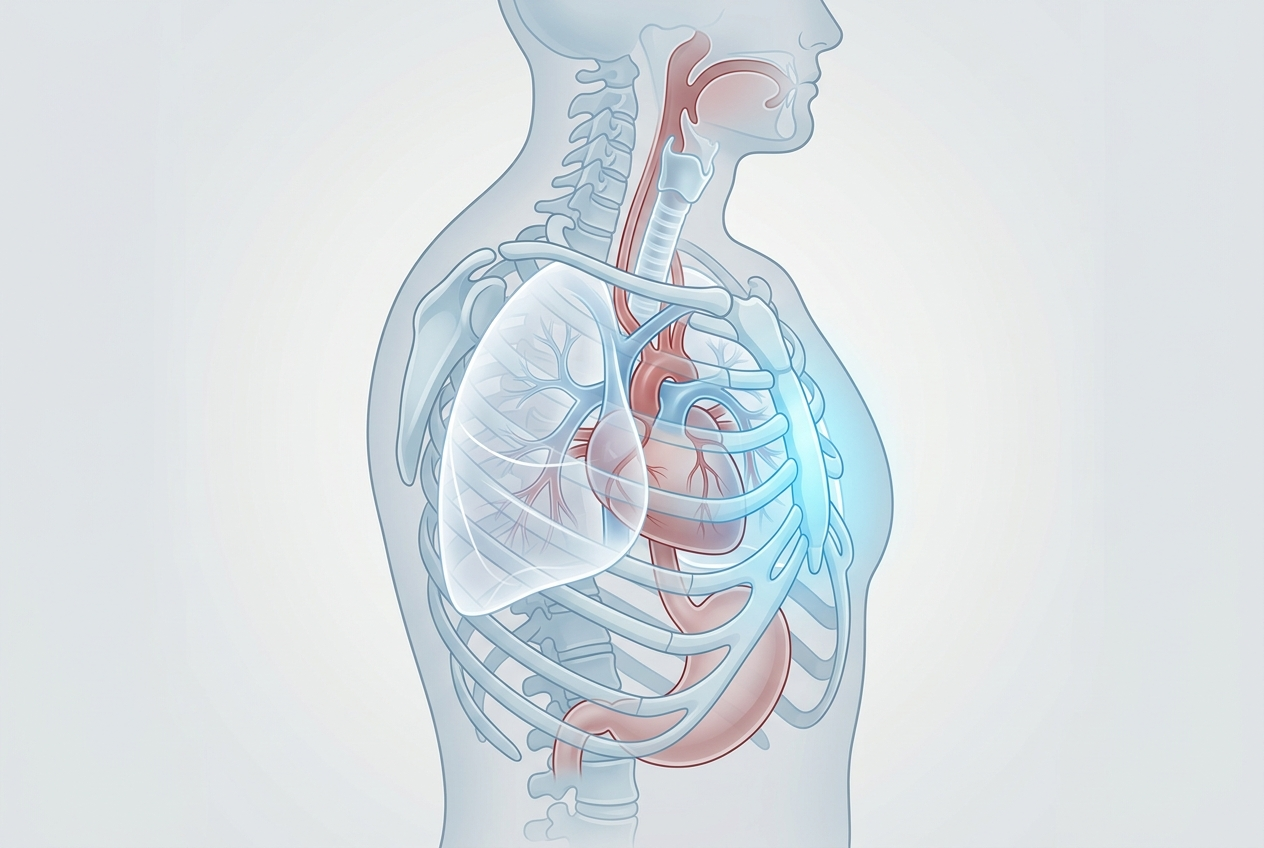
    Simplified chest anatomy showing the heart, lungs, airway, and esophagus as possible sources of chest sensations
    Simplified chest anatomy showing the heart, lungs, airway, and esophagus as possible sources of chest sensations

    Cold air can trigger coughing, wheezing, shortness of breath, or chest tightness in susceptible airways. The National Heart, Lung, and Blood Institute lists cold air and exercise among common asthma triggers, but a cold sensation without wheeze does not establish asthma. Hyperventilation creates a different pathway: rapid or deep breathing lowers carbon dioxide and may cause chest pain, a pounding heartbeat, breathlessness, dizziness, muscle spasm, or tingling. MedlinePlus notes that hyperventilation can arise from anxiety but also from medical problems including infection, asthma, pulmonary embolism, and heart conditions. That overlap makes “it is just panic” a risky first conclusion. Record whether the episode follows outdoor cold, exercise, laughter, stress, a respiratory infection, or rapid breathing. A clinician may compare the history with oxygen level, lung examination, peak flow or spirometry, electrocardiography, and other tests based on risk.

    What details should you record before a medical visit?

    Write down the exact start time, duration, location, intensity, and whether the sensation stays in one spot or spreads. Note what happened immediately beforehand: exercise, cold-air exposure, eating, swallowing, lying down, medication use, caffeine, nicotine, illness, or emotional stress. Record accompanying pressure, pain, palpitations, cough, wheeze, breathlessness, sweating, nausea, dizziness, tingling, belching, sour taste, trouble swallowing, fever, or rash. Describe what changes it, including rest, posture, a deep breath, pressing the chest wall, warm air, food, or an antacid, without using the response as proof of a diagnosis. Include medical history, pregnancy status, recent travel or immobility, infections, heart or lung risk factors, and all prescription and nonprescription substances. A timestamped note is more useful than repeatedly checking pulse or searching symptom lists. If a warning sign appears while tracking, stop documenting and seek urgent care.

    What might a clinician check for this symptom?

    The evaluation depends on urgency and pattern. A clinician may check vital signs, oxygen saturation, heart rhythm, lung sounds, chest-wall tenderness, swallowing symptoms, medication effects, and cardiovascular or clotting risk. An electrocardiogram and blood testing may be used when a heart cause is possible; chest imaging or clot-focused testing may be considered when breathing symptoms, infection, trauma, or pulmonary embolism risk is present. Spirometry can help assess recurring wheeze or cold-air-triggered tightness. Reflux-focused care usually begins with history and a limited treatment plan, while persistent swallowing pain, food sticking, or unexplained weight loss can prompt endoscopy or esophageal testing. Normal results on one test do not automatically explain the sensation, but they can narrow dangerous possibilities. Ask what has been ruled out, what remains likely, which changes require emergency care, and how long to observe before follow-up. A clear safety plan is more useful than a vague reassurance.

    What are common questions about a cold chest sensation?

    Can anxiety make the inside of the chest feel cold?

    Anxiety can change breathing rate, muscle tension, heartbeat awareness, and temperature perception. It should be considered after urgent heart, lung, and other medical causes have been assessed, especially when the symptom is new or different.

    Is a cool feeling in the chest a typical GERD symptom?

    Heartburn and regurgitation are more typical GERD symptoms. A cool or minty feeling may still be described during an esophageal event, but the adjective alone does not confirm reflux.

    Why does the sensation happen when I breathe cold air?

    Cold, dry air can irritate sensitive airways and trigger cough, wheeze, or tightness. Repeated exercise- or cold-triggered symptoms deserve an asthma-focused assessment rather than unsupervised inhaler use.

    Can an esophageal spasm feel like a heart problem?

    Yes. Esophageal spasm and heart-related discomfort can overlap in location and quality, so chest symptoms with pressure, exertion, breathlessness, sweating, faintness, or spreading pain require urgent evaluation.

    Should I take an antacid to see whether it is reflux?

    An antacid response does not reliably exclude heart or lung causes. Follow label directions only when the situation is nonurgent and a clinician or pharmacist says the medicine fits your history.

    When should a mild recurring sensation be checked?

    Arrange a medical visit when episodes recur, last longer, change pattern, follow exertion, disturb sleep, or include swallowing or breathing symptoms. Seek emergency care immediately if any warning sign appears.

    What is the practical bottom line?

    A cold sensation in the chest cannot be diagnosed from the temperature word alone. First screen for emergency features: pressure, squeezing, spreading discomfort, breathlessness, sweating, nausea, faintness, blue or gray lips, coughing blood, neurological changes, or a rapidly worsening episode. When those are absent, the timing can guide the next step: meals and lying down may suggest reflux evaluation; swallowing or temperature-sensitive foods may point toward the esophagus; cold air, exercise, cough, or wheeze may support airway testing; rapid breathing and tingling may reveal hyperventilation. These patterns are clues, not home diagnoses. Record the episode, substances, triggers, and associated symptoms, then discuss recurring or unexplained sensations with a clinician. Do not let a previous label of GERD, asthma, or anxiety automatically explain a new presentation. If the symptom is occurring now and feels concerning, use emergency services or urgent clinical guidance instead of continuing to search online.

  • Why Can Extreme Hunger and Burping Happen Together?

    Why Can Extreme Hunger and Burping Happen Together?

    Extreme hunger and burping can happen together when long meal gaps lead to fast eating, large portions, carbonation, or extra swallowed air. Indigestion or reflux may also contribute, but hunger does not prove excess stomach acid. Track timing and related symptoms. Persistent extreme hunger, weight loss, thirst, frequent urination, vomiting, or pain needs medical evaluation.

    How did we evaluate extreme hunger and burping?

    We evaluated the symptom pair by separating normal gastric belching, swallowed air, supragastric belching, meal timing, eating speed, carbonation, dyspepsia, reflux, medicines, glucose-related symptoms, and warning signs. We prioritized National Institute of Diabetes and Digestive and Kidney Diseases guidance, American Gastroenterological Association expert review, peer-reviewed belching research, and symptom-pattern tracking over “too much acid,” “fast metabolism,” parasite, or food-intolerance assumptions. We excluded the idea that burping locates a diagnosis, that hunger confirms an empty or over-acidic stomach, or that one elimination diet tests every cause. Evidence is limited because hunger and belching are common sensations that may coincide without sharing one mechanism, while excessive belching can arise from distinct gastric or supragastric patterns. The practical method is to record when each symptom starts, identify behaviors that change swallowed air or meal size, and escalate persistent or concerning patterns for clinical assessment rather than building a treatment plan from two symptoms alone.

    Why can hunger and burping occur at the same time?

    Long gaps between meals can make some people eat quickly, take larger bites, talk while chewing, or consume a large portion once food becomes available. Those behaviors increase swallowed air, and the stomach releases some of that air upward as a gastric belch. Carbonated drinks add gas directly, while gum, hard candy, straws, smoking, vaping, and hurried drinking can add more swallowed air. Hunger itself does not manufacture a large gas volume, but the behavior surrounding hunger can change how much air enters the upper digestive tract. Belching can also occur independently of meals. The American Gastroenterological Association review distinguishes gastric belching from supragastric belching, in which air moves into and out of the esophagus without reaching the stomach. That review draws on controlled and observational evidence plus expert opinion rather than a formal systematic review, so it supports a mechanism-based assessment, not self-diagnosis. Timing and behavior reveal more than the burp count alone.

    Does an empty stomach or “too much acid” explain the pattern?

    An empty stomach does not automatically mean excessive acid, and burping does not measure gastric acidity. Acid secretion, stomach stretch, swallowed air, esophageal movement, meal composition, and sensory processing are different processes. Some people notice burning, sour taste, regurgitation, or upper-abdominal discomfort alongside belching, which can make reflux or dyspepsia part of the clinical question. The NIDDK indigestion guide lists belching, bloating, nausea, upper-abdominal discomfort, early fullness, and uncomfortable post-meal fullness as possible dyspepsia symptoms, while noting that heartburn is a separate condition that can coexist. “Hunger pain” can also be a label people give to burning, emptiness, nausea, or discomfort rather than a verified need for calories. Avoid using symptom relief after food or an antacid as a diagnostic test because several mechanisms can change temporarily. A clinician interprets the pattern with history, examination, medicines, diet, and selective testing when indicated.

    What should you track before changing your diet?

    Track clock time, last meal, hunger intensity, belch frequency, meal size, eating speed, carbonation, gum, straws, caffeine, alcohol, nicotine, body position, and any burning, sour taste, nausea, bloating, pain, early fullness, or bowel change. Record medicines and supplements because metformin, glucose-lowering medicines, acid suppressors, pain relievers, fiber products, and other agents can change appetite or digestive sensations through different mechanisms. Use observations rather than conclusions: write “six belches within ten minutes after sparkling water” instead of “low stomach acid.” Keep ordinary eating reasonably stable for one to two weeks unless a clinician has already advised a change. Simultaneously removing dairy, gluten, fermentable carbohydrates, fat, caffeine, and spices destroys the comparison and can create an unnecessarily restrictive diet. Note whether extreme hunger comes with thirst, frequent urination, fatigue, blurred vision, shakiness, sweating, or unexplained weight change. A structured log helps a clinician choose a focused evaluation; it does not confirm reflux, dyspepsia, diabetes, hypoglycemia, or food intolerance by itself.

    Which low-risk changes can clarify the cause?

    Test one behavior at a time for several days. Eat before hunger becomes extreme when long gaps consistently lead to rushed meals, then slow the first ten minutes by taking smaller bites, chewing fully, and pausing between mouthfuls. Replace carbonated drinks with still water during the test and avoid gum, hard candy, straws, and talking while chewing when they appear linked to air swallowing. Keep portions moderate and remain upright after eating if regurgitation or sour taste occurs. Diaphragmatic breathing may help some supragastric-belching patterns; the AGA review lists behavioral approaches such as diaphragmatic breathing, cognitive behavioral therapy, and speech therapy, but these belong after the pattern is identified rather than as proof of a diagnosis. Do not start multiple supplements, digestive enzymes, acid products, or restrictive diets during the observation period. If one change clearly reduces episodes and symptoms return when the behavior returns, the pattern becomes more informative. Lack of response is also useful and supports broader clinical review.

    When does extreme hunger need medical evaluation?

    Fast meal with carbonation compared with slower eating and still water to assess swallowed air
    Fast meal with carbonation compared with slower eating and still water to assess swallowed air

    Arrange medical evaluation when hunger is new, persistent, difficult to satisfy, or paired with unexplained weight loss, excessive thirst, frequent urination, blurred vision, marked fatigue, shakiness, sweating, faintness, or medicine changes. The NIDDK diabetes symptom guide lists feeling very hungry even after eating alongside thirst and increased urination, but symptoms cannot diagnose diabetes; blood testing is required. Prompt assessment also matters for difficulty swallowing, repeated vomiting, bloody vomit, black stools, severe or constant abdominal pain, dehydration, anemia, or progressive early fullness. Chest, jaw, neck, or arm pain and breathing difficulty require urgent evaluation because digestive symptoms can overlap with emergencies. Excessive belching that disrupts speaking, eating, sleep, or work deserves review even without pain. A clinician can distinguish a behavioral belching pattern from reflux, dyspepsia, medication effects, glucose problems, or another cause and reserve endoscopy, imaging, breath testing, or motility studies for indications rather than ordering every test at once.

    FAQ: Does frequent burping mean you have acid reflux?

    No; burping is not specific to reflux because swallowed air, carbonation, gastric belching, supragastric belching, dyspepsia, and learned behavioral patterns can all produce it. Reflux becomes more relevant when belching accompanies sour taste, regurgitation, burning behind the breastbone, throat symptoms, or a consistent relationship to meals and lying down, but that combination still requires clinical interpretation. The AGA review notes that history and examination can guide the distinction and impedance-pH monitoring can differentiate gastric and supragastric belching when objective testing is needed; track content, timing, body position, and associated symptoms instead of counting burps alone because a dozen painless belches after carbonation differs from repeated regurgitation, swallowing difficulty, or nighttime symptoms. Seek evaluation when symptoms persist, worsen, disturb sleep or eating, or include warning signs rather than treating every belch as evidence of excess acid.

    FAQ: Can being very hungry make you swallow more air?

    Yes, indirectly, because intense hunger can lead to faster eating, larger bites, rapid drinking, talking while chewing, or reaching for carbonated beverages, all behaviors that can increase air swallowing even though hunger itself does not produce digestive gas. Test the pattern by eating a planned moderate meal or snack before hunger becomes extreme, slowing the first ten minutes, using still water, and removing gum or straws while keeping the foods otherwise similar. If belching falls when pace and air exposure change, the result supports a behavioral contribution but does not exclude reflux, dyspepsia, or another overlapping issue. If hunger remains extreme despite adequate meals, or occurs with thirst, frequent urination, weight loss, shakiness, sweating, or medicine changes, do not keep solving it through larger meals alone; record the symptoms and obtain medical guidance because the causes of hunger and belching may be related, partly related, or separate.

    FAQ: Does drinking water help hunger-related burping?

    Still water can replace carbonated drinks and may make slower eating easier, but drinking a large volume quickly can increase stomach stretch and swallowed air, so sip comfortably and compare still water with the usual beverage rather than assuming more is always better. Water does not confirm or correct “too much acid,” diagnose dehydration, or substitute for food when the body needs energy. If thirst is unusually strong and occurs with frequent urination, persistent hunger, blurred vision, fatigue, or weight loss, the combination deserves medical evaluation rather than a home hydration experiment. Avoid adding citrus, vinegar, carbonation, or large amounts of sweetener because each changes the exposure; a useful test isolates one variable with the same meal, similar portion, slower pace, and still water, then records burping, burning, fullness, and hunger separately because one sensation can improve while another remains.

    FAQ: Should you take an antacid when hunger and burping occur?

    Do not use an antacid as a diagnostic test for the symptom pair because temporary improvement in burning or sour taste does not prove reflux, no response does not rule it out, and belching driven by swallowed air or a supragastric pattern may be unaffected. Follow package directions and check with a pharmacist or clinician when you use other medicines, have kidney or heart concerns, are pregnant, or need antacids repeatedly. Frequent self-treatment can obscure the timeline, add sodium, calcium, magnesium, or aluminum depending on the formula, and delay evaluation of persistent symptoms, so track what changes—burning, taste, pain, or belching—rather than recording only “better.” Seek medical advice when symptoms require regular use, wake you at night, worsen, or accompany swallowing difficulty, vomiting, bleeding, weight loss, severe pain, chest discomfort, or breathing difficulty because the safest next step depends on the full pattern, not one burp.

    FAQ: What is the difference between gastric and supragastric belching?

    Gastric belching releases swallowed air that reached the stomach, while supragastric belching moves air rapidly into and out of the esophagus without entering the stomach; the patterns can feel similar, and supragastric belching can become frequent, repetitive, and linked to attention, stress, speech, or learned air movement. A 2026 diagnostic review describes clinical evaluation plus impedance-pH monitoring or high-resolution impedance manometry when confirmation changes management, while acknowledging that formal treatment evidence and validated outcome tools remain limited. Behavioral therapies, diaphragmatic breathing, and speech therapy may fit a confirmed supragastric pattern, whereas routine dietary restriction does not address the underlying air movement. Do not label the type from sound, force, or frequency alone; a gastroenterology or behavioral specialist can assess disruptive belching and choose testing selectively, especially when the pattern coexists with regurgitation, rumination, swallowing trouble, weight change, or other concerning symptoms.

  • How Can You Protect Your Teeth From Acid Reflux?

    How Can You Protect Your Teeth From Acid Reflux?

    Protect teeth from acid reflux by rinsing with water after regurgitation, waiting about an hour before brushing, using a soft brush with fluoride toothpaste, and reducing repeated acid exposure. A dentist can identify early erosive wear, while a medical clinician can evaluate frequent reflux. Enamel already lost to erosion does not grow back.

    How did we evaluate ways to protect teeth from acid reflux?

    We evaluated tooth-protection steps by separating immediate acid clearance, daily oral hygiene, fluoride exposure, dietary acids, saliva, reflux management, and professional monitoring. We prioritized the American Dental Association’s evidence review on dental erosion, systematic reviews indexed by PubMed, National Institute of Dental and Craniofacial Research materials, and consensus guidance over whitening advice, alkaline “hacks,” or product testimonials. We excluded claims that one rinse neutralizes every episode, that hard brushing removes acid damage, that enamel lost to erosion regrows, or that oral care alone controls gastroesophageal reflux. Evidence varies because erosive tooth wear reflects the frequency, duration, and intensity of acid exposure plus saliva, diet, brushing technique, anatomy, medicines, and nighttime patterns. The practical goal is therefore to shorten acid contact, avoid mechanical wear while enamel is softened, strengthen the remaining surface, and identify progression early. Dental and medical evaluation address different parts of that problem and work best together.

    Why can acid reflux damage tooth enamel?

    Gastric contents can bring acid into the mouth during regurgitation, especially when reflux reaches the throat or oral cavity. That acid can soften the mineralized enamel surface; repeated chemical challenges plus chewing or abrasion can gradually remove tooth structure. Dental erosion differs from cavities because acid-driven mineral loss does not require bacterial plaque, although a person can have erosion and tooth decay at the same time. A systematic review of 17 studies found a strong association between gastroesophageal reflux and dental erosion, but study designs and prevalence estimates varied widely, so reflux does not guarantee visible damage in every person. The American Dental Association notes that nighttime exposure can be especially concerning because saliva and swallowing decrease during sleep. Saliva normally dilutes, clears, and buffers acids. Repeated sour taste, regurgitation, dry mouth, or morning symptoms can therefore matter even without classic heartburn. A dentist confirms wear by history and examination rather than symptoms alone.

    What should you do right after reflux reaches your mouth?

    Rinse gently with plain water as soon as practical, then spit it out. Water removes residual acid without adding another acidic exposure or scraping a softened surface. The American Dental Association’s dental-erosion guidance also lists water, a sodium-bicarbonate rinse, or milk after vomiting, but a dentist should individualize any repeated rinse routine. Do not scrub the teeth immediately after regurgitation. Acid temporarily softens the enamel surface, and immediate brushing can add mechanical wear before saliva has helped the surface recover. ADA consumer guidance commonly recommends waiting about one hour before brushing after an acidic challenge. During that interval, avoid swishing acidic drinks, sucking citrus, or using abrasive whitening powders. Sugar-free gum may increase salivary flow when chewing is safe and comfortable. This sequence does not reverse erosion or manage the cause of reflux; it simply reduces the next avoidable insult while the mouth clears and buffers acid.

    How should you brush and use fluoride when reflux is frequent?

    Brush twice daily with a soft-bristle toothbrush and a low-abrasion fluoride toothpaste, using gentle pressure rather than aggressive scrubbing. Fluoride supports remineralization of the enamel that remains, but it cannot rebuild contour already lost through erosive wear. The ADA fluoride review explains that fluoride can create a more acid-resistant mineral surface, while the dental-erosion review cautions that protection varies by fluoride compound and preparation. Spit after brushing and follow the toothpaste directions; repeated vigorous rinsing can reduce the time fluoride stays in contact with teeth. Clean between teeth daily because reflux protection does not replace cavity and gum-disease prevention. Avoid abrasive charcoal, baking-soda scrubs, or frequent whitening products unless a dentist confirms they fit the wear pattern. A dentist may recommend higher-fluoride toothpaste, varnish, a specific mouthrinse, or protective restorations when risk is elevated. Those options depend on examination, age, caries risk, erosion severity, and total fluoride exposure.

    Which daily habits can reduce repeated acid exposure?

    Track when oral acid exposure occurs before changing many habits at once. Record meals, acidic drinks, alcohol, bedtime, body position, regurgitation, sour taste, dry mouth, medicines, and morning symptoms for one to two weeks. Reduce the frequency of acidic beverages and avoid holding or swishing them around the teeth; if you choose one, having it with a meal and rinsing with water afterward limits repeated contact better than sipping it for hours. Leave an appropriate interval between the last meal and lying down when a clinician recommends that strategy for nighttime reflux. Review dry-mouth contributors because saliva protects enamel through clearance, buffering, calcium, and phosphate. A 2024 systematic review of calcium formulations found mixed, formulation-specific evidence and variable risk of bias, so calcium products are not a universal solution. Food timing, reflux care, saliva, fluoride, and dental monitoring matter together. Do not stop prescribed reflux medicine or change dosing solely to protect teeth without medical guidance.

    When should a dentist and medical clinician get involved?

    Schedule a dental examination when reflux is frequent, teeth become sensitive, edges look thinner or more transparent, surfaces appear smooth or cupped, fillings seem raised, or bite and color change. Early erosive wear can be subtle and painless, so routine comparison with photographs, study models, scans, or wear indices may identify progression before major structure is lost. A dentist can distinguish erosion from abrasion, grinding, cavities, and developmental enamel changes, then match preventive or restorative care to the pattern. Medical evaluation belongs alongside dental care when regurgitation, heartburn, swallowing difficulty, chronic cough, unexplained chest discomfort, vomiting, or nighttime symptoms persist. Urgent assessment is appropriate for alarming symptoms such as vomiting blood, black stools, food sticking, severe dehydration, or chest pain that could have a cardiac cause. Dental treatment protects tooth structure but does not determine why gastric contents reach the mouth. Medical treatment can reduce exposure but does not restore eroded enamel. Coordinated care closes both gaps.

    FAQ: Should you brush immediately after acid reflux?

    No; rinse with water and wait about one hour before brushing after acid or vomit reaches the mouth. Gastric acid can soften the outer enamel surface, and immediate mechanical brushing may add wear while that surface is vulnerable, so use a soft-bristle brush, fluoride toothpaste, and gentle pressure after the waiting period rather than an abrasive whitening paste or hard scrubbing. This timing reduces a preventable mechanical challenge, but it does not mean that one reflux episode permanently damages every tooth or that waiting alone stops ongoing erosion because saliva flow, exposure duration, frequency, diet, brushing force, and existing enamel condition all influence risk. If reflux happens most nights or you are delaying brushing repeatedly, ask a dentist to design a workable schedule and a medical clinician to evaluate the exposure pattern; do not skip oral hygiene indefinitely, but move it away from the acid event and keep the routine consistent.

    FAQ: Can you neutralize stomach acid on your teeth with baking soda?

    A dilute sodium-bicarbonate rinse appears in ADA guidance as one option after vomiting, but concentration, frequency, swallowing risk, sodium considerations, and individual oral conditions make professional instructions worthwhile. Do not scrub dry baking soda onto softened teeth because abrasive rubbing and uncertain dosing solve a different problem from gentle rinsing; plain water remains the simplest immediate option when no tailored rinse has been recommended. A rinse can help clear or buffer residual acid, but it cannot replace saliva, fluoride, reflux care, or dental monitoring, cannot rebuild enamel already removed, and should not become a mixture of home chemicals or highly alkaline ingredients that irritate oral tissues. People with sodium restrictions, young children, or anyone likely to swallow a rinse should obtain specific guidance, and if repeated neutralizing feels necessary, record the timing because the frequency itself is useful information for both the dentist and the clinician managing the reflux symptoms.

    FAQ: Does fluoride toothpaste repair enamel damaged by reflux?

    Fluoride toothpaste supports remineralization and acid resistance in enamel that remains, but it does not regenerate missing tooth shape or replace dentin exposed by established erosion. Early surface softening and mineral loss may become more resistant when acid exposure decreases and fluoride, saliva, calcium, and phosphate support the remaining surface, while visible cupping, shortened edges, large smooth defects, or bite changes may require professional protection or restoration rather than a stronger over-the-counter paste alone. Use a soft brush and a fluoride toothpaste with an ADA-accepted claim that matches your needs, then follow the label instead of adding multiple high-fluoride products; a dentist may prescribe a higher-fluoride formulation when caries or erosion risk justifies it, but age, swallowing ability, total fluoride exposure, and the wear pattern matter. The realistic goal is to slow progression, reduce sensitivity, and protect remaining structure because “rebuild enamel” marketing often blurs surface remineralization with replacement of lost anatomy.

    FAQ: What does reflux-related tooth erosion look or feel like?

    Reflux-related erosive wear can produce smooth, silky, flattened, or cupped surfaces, thinning edges, yellowing as dentin becomes more visible, and sensitivity to temperature or sweetness. The pattern often affects surfaces exposed to regurgitated gastric contents, but location alone cannot prove reflux because acidic drinks, vomiting, occupational acids, dry mouth, grinding, and brushing abrasion can overlap. Early erosion may cause no symptom and may be easier to recognize by comparing photographs or scans over time than by looking in a mirror, while a dentist evaluates surface texture, contour, distribution, restorations, bite, diet, medicines, saliva, and symptom history before identifying likely contributors. Do not use sensitivity alone to self-diagnose erosion because cavities, cracks, gum recession, and recent dental work can produce similar sensations; if a tooth suddenly hurts, fractures, changes color, or becomes sensitive without an obvious reason, arrange dental assessment instead of waiting for a reflux appointment.

    FAQ: Can controlling reflux stop dental erosion completely?

    Reducing how often and how far gastric contents travel can lower one important acid source, but no intervention guarantees that erosive wear stops completely. Dietary acids, low saliva, vomiting, acidic medicines, supplements, grinding, and brushing abrasion can continue to affect teeth even when heartburn improves, and “silent” or weakly acidic reflux patterns may not be measured reliably by symptoms alone. Track oral and digestive events, maintain fluoride-based hygiene, reduce prolonged acidic sipping, and let a dentist monitor whether surfaces remain stable; medical clinicians can evaluate reflux frequency, warning signs, medicines, and treatment response, while dentists document wear and protect vulnerable structure. Do not judge control only by pain because enamel loss may progress without sensitivity, and do not assume every new dental change proves failed reflux treatment; complete protection means fewer acid challenges, better clearance, appropriate brushing, adequate fluoride, reduced abrasion, and periodic objective comparison.

  • How Do You Track Food and Digestive Symptoms for Free?

    How Do You Track Food and Digestive Symptoms for Free?

    A free food-and-symptom tracker can be a paper diary, phone note, or spreadsheet. Record meal time, ingredients, approximate amount, symptoms, bowel pattern, medicines, sleep, stress, and menstrual timing when relevant. Track consistently before removing foods. A diary can reveal repeatable patterns, but it cannot diagnose an allergy, intolerance, or digestive disorder by itself.

    How did we evaluate free food-symptom tracking methods?

    We evaluated tracking methods by asking whether they capture enough detail to test a repeatable pattern without making daily logging burdensome. We prioritized guidance from the National Institute of Diabetes and Digestive and Kidney Diseases, the National Institute of Allergy and Infectious Diseases food-allergy guideline, and clinical references on food-and-symptom diaries over commercial sensitivity tests or automated trigger scores. We excluded any tool that labels a food as an allergy from correlation alone, encourages multiple long-term eliminations without reintroduction, hides the raw entries, or asks users to change several variables at once. No tracking format has been proven universally superior, so this method ranks completeness, repeatability, exportability, privacy, ease of use, and a defined review date; a clinician or registered dietitian should interpret persistent symptoms, nutritional risk, suspected allergy, or severe reactions.

    What should a useful food-and-symptom diary record?

    A useful diary records time before it records theories. For each meal or snack, note the clock time, ingredients, approximate portion, preparation method, drinks, and any unusually large amount of fat, fiber, caffeine, alcohol, or sugar alcohols. Record symptoms separately with onset time, location, severity on a consistent 0–10 scale, and duration. Bowel entries can use the seven-type Bristol Stool Form Scale plus urgency and frequency. Context variables matter because sleep, stress, exercise, menstruation, travel, illness, and medicines can alter digestion independently of food. Write exact observations such as “cramping began 90 minutes after lunch” instead of conclusions such as “wheat allergy.” A free spreadsheet works well when rows represent events and columns represent variables; a phone note or paper page works when it is completed more reliably. Consistent, modest detail produces more useful evidence than an elaborate diary abandoned after two days.

    How can tracking avoid false food-trigger conclusions?

    False conclusions arise when a diary records only the suspected food and ignores dose, timing, meal combinations, or non-food variables. One uncomfortable evening after onions does not establish that onions caused the symptom. Look for the same exposure followed by a similar symptom across separate days, then check whether the pattern disappears on days without that exposure. Consider total meal size, fat content, fiber dose, carbonated drinks, caffeine, sleep loss, stress, and menstrual timing before isolating one ingredient. Delayed symptoms also make memory unreliable, which is why timestamps matter. The NIAID-sponsored guideline reports that many self-reported food allergies do not hold up when formally evaluated. A diary creates a hypothesis for professional review; it does not confirm immune-mediated allergy. Avoid algorithmic certainty scores that cannot show how they weighted missing entries, co-occurring foods, or days when the suspected food caused no symptoms.

    How long should someone track before changing the diet?

    Two weeks of ordinary eating often captures weekday, weekend, and routine variation without creating an endless surveillance project. Track longer when symptoms are infrequent, but choose a review date before starting. The goal is a sufficient sample of exposures and non-exposures, not a perfect record of every bite. Do not remove several foods during the baseline period unless a clinician has already advised avoidance, because simultaneous changes erase the comparison. When one plausible pattern emerges, discuss a time-limited, one-variable test and a planned reintroduction with a qualified professional. NIDDK notes that dietary changes may need several weeks to evaluate and recommends dietitian involvement for structured approaches such as a low-FODMAP diet. A tracker should become simpler after it answers the defined question. If no repeatable pattern appears, that result is useful: it argues against blaming a single ingredient and supports a broader medical, medication, bowel-pattern, or lifestyle review.

    When is self-tracking the wrong next step?

    Visual checklist of fields for a free food and digestive symptom tracker
    Visual checklist of fields for a free food and digestive symptom tracker

    Self-tracking is the wrong next step when symptoms suggest an urgent allergic or medical problem. Trouble breathing, throat or tongue swelling, faintness, widespread hives, or a rapidly worsening reaction requires emergency care rather than another diary entry. Blood in stool, black stool, persistent vomiting, dehydration, fever, severe or localized abdominal pain, unexplained weight loss, anemia, nighttime symptoms, or a major change in bowel habits also warrants clinical assessment. A food diary should not delay testing for celiac disease, inflammatory conditions, infection, medication effects, or other causes. Avoid starting a gluten-free diet before celiac testing unless a clinician directs it, because removing gluten can alter diagnostic results. Children, pregnant people, older adults, and anyone with a history of an eating disorder or nutritional deficiency need extra caution with restriction. A free tracker is useful for stable, non-urgent pattern collection; it is not a safety screen or diagnostic substitute.

    How should someone review the diary without over-restricting food?

    Review the diary on a scheduled day instead of reacting after every uncomfortable meal. Count exposures to the suspected food, symptom-positive exposures, symptom-free exposures, typical onset time, and whether the relationship changes with portion size. Compare the candidate trigger with context variables such as sleep, stress, constipation, menstrual timing, meal size, and medicines. Prioritize one testable question, for example whether a large milk serving repeatedly precedes symptoms while smaller servings do not. The NCBI food-allergy overview explains that diaries can support evaluation, while supervised testing is often needed to confirm allergy. A registered dietitian can protect nutrient adequacy and design reintroduction when restriction is justified. Keep tolerated foods in the diet. The most informative outcome may be a threshold, preparation method, or meal combination rather than complete avoidance. Broad, permanent restriction based only on a software correlation creates more certainty than the data can support.

    What should a free tracker template look like?

    Use one row per meal, symptom, bowel movement, medicine, or major context event. Recommended columns are date, time, event type, food or drink, ingredients, approximate amount, preparation, symptom, severity 0–10, onset, duration, stool type, urgency, sleep, stress, exercise, menstrual timing, and notes. Keep the raw data visible and editable. A daily summary can add total fiber changes, unusually large meals, hydration, and the day’s main symptom, but it should not replace event-level timestamps. Color can improve scanning, yet automatic red “trigger” labels should remain off until a repeatable pattern is reviewed. Store only the health information needed for the project, use device security, and remove names or identifiers before sharing. Export the relevant date range as a simple document for an appointment. A useful free template makes uncertainty visible, including blank cells, symptom-free exposures, and days when the suspected food was absent.

    What do people ask about food-and-symptom trackers?

    Can a diary diagnose a food intolerance?

    No. A diary can show a reproducible association and help a clinician choose the next test. Diagnosis depends on the condition and may require history, laboratory testing, breath testing, or supervised elimination and reintroduction.

    Should every ingredient be logged?

    Record enough detail to distinguish plausible exposures, especially sauces, sweeteners, dairy, wheat, onions, garlic, caffeine, and alcohol. Do not let perfection make the diary unusable; consistency matters more than reconstructing every trace ingredient.

    Is a symptom score useful?

    Yes, when the same 0–10 definition is used each time. Pair severity with onset and duration, because a number without timing cannot establish a meal relationship.

    Should several foods be eliminated at once?

    Usually not without professional guidance. Multiple simultaneous eliminations obscure which change mattered and can reduce fiber, calcium, energy, or overall dietary variety.

    What if every meal seems to cause symptoms?

    That pattern weakens the case for one specific food and raises questions about meal size, bowel motility, medication effects, constipation, visceral sensitivity, or another condition. A clinician should review persistent meal-linked symptoms.

    How should the diary be shared at an appointment?

    Bring a concise date range, a one-paragraph question, and the raw entries behind any summary. Highlight repeatable exposures and symptom-free counterexamples instead of presenting an app-generated diagnosis.

    What is the bottom line for tracking food symptoms for free?

    Choose the simplest tool you will complete: paper, a phone note, or a spreadsheet. Record timestamps, ingredients, portions, symptom severity, onset, duration, bowel pattern, medicines, sleep, stress, exercise, and menstrual timing when relevant. Keep ordinary eating stable long enough to observe a baseline, then review repeatable exposures and symptom-free counterexamples on a scheduled date. Do not let software convert correlation into an allergy label. Test one variable at a time only when the question is safe, specific, and compatible with nutritional needs, and plan reintroduction before restriction begins. Seek urgent care for breathing difficulty, swelling, faintness, blood in stool, dehydration, severe pain, or rapidly worsening symptoms. Use the diary as organized evidence for a clinician or registered dietitian, not as permission to remove an expanding list of foods. A good tracker narrows uncertainty; it does not manufacture certainty.

  • Why Can Probiotics Cause Side Effects Even When You Start Slowly?

    Why Can Probiotics Cause Side Effects Even When You Start Slowly?

    Starting a probiotic slowly does not guarantee tolerance. Mild gas can occur, but strong, persistent, or worsening bloating, pain, diarrhea, constipation, rash, fever, or vomiting is not a reason to keep escalating the dose. Stop the product, review every ingredient, and seek medical guidance when symptoms are significant or do not settle.

    How did we evaluate probiotic side effects?

    We evaluated probiotic reactions by separating common self-limited gastrointestinal effects from symptoms that require prompt review. We prioritized the NIH Office of Dietary Supplements probiotic fact sheet, the National Center for Complementary and Integrative Health safety summary, human microbiome studies, and complete ingredient labels over online “die-off” explanations. We excluded claims that worsening symptoms prove a supplement is working, because that interpretation cannot distinguish ordinary gas from intolerance, an unrelated illness, or a more serious reaction. Evidence remains limited because many probiotic trials do not collect adverse events consistently, commercial formulas contain different strains and excipients, and individual microbiomes respond differently. We also considered whether withdrawal produced a clear, repeatable change in symptom intensity. This framework supports a cautious stop-review-decide process; it cannot identify the cause of a specific person’s symptoms without clinical assessment.

    Why can a “mild” probiotic still cause strong symptoms?

    “Mild” is a marketing description, not a standardized dose, strain, safety category, or universally safe formula. A low capsule count can still deliver billions of viable organisms, multiple strains, fermentable prebiotic fibers, sugar alcohols, or allergens. These components can change gas production, stool water, or intestinal fermentation soon after use. Baseline diet, constipation, recent antibiotics, infection, medication changes, and existing gastrointestinal sensitivity can also shape the response. A human study in Cell found that probiotic colonization patterns were person-, region-, and strain-specific, which helps explain why one formula can feel neutral to one person and disruptive to another. That study does not prove the cause of any individual reaction, but it argues against universal tolerance claims. Starting with half a serving reduces exposure; it does not make an unsuitable organism, added fiber, or excipient automatically tolerable.

    Which reactions can be monitored, and which should not be pushed through?

    Temporary gas or a modest change in stool pattern can occur in otherwise healthy adults, according to the NIH, but safety data do not define a universal “adjustment period.” Stop escalating when discomfort interferes with sleep, meals, work, hydration, or ordinary activity. Stop the product and seek medical advice for persistent diarrhea, repeated vomiting, severe constipation, increasing abdominal pain, marked swelling, or symptoms that continue after the supplement is withdrawn. Urgent assessment is appropriate for trouble breathing, facial or tongue swelling, fainting, blood or black stool, high fever, severe dehydration, a rigid abdomen, or rapidly worsening pain. People with severe illness, compromised immune function, central venous catheters, or complex medical care should not use casual trial-and-error guidance. The NCCIH safety review reports that serious infections are rare but occur more often in vulnerable populations.

    What should you do when probiotic symptoms start?

    Pause the probiotic instead of increasing the serving to “get through” the reaction. Record the product name, lot number, organism names, strain codes, CFU statement, serving size, start date, last dose, storage method, and every symptom with timing. Keep meals, medicines, hydration, caffeine, alcohol, fiber supplements, and other new products as stable as practical so the timeline remains interpretable. Do not restart during active vomiting, substantial diarrhea, dehydration, fever, or escalating pain. If symptoms settle after withdrawal, that sequence supports—but does not prove—a product-related reaction. A clinician or pharmacist can review interactions, health risks, and whether another cause deserves evaluation. Report a serious supplement adverse event through the FDA MedWatch pathway when appropriate. Save receipts and packaging. A clean timeline is more useful than an unstructured cycle of stopping, restarting, and changing several products at once.

    Could the non-probiotic ingredients be the problem?

    Yes. A reaction can come from the delivery system rather than the live organism. Inulin, fructooligosaccharides, resistant starch, and other fermentable fibers can increase gas or alter stools, especially when the existing diet already contains substantial fermentable carbohydrate. Gummy formulas may contain maltitol, sorbitol, xylitol, or other sugar alcohols that draw water into the intestine and can loosen stools at higher intakes. Capsules can contain milk derivatives, soy, gelatin, colorants, or other excipients relevant to an allergy or dietary restriction. A synbiotic combines probiotics with prebiotic substrate, so its effects cannot be attributed to the microorganism alone. Read the Supplement Facts and “other ingredients” panels line by line, then compare them with foods, medicines, powders, or gummies used the same day. Serving size still matters. A shorter ingredient list makes troubleshooting easier, but simplicity does not guarantee tolerance.

    Why does starting slowly fail for some people?

    Ingredient and symptom checklist for reviewing a probiotic reaction
    Ingredient and symptom checklist for reviewing a probiotic reaction

    A slower start changes dose exposure, but it does not change strain identity, ingredient chemistry, or the person’s baseline risk. A quarter serving of a multi-strain synbiotic still contains the same organisms and fermentable additives in smaller amounts. Some people react at low exposure, while others tolerate a full serving. The NIH states that probiotic effects depend on genus, species, strain, dose, and intended use; one strain’s evidence cannot be transferred to every product. Human research also indicates that introduced organisms often interact with the resident microbiome in individualized ways. “Start low and go slow” is therefore a monitoring strategy, not a promise of adaptation. If each dose reliably recreates substantial symptoms, repeating the challenge can add discomfort without producing useful information. A planned stop, label review, and professional risk check is more defensible than indefinite dose escalation.

    How should you compare options before trying another probiotic?

    First decide whether another probiotic is necessary and name the exact goal. Then compare one clearly identified strain, a transparent CFU statement through expiration, minimal added fermentable ingredients, storage requirements, and a serving size that allows controlled use. Avoid changing strain, dose, prebiotic fiber, diet, and medication on the same day. Best for troubleshooting: a single-strain formula with a short excipient list. Best for ingredient sensitivity: a product without added inulin, fructooligosaccharides, or sugar alcohols. Best for evidence matching: a strain studied in humans for the same goal and population. Best for cautious monitoring: a format whose serving can be measured reliably. If no strain matches the goal, skipping supplements may be the most rational option. A warm-stage probiotic comparison guide can help with label questions, but a shopping list cannot replace individualized safety advice.

    What do people ask after a bad probiotic reaction?

    Do bad symptoms mean the probiotic is working?

    No. Worsening symptoms do not prove beneficial microbiome change, and “die-off” language cannot identify the cause. Treat symptoms as safety and tolerance information. The product label cannot predict individual response.

    How long does probiotic gas usually last?

    There is no universal adjustment period because formulas and people differ. Mild gas may settle, but persistent or disruptive symptoms justify stopping and reviewing the product.

    Can I open a capsule and take less?

    Only if the product instructions or a pharmacist confirms that the dosage form can be altered. Delayed-release, enteric-coated, or specially packaged products may not function as intended when opened.

    Should I switch to a higher CFU product?

    Not because the first product caused symptoms. Higher CFU does not guarantee a better fit and may increase exposure without solving a strain or ingredient mismatch.

    Can prebiotic fiber cause the reaction instead?

    Yes. Inulin, fructooligosaccharides, and sugar alcohols can increase gas or change stools. Review the complete ingredient panel, not only the probiotic line.

    Can probiotics be risky for immunocompromised people?

    Yes. Rare bloodstream or systemic infections have occurred mainly in severely ill or immunocompromised people, so professional guidance matters before use.

    When should medical evaluation come before another trial?

    Medical evaluation should come first when symptoms are severe, recurrent, unexplained, or accompanied by warning signs. Trouble breathing, facial or tongue swelling, fainting, blood or black stool, high fever, repeated vomiting, dehydration, a rigid abdomen, or rapidly worsening pain needs urgent assessment. Persistent bowel changes, unintentional weight loss, nighttime symptoms, anemia, or a new reaction after recent antibiotics also deserves clinical review. A probiotic can coincide with infection, medication effects, food intolerance, or another condition without causing it, so timing alone does not establish a diagnosis. Bring the bottle, label photographs, lot number, symptom timeline, medication list, and recent diet changes to the appointment. Testing and examination can separate urgent problems from self-limited supplement intolerance more reliably. People with immune suppression, serious illness, pregnancy, infancy, or central venous access should seek individualized advice before restarting any live-microorganism supplement.

    For a detailed comparison of specific products and strains, see Mild Probiotic Side Effects: What to Compare Before Trying Another One.

    For a detailed comparison of specific products and strains, see Why a “Mild” Probiotic Can Still Cause Side Effects.

    What is the safest bottom line after probiotic side effects?

    Do not interpret strong symptoms as proof that a probiotic is “resetting” the gut. Pause the product, document the timeline, read the organism and full ingredient panels, and allow symptoms to settle before considering another change. Mild gas can occur, but significant pain, persistent diarrhea, severe constipation, vomiting, rash, swelling, fever, or dehydration needs a more cautious response. Another product should have a named goal, a strain matched to evidence, transparent potency language, and fewer confounding ingredients. Change one variable at a time and set a stop rule before restarting. If symptoms return after a supervised retry, continuing the same formula usually adds little information. Seek professional review early when health risks, medicines, recent antibiotics, immune suppression, or warning signs complicate the picture. Slow dosing can reduce exposure; it cannot guarantee that a formula is appropriate.

  • How Can You Help a Partner With Acid Reflux?

    How Can You Help a Partner With Acid Reflux?

    Help a partner with acid reflux by listening first, reducing pressure around food, and making practical changes together. Earlier dinners, a three-hour gap before lying down, an elevated sleep setup, and a simple trigger log can help. Do not control their diet or medicines. Persistent symptoms, swallowing trouble, bleeding, or concerning chest pain need medical care.

    How did we evaluate ways to support a partner with acid reflux?

    We evaluated partner support by separating evidence-backed reflux measures from relationship advice and medical decision-making. Guidance from the National Institute of Diabetes and Digestive and Kidney Diseases, systematic reviews of nighttime reflux interventions, and National Library of Medicine safety information received more weight than universal food-ban lists or anecdotal home remedies. We prioritized actions a partner can enable without diagnosing, prescribing, monitoring, or taking control: meal timing, sleep setup, symptom notes, appointment preparation, and respectful communication. We excluded “detox” plans, aggressive elimination diets, unverified supplement stacks, and instructions to stop prescription medicines. Evidence remains individual because heartburn, regurgitation, cough, chest discomfort, and throat symptoms can have different causes. The most useful support makes daily experiments easier while leaving treatment decisions with the person experiencing symptoms and a qualified clinician. That boundary protects both partners.

    What can you do first when your partner has reflux?

    Ask what kind of help they want before changing dinner, buying products, or offering advice. Some people want a smaller meal, others want help recording timing, and others simply want reassurance while discomfort passes. Reduce immediate friction by keeping waistbands loose, making water available, and avoiding pressure to lie flat after eating. If the episode follows a large meal, a calm upright period may be more useful than a complicated remedy. Record the meal time, symptom start, body position, and any unusual factor such as alcohol, late exercise, or a new medicine. Do not assume every chest sensation is reflux. Call emergency services when chest pain occurs with shortness of breath or jaw or arm pain. The MedlinePlus GERD guide also identifies trouble swallowing as a reason for medical attention. Support starts with safety, consent, and observation.

    How can you help create a lower-reflux evening routine?

    Build the routine around timing rather than a giant forbidden-food list. The NIDDK eating guidance states that eating at least three hours before lying down may improve nighttime symptoms. A partner can help by scheduling dinner earlier, saving heavy snacks for another time, and planning a light post-meal activity that does not involve bending or intense exercise. Prepare the bedroom before symptoms peak. NIDDK describes raising the head and upper back by 6 to 8 inches; a wedge or bed riser generally creates a more stable incline than stacking loose pillows under the neck alone. Keep the experiment narrow for one to two weeks. Earlier dinner plus a consistent incline produces clearer information than simultaneously banning ten foods, changing medicines, and adding several remedies. Keep cleanup calm so the new timing remains sustainable on busy nights.

    Which food changes are worth testing together?

    Start with foods and portions that repeatedly precede symptoms instead of treating every commonly cited trigger as mandatory. NIDDK lists alcohol, caffeine, chocolate, high-fat foods, mint, spicy foods, citrus, and tomatoes as commonly reported triggers, but individual responses vary. Create a short log that pairs one meal with symptom timing and severity, then test one substitution at a time. A smaller evening portion may matter more than removing one ingredient. A lower-fat preparation may help when rich meals repeatedly precede regurgitation. Decaffeinated coffee may still bother one person and work well for another. Avoid turning the household into a surveillance system; the person with symptoms owns the decision and the record. If eating becomes fearful, intake drops, or the diet keeps shrinking, involve a registered dietitian or clinician. The goal is a sufficient, tolerable diet with fewer reproducible triggers, not perfect compliance with an internet list.

    How should you support reflux medicine decisions?

    Stable foam wedge and bedtime setup used to test nighttime acid reflux support.
    Stable foam wedge and bedtime setup used to test nighttime acid reflux support.

    Help with organization, not prescribing. A partner can photograph the medication list, note when symptoms occur relative to doses, prepare questions for a pharmacist, and remind the person to follow the label or clinician’s instructions. Do not change dose timing, split tablets, combine acid-reducing products, or stop a prescription because an online post sounds convincing. Antacids, histamine-2 receptor blockers, proton pump inhibitors, alginates, and prescription therapies have different uses, timing rules, interactions, and limits. The NIDDK treatment overview advises medical discussion when symptoms do not go away with over-the-counter medicines and cautions against daily antacid use for severe symptoms without clinician input. Bring a concise log to the appointment: symptom frequency, nighttime awakenings, swallowing difficulty, medicines, doses, missed doses, and response. Clear data helps more than pressure to “try something stronger.” That boundary matters.

    Which lifestyle changes have the strongest evidence?

    Evidence is strongest for matching the measure to the pattern. Avoiding late meals and elevating the head of the bed have the clearest relevance when symptoms occur at night or while lying down. A systematic review of head-of-bed elevation included five controlled trials with 228 participants and found encouraging but limited evidence, so an incline is reasonable without being guaranteed. Weight reduction can help some adults with overweight or obesity, but a partner should not turn reflux into unsolicited weight policing. Smoking cessation belongs only when the person smokes and wants support. Trigger avoidance works best when the trigger is reproducible. Tight clothing, very large meals, and lying flat soon after eating are practical variables to test. Stress reduction may improve coping, but it does not prove symptoms are “all anxiety.” Useful support is specific, voluntary, measurable, and willing to stop an experiment that adds burden without benefit.

    When should your partner seek medical care?

    Arrange prompt medical review when reflux-like symptoms are frequent, worsening, waking the person repeatedly, or continuing despite reasonable self-care. Trouble or pain with swallowing, food sticking, persistent vomiting, unexplained weight loss, black stool, visible blood, anemia, or recurrent choking can signal a problem that needs evaluation. Chest pain requires special caution because heart and esophageal symptoms can overlap; call emergency services when pain is new, severe, or accompanied by shortness of breath, sweating, faintness, or jaw or arm discomfort. A clinician may diagnose reflux from history and response to treatment, while persistent or atypical symptoms may require testing. NIDDK notes that symptoms unresponsive to lifestyle measures and medicines can justify additional evaluation. A partner can help by documenting the timeline, arranging transportation, and attending the visit if invited. Support should lower barriers to care, not decide that symptoms are harmless.

    What do partners often ask about helping with reflux?

    Should I make a separate meal?

    Only if your partner wants one. One tested substitution may be easier than redesigning the entire household menu.

    Can they lie down when the burning starts?

    Lying flat can worsen positional reflux. Help them remain comfortably upright unless dizziness, faintness, injury, or another condition makes that unsafe.

    Are extra pillows enough?

    Loose pillows may bend the neck without elevating the torso. A stable wedge or bed incline better matches the studied setup for nighttime reflux.

    Should we remove every trigger food?

    No. Track reproducible triggers and test one change at a time; broad restriction can add stress and reduce dietary adequacy.

    Can stress cause reflux symptoms?

    Stress can change symptom perception and routines, but it does not prove symptoms are imaginary. Persistent symptoms still deserve appropriate evaluation.

    How long should we track symptoms?

    One to two weeks can reveal timing patterns. Seek care sooner when symptoms are severe, progressive, or accompanied by warning signs.

    For a detailed comparison of specific products and strains, see Can 1.1 Grams of Ginger Help Acid Reflux? Options Compared.

    For a detailed comparison of specific products and strains, see Acid Reflux While Driving: What Helps and What to Compare.

    What is the practical bottom line for helping a partner?

    The best support is collaborative and boring in the useful sense: ask what help is wanted, make dinner timing easier, create a stable sleep incline, record a few variables, and preserve normal nutrition. Do not police bites, blame body size, dismiss symptoms as anxiety, or manage another adult’s medicines. Use a one-change-at-a-time experiment so the result can be interpreted. Earlier meals and head-of-bed elevation have reasonable evidence for nighttime patterns, while food avoidance should follow reproducible personal triggers rather than a universal ban list. Medical care becomes the priority when symptoms persist, swallowing changes, intake falls, bleeding appears, weight drops unexpectedly, or chest pain raises concern. A thoughtful partner reduces practical friction and helps accurate information reach the clinician. That is more valuable than becoming an amateur prescriber. Respect keeps the experiment sustainable for both partners.

  • What Is the Connection Between Vocal Cord Dysfunction and GERD?

    What Is the Connection Between Vocal Cord Dysfunction and GERD?

    Vocal cord dysfunction—now often called inducible laryngeal obstruction—and GERD can coexist, but neither condition proves the other. ILO causes temporary narrowing at the larynx, often during inhalation; GERD moves stomach contents into the esophagus. Symptom timing, laryngoscopy during an episode, and reflux evaluation help clinicians separate them and treat each documented problem.

    How did we evaluate the connection between VCD and GERD?

    We evaluated vocal cord dysfunction, inducible laryngeal obstruction, and gastroesophageal reflux by prioritizing respiratory and laryngology consensus statements, diagnostic studies, government digestive-health guidance, and patient education from professional medical organizations. We separated association from causation because reflux can irritate the throat, ILO can occur without reflux, and the two conditions can share cough, throat tightness, voice changes, or breathing discomfort. We excluded testimonials, symptom-only diagnoses, and claims that acid suppression confirms the cause of every throat symptom. We also distinguished classic GERD, which commonly includes heartburn or regurgitation, from laryngeal symptoms that have several possible causes. Evidence remains incomplete: ILO terminology and diagnostic pathways have evolved, while extra-esophageal reflux symptoms do not map neatly to one test. This article explains the diagnostic logic, not an individual diagnosis, and persistent breathing or swallowing symptoms need clinical assessment.

    What is vocal cord dysfunction or inducible laryngeal obstruction?

    Inducible laryngeal obstruction describes inappropriate, temporary narrowing of the larynx in response to a trigger. The European Respiratory Society and European Laryngological Society statement uses ILO as the broader term for a group of presentations previously labeled vocal cord dysfunction or paradoxical vocal fold motion. Episodes can produce sudden throat tightness, noisy inhalation, shortness of breath, voice change, or a sensation that air cannot move through the throat. Symptoms often start and stop quickly, and breathing tests may look normal between episodes. Exercise, strong odors, smoke, cold air, respiratory infections, voice use, and emotional stress can act as triggers in different people. ILO can mimic asthma, coexist with asthma, or be confused with other airway problems. The disorder concerns laryngeal movement, not damaged vocal cords or a permanently blocked airway. That distinction explains why capturing the larynx during symptoms matters.

    What is GERD, and how can it affect the throat?

    Gastroesophageal reflux occurs when stomach contents move upward into the esophagus; GERD describes a recurring pattern that causes troublesome symptoms or complications. The NIDDK symptom guide lists heartburn and regurgitation as common symptoms, while chest discomfort, nausea, swallowing difficulty, cough, and hoarseness can also occur. Throat symptoms do not prove that reflux reached the larynx because postnasal drainage, infection, allergy, voice overuse, asthma, medication effects, and ILO can create similar complaints. Clinicians sometimes use the term laryngopharyngeal reflux when reflux is suspected above the esophagus, but symptom questionnaires alone cannot establish the mechanism. A person can have classic GERD without ILO, ILO without GERD, or both. The strongest clue is a consistent relationship among meals, body position, regurgitation, heartburn, throat events, and objective testing—not the presence of one nonspecific symptom. That uncertainty makes objective pattern-matching important.

    How can VCD and GERD symptoms overlap?

    Both conditions can involve cough, throat clearing, hoarseness, chest or throat tightness, and symptoms that feel alarming. ILO usually points toward abrupt inspiratory difficulty, noisy breathing from the throat, a clear trigger, and relatively rapid recovery. GERD more often points toward burning behind the breastbone, sour or bitter regurgitation, symptoms after meals, and worsening when lying down or bending. These are patterns, not diagnostic rules. Reflux-related irritation may lower the threshold for a laryngeal episode in some people, but an episode that follows a meal does not prove acid caused it. Anxiety can follow sudden breathing difficulty and amplify the experience without being the sole cause. Asthma generally creates lower-airway narrowing and commonly affects exhalation, while ILO centers on the upper airway and often affects inhalation. Because overlap is real, a useful history records which phase of breathing is difficult, whether sound comes from the throat or chest, episode duration, meals, exercise, odors, and response to treatment.

    How do clinicians distinguish ILO from GERD and asthma?

    Clinicians begin with the symptom pattern, medical history, medication response, physical examination, and possible competing diagnoses. A 2023 international Delphi consensus identified laryngoscopy with provocation as the diagnostic gold standard for VCD/ILO because the larynx must be observed during a representative episode. Exercise-triggered symptoms may require continuous laryngoscopy during exercise. Spirometry and flow-volume loops can support evaluation, but normal results between attacks do not exclude ILO. Asthma testing may include bronchodilator response, bronchial challenge, or inflammatory markers, depending on the situation. GERD often starts with clinical assessment; the NIDDK diagnosis guide explains that endoscopy and esophageal pH monitoring may be used when complications, alternative diagnoses, or uncertain treatment response matter. A specialist may also reproduce odor, exercise, or voice triggers under controlled conditions when appropriate. One test cannot answer every part of an overlapping presentation.

    How are ILO and GERD treated differently?

    Laryngoscopy, spirometry, symptom diary, and esophageal pH monitoring shown as diagnostic tools.
    Laryngoscopy, spirometry, symptom diary, and esophageal pH monitoring shown as diagnostic tools.

    ILO management commonly emphasizes respiratory retraining, laryngeal control techniques, trigger recognition, and care from a speech-language pathologist or multidisciplinary airway team. The American Thoracic Society patient guide describes laryngoscopy as the best way to identify VCD and notes that breathing-control techniques require practice. GERD management may include meal timing, weight management when appropriate, avoiding individual triggers, elevating the head during sleep for selected nighttime patterns, and clinician-directed medicines. Acid suppression treats acid exposure; it does not directly retrain abnormal laryngeal closure. Breathing exercises address ILO mechanics; they do not stop regurgitation. When both conditions are documented, clinicians may treat both and track separate outcomes, such as fewer regurgitation episodes and faster recovery from inspiratory attacks. Improvement with one therapy supports its target but does not automatically prove the entire original diagnosis. The treatment plan should follow the demonstrated mechanism.

    What can someone track before an appointment?

    A compact episode log can make an appointment more productive. Record the date, time, duration, activity, recent meal, body position, odor or temperature exposure, stress level, and whether breathing in or breathing out felt harder. Note throat noise, wheezing, heartburn, sour taste, regurgitation, coughing, hoarseness, swallowing difficulty, and how quickly the episode resolved. Record inhaler use, reflux medicine timing, and whether either changed the event. A phone audio or video recorded safely during a non-emergency episode can sometimes help a clinician understand the sound and breathing pattern, but recording should never delay care. Keep the log descriptive instead of labeling each event “reflux,” “asthma,” or “VCD.” Labels can bias memory; observations preserve diagnostic value. Bring medication bottles, prior test reports, and a list of exercise or workplace exposures. Two weeks of structured detail usually communicates more than months of generalized symptom recall.

    Which warning signs need urgent assessment?

    Emergency evaluation is appropriate for severe or rapidly worsening breathing difficulty, blue or gray lips, fainting, confusion, inability to speak, drooling, suspected choking, facial or tongue swelling, or symptoms that do not improve as expected. Chest pressure with sweating, nausea, jaw or arm pain, or major shortness of breath can represent a cardiac emergency rather than reflux. Trouble swallowing with food impaction, vomiting blood, black stool, unplanned weight loss, recurrent aspiration, or progressive swallowing difficulty also requires prompt medical attention. A prior diagnosis of ILO, asthma, or GERD should not be used to explain away a new pattern automatically. Children, pregnant people, older adults, and people with significant heart, lung, neurologic, or immune conditions may need a lower threshold for assessment. A familiar breathing exercise can be useful only when a clinician has taught it for a confirmed pattern and the current episode matches that pattern. Diagnostic confidence should never outrank safety.

    What questions do people ask about VCD and GERD?

    Can GERD cause vocal cord dysfunction?

    Reflux may act as a laryngeal irritant or trigger in some people, but association does not prove that GERD caused ILO. Objective assessment should separate documented reflux from other laryngeal triggers and comorbid conditions.

    Does VCD feel like acid reflux?

    The sensations can overlap, especially when throat tightness, cough, or hoarseness dominate. Inspiratory difficulty and throat noise point more toward ILO, while burning and regurgitation point more toward GERD, but neither pattern is conclusive alone.

    Can VCD be mistaken for asthma?

    Yes. ILO can mimic asthma and can also coexist with asthma, which is why treatment response and laryngoscopy during symptoms matter.

    Will a normal breathing test rule out VCD?

    No. Spirometry can be normal when the larynx is not actively narrowing, so provoked or symptom-time laryngoscopy may be needed.

    Does a proton pump inhibitor prove reflux caused throat symptoms?

    No. Improvement can be informative, but response to acid suppression does not by itself prove that every throat or breathing symptom came from reflux.

    Who evaluates suspected ILO?

    Evaluation may involve an otolaryngologist, pulmonologist, allergist, gastroenterologist, and speech-language pathologist. The team depends on whether breathing, voice, exercise, asthma, swallowing, or reflux features dominate.

    For a detailed comparison of specific products and strains, see Possible GERD? How OTC Reflux Options Compare.

    What is the bottom line about VCD and GERD?

    Vocal cord dysfunction or inducible laryngeal obstruction and GERD are distinct conditions that can coexist and imitate parts of each other. ILO produces temporary laryngeal narrowing and often causes abrupt inspiratory symptoms; GERD produces troublesome reflux and commonly causes heartburn or regurgitation. Cough, hoarseness, and throat tightness sit in the overlap and therefore carry less diagnostic weight by themselves. The cleanest evaluation captures the breathing pattern, documents meal and trigger timing, tests asthma when appropriate, views the larynx during a representative episode, and evaluates reflux when the history or treatment response remains uncertain. Treatment should then follow the documented mechanism: laryngeal control therapy for ILO, reflux-directed care for GERD, and separate management when both are present. Severe, new, or persistent breathing and swallowing symptoms require medical assessment rather than self-diagnosis. That separation prevents one label from swallowing the entire story.